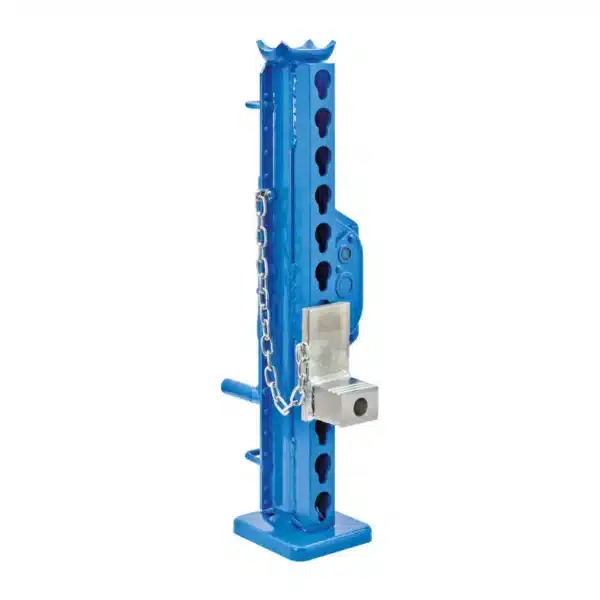
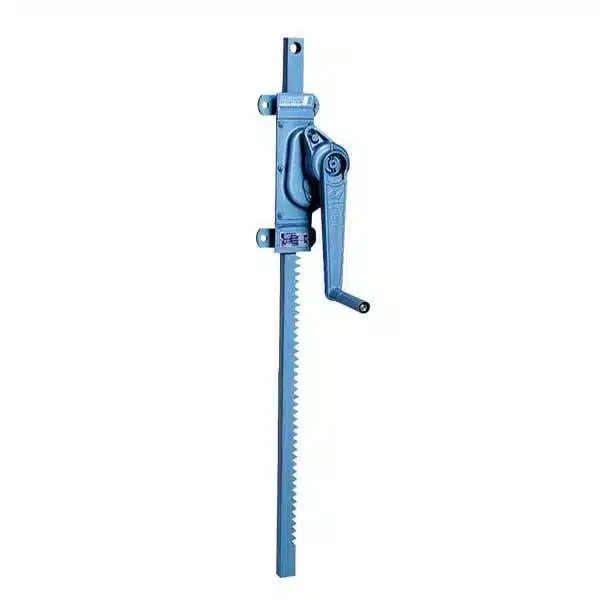
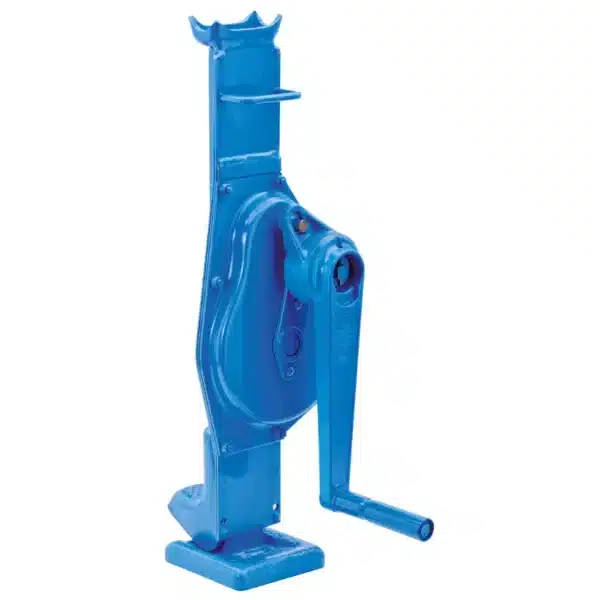
The Pfaff-Silberblau RSJ 50 is a purpose-designed rail jack for railway track maintenance, certified to DIN 7355. The distinctive shoe-type foot with wider support surface allows the jack to be applied between sleepers and tracks on gravel ballast, with a 5,000 kg capacity matched to typical rail work — sleeper replacement, point gear adjustment and fishplate work. The standard Raku ratchet crank enables operation in the confined space between sleepers.
Key Features
- Precisely machined gearbox: Optimal gear ratio ensures minimum operator effort and smooth operation.
- Hardened gearing parts: Low wear and extended service life under demanding industrial conditions.
- Load held in any position: Self-energising load brake generates axial pressure proportional to load weight, securely holding the load when the crank is released.
- Robust steel construction: Steel design with toothed rack of solid material for industrial and outdoor use.
- Load support on claw or head: No reduction of capacity when lifting on the claw, full WLL available at any rated position.
- Rail-specific shoe-type foot: Wider base designed for application between sleepers and tracks. Stable on gravel ballast.
- Self-locking, anti-kickback crank: Handle can be tilted for use in confined spaces between sleepers.
- 5,000 kg capacity: Matched to rail maintenance loads: sleeper replacement, point gear, rail joints.
Technical Specifications
| Model |
Article No. |
Capacity (kg) |
Height A (mm) |
Lift (mm) |
Hand Effort at WLL (daN) |
Weight (kg) |
| RSJ 50 |
N01900008 |
5,000 |
740 |
360 |
28 |
29 |
Height of Lift = Height A + Lift = 1,100 mm. Dimensions A = 740 mm, B = 200 mm, C = 250 mm, D = 108 mm, N = 275 mm. The shoe-type foot has a wider support surface than the standard SJ for stability on ballast.
CE & UKCA Marked | DIN 7355 Compliant | German Engineered
Pfaff-Silberblau is part of the Columbus McKinnon group, one of the world's largest manufacturers of motion technology and lifting equipment. This product is CE marked (EU Machinery Directive 2006/42/EC) and UKCA marked (UK Supply of Machinery (Safety) Regulations 2008), manufactured to DIN 7355 (Steel jacks acc. to DIN), and is supplied with a Declaration of Conformity. LOLER 1998 thorough examinations are required every 12 months by a competent person after initial certification.
Suitable Applications
The specialist rail jack for railway track maintenance. Applications: sleeper replacement, point gear and switch adjustment, rail joint and fishplate work, ballast preparation, and small-scale re-railing operations.
A rack and pinion jack has no fluid to leak and no seals to fail, which suits infrequent use and cold or dirty conditions; for cylinder-based lifting a matched hydraulic pump is needed.
How to Use the Pfaff-Silberblau RSJ 50 Rail Jack
- Position between sleepers: Place on stable ballast or a foot-pad if ballast is loose.
- Position jack head under rail: Position directly under the rail foot, ensuring vertical load alignment.
- Engage the rail: Slowly raise until contact with the rail. Verify stable contact.
- Lift using the Raku crank: 28 daN hand effort at WLL, single operator manageable.
- Hold position: Load brake holds automatically when crank is released.
- Carry out work: Perform maintenance with rail held in lifted position.
- Lower and remove: Reverse crank to lower, remove jack from between sleepers.
Warning:
Rail work must comply with the network operator's Rule Book (e.g. Network Rail Track Worker Safety in UK). Possession of the line, isolation, and competent supervision are essential.
Safety Information
- Always inspect the jack before each use (base plate, rack, gear housing, crank).
- Never exceed the Working Load Limit stamped on the jack body.
- Use only the manufacturer-approved crank, never with extension bars or mechanical drives.
- Never use on soft ground, ice, or unstable surfaces.
- Never side-load, angle-load, or use the jack to lift persons.
- For sustained load support, place additional supports beside the jack before any work beneath the load, and see the hydraulic jack range where a powered lift is more practical.
- LOLER 1998 thorough examination required every 12 months where used as lifting equipment.
- Rail work requires appropriate possession, isolation, and safe system of work from the infrastructure operator.
- The shoe-type foot must bear on stable ballast or a foot-pad.
Inspection and Maintenance
Inspect the rack, gear housing, claw, shoe-type foot, and crank before each use. The shoe-type foot is exposed to ballast wear and should be inspected frequently. Lubricate annually. WOLFF Onsite provides LOLER inspection.
Optional Accessories
- Pfaff Cranks: Replacement Raku, Siku, or Sifeku cranks.
- Rail grab: Complementary rail grab accessory for re-railing operations.
- LOLER inspection and overhaul service: WOLFF Onsite provides full LOLER inspection.
Downloads
Frequently Asked Questions
Q: Why is the RSJ 50 different from the SJ 50?
Same 5,000 kg capacity and mechanism, but with a wider shoe-type foot designed for railway ballast and the right dimensions to fit between standard sleeper spacings.
Q: Is the RSJ 50 certified for railway use?
Certified to DIN 7355. Use on a specific network must additionally comply with that network's track worker safety rules and equipment approvals (e.g. Network Rail NR/L2/OHS/021 in UK).
Q: Can I use it for non-rail applications?
Yes, the RSJ 50 functions as a standard 5,000 kg steel jack. The wider shoe is useful on soft or irregular ground but the SJ 50 or STW-F 50 are typically more economical for non-rail use.
Q: What's the hand effort at full 5,000 kg load?
28 daN at WLL (approximately 28.5 kgf or 285 N), manageable by a single operator. The Raku ratchet crank allows partial-swing operation in the confined space between sleepers.
Q: How does the rail grab accessory work with the RSJ 50?
The Pfaff rail grab is a complementary accessory that clamps onto a rail foot, providing a positive engagement point for re-railing operations after small-scale derailments. Used with the RSJ 50, it allows precise rail positioning during recovery work. Contact us for rail grab availability and specification.
Q: How often does the RSJ 50 need LOLER inspection?
LOLER 1998 (UK) requires thorough examination every 12 months by a competent person where used as lifting equipment. WOLFF Onsite provides LOLER inspection for all Pfaff jacks including rail-specific variants.