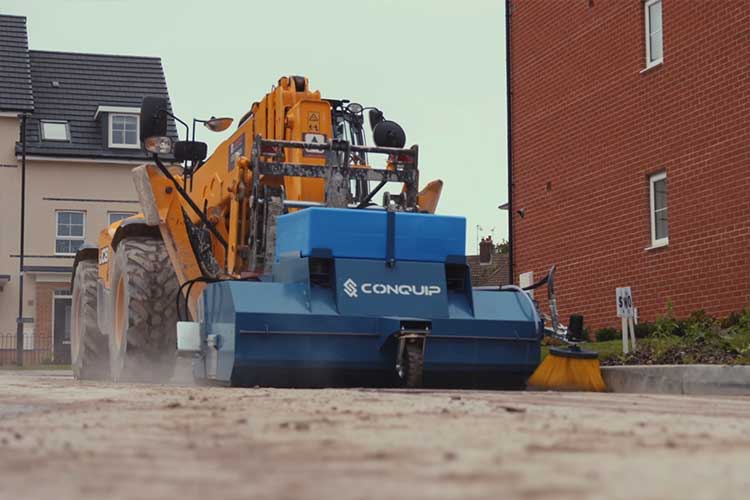
The Conquip Powerbrush Forklift Sweeper is a hydraulic attachment that mounts to a standard forklift or telehandler to clean and collect dirt, dust and waste across haul roads, plant yards and site compounds. A 250 litre water tank delivers either drip-fed or pressurised water spray to suppress airborne dust during operation, and an optional kerb brush extends cleaning into gullies and along kerb lines.
Key Features
- Simple hydraulic system with a single one-way valve.
- Robust hopper for collecting dirt, dust and waste materials.
- Three-wheel design for stability across uneven ground, with two heavier-duty rear wheels supporting downward fork load.
- Heel pins keep the unit secure on the machine forks during operation.
- 250 litre water tank with quick-release plug and tethered cap to prevent loss.
- Choice of drip feed or pressurised water spray models for different dust conditions.
- Main brush built from just seven components for fast on-site replacement.
- Tool-less brush height adjustment.
- Storage pocket for spare fork retaining pins when not in use.
- Hydraulic flow: 60 L/min continuous, 75 L/min intermittent.
- Hydraulic pressure: 175 bar continuous, 190 bar intermittent.
Technical Specifications
| Product Code |
Type |
Length (mm) |
Width (mm) |
Height (mm) |
Fork Pockets W x H (mm) |
Weight (kg) |
Tank Capacity (litres) |
| SA800AK-02100 |
Standard Drip Feed |
2180 |
2340 |
1260 |
148 x 60 |
560 |
250 |
| SA800AI-02100 |
Pressurised Water Spray |
2180 |
2340 |
1260 |
148 x 60 |
560 |
250 |
| SA800AP-02100 |
Standard Drip Feed with Kerb Brush |
2300 |
2700 |
1260 |
148 x 60 |
585 |
250 |
| SA800AQ-02100 |
Pressurised Water Spray with Kerb Brush |
2300 |
2700 |
1260 |
148 x 60 |
585 |
250 |
Hydraulic couplings:
our team will confirm the type of hydraulic couplings required to fit your host machine prior to delivery.
250 litre water tank
Drip feed or pressurised spray | Optional kerb brush | 60 to 75 L/min hydraulic flow at 175 to 190 bar
Suitable Applications
The Powerbrush is designed for keeping construction sites, plant yards and haul roads clean throughout the year. The drip feed model suits general site sweeping and damp conditions, while the pressurised spray model is engineered for dustier environments such as housebuilding plots, civils sites and demolition compounds. The optional kerb brush extends cleaning into gullies and along kerb lines where the main brush cannot reach. As an on-site asset rather than a scheduled service, the Powerbrush removes the lead time and downtime associated with road sweeper visits.
Attachments are chosen by load shape: drums, bulk bags and banded packs each need a different one, and every attachment moves the load centre forward and derates the truck.
How to Use
- Confirm the correct hydraulic coupling type with Conquip prior to delivery so the unit is ready to connect on arrival.
- Engage the host machine forks fully into the Powerbrush fork pockets and fit the heel pins.
- Connect the hydraulic hoses to the host machine auxiliary circuit.
- Fill the 250 litre water tank and replace the tethered cap.
- Adjust brush height to suit the surface being swept.
- Engage the hydraulic flow and operate at walking pace, allowing the brush to collect material into the hopper.
- Empty the hopper into a designated waste skip when full.
- Drain the water tank and clean the brushes at the end of each shift.
Warning:
Confirm the host machine meets the required hydraulic flow and pressure (60 to 75 L/min at 175 to 190 bar). Operating outside these parameters may damage the unit and create unsafe conditions. Maximum pressure drop at high flow and pressure is 135 bar continuous.
Safety Information
- Operators must hold valid forklift or telehandler certification.
- Inspect hydraulic hoses, brushes, wheels and fork retaining pins before each shift.
- Keep ground personnel clear of the brush rotation zone during operation.
- Do not exceed the maximum hydraulic flow or pressure specified for the unit.
- Drain the water tank in freezing conditions to prevent damage.
- Isolate hydraulic flow and lower the unit to the ground before maintenance or brush replacement.
- The pressurised water spray system runs from a 110V battery; charge and store the battery according to the manufacturer instructions.
Frequently Asked Questions
Q: How does the pressurised water spray work?
The pressurised spray system runs from a chargeable battery with a 110V lead, providing consistent fine atomisation of water for effective dust suppression on dustier sites and during dry summer conditions.
Q: Is the Powerbrush more cost-effective than a road sweeper?
For sites that need regular sweeping, an on-site Powerbrush is generally more cost-effective than booking external road sweeper visits. It also removes the lead time involved in scheduling appointments and keeps a sweeping capability available on demand.
Q: What hydraulic flow and pressure are required?
The Powerbrush requires up to 60 L/min continuous (75 L/min intermittent) hydraulic flow, with a maximum pressure of 175 bar continuous (190 bar intermittent). Confirm machine compatibility before ordering.
Q: Can the kerb brush be added to either model?
Yes. The kerb brush is available on both the Standard Drip Feed and Pressurised Water Spray variants, and is ideal for cleaning gullies and along kerb lines where the main brush cannot reach.
Q: What surfaces is the Powerbrush suitable for?
The Powerbrush is suited to compacted hardstanding, tarmac, concrete and well-formed haul roads. The three-wheel design lets the unit follow uneven ground, but it is not intended for soft or boggy surfaces.