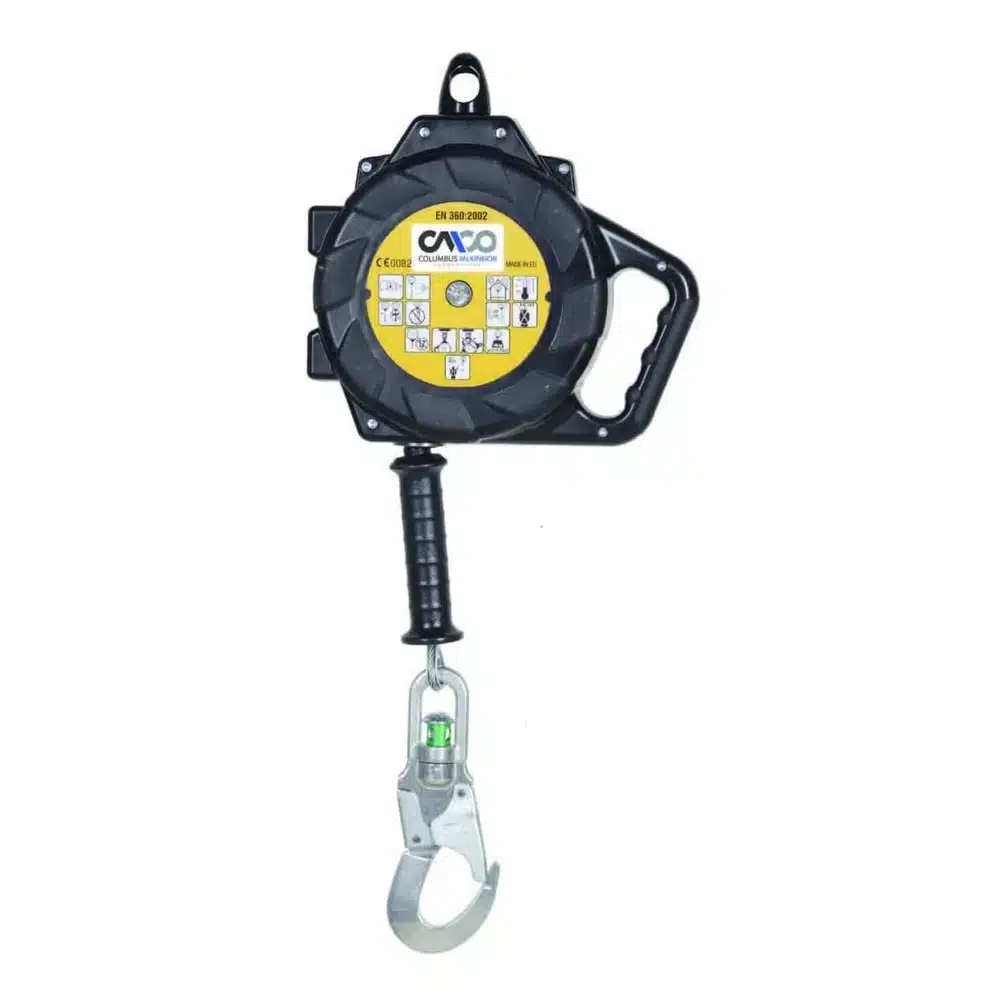
The Yale Fall Arrest Cable Block is a self-retracting fall arrester (SRFA) providing a continuously taut connection between the user's harness and an overhead anchor — extending as the user moves away and retracting as they return, maintaining minimal slack at all times. In the event of a fall, an internal brake locks the cable within centimetres, drastically reducing fall distance compared with a fixed-length lanyard. Available in six cable lengths from 6 m to 25 m; manufactured by Columbus McKinnon under the Yale brand, supplied with test certificate and operating manual.
Key Features
- Self-retracting cable — automatically maintains a taut connection between the user and the overhead anchor
- Galvanised steel wire rope — abrasion-resistant against rough structures and weather-resistant for outdoor use
- Internal speed-sensitive brake — locks the cable within centimetres in a fall event, reducing fall distance vs a fixed-length lanyard
- Reduced fall clearance requirement — typically only 2 m to 3 m of clearance needed below the working position
- Six length options — 6 m, 10 m, 12 m, 15 m, 20 m, and 25 m to suit any working height
- Robust housing — impact-resistant for daily site use
- Compatible with all Yale harnesses — swivel snap hook end-connector attaches to any standard harness rear D-ring
Technical Specifications
| Model |
Part Number |
Cable Length |
Cable Material |
Standard |
| CMHCR250v06-2 |
192066967 |
6 m |
Galvanised steel wire rope |
BS EN 360 |
| CMHCR250v10-2 |
192066968 |
10 m |
Galvanised steel wire rope |
BS EN 360 |
| CMHCR250v12-2 |
192066972 |
12 m |
Galvanised steel wire rope |
BS EN 360 |
| CMHCR250v15-2 |
192066973 |
15 m |
Galvanised steel wire rope |
BS EN 360 |
| CMHCR30020 |
N37320020 |
20 m |
Galvanised steel wire rope |
BS EN 360 |
| CMHCR30025 |
N37320025 |
25 m |
Galvanised steel wire rope |
BS EN 360 |
Choose the cable length to match the working height. The 6 m and 10 m blocks suit single-storey access work; longer cables suit multi-level construction and structural work.
CMCO Group | EN ISO 9001 Certified | EN 360 Compliant | CE Marked
This product is manufactured by Columbus McKinnon under the Yale lifting brand to EN ISO 9001 quality management standards. Compliant with BS EN 360 for retractable type fall arresters. Supplied with a manufacturer's test certificate and CE Declaration of Conformity. PPE Regulation (EU) 2016/425 Category III. Work at Height Regulations 2005 require thorough examinations every 6 months by a competent person, with records kept.
More About This Product
The Yale Fall Arrest Cable Block is a self-retracting fall arrester (SRFA) that provides a continuously taut connection between the user's harness and an overhead anchor. The block automatically extends as the user moves away from the anchor and retracts as they move back, maintaining minimal slack at all times. In the event of a fall, an internal brake locks the cable within centimetres, drastically reducing fall distance compared with a fixed-length lanyard. Available in six cable lengths from 6 m to 25 m to suit a wide range of working heights and applications. Manufactured by Columbus McKinnon under the Yale lifting brand, supplied with a manufacturer's test certificate and operating manual.
Suitable Applications
Suited to roofing, structural steel work, scaffold inspection, building maintenance, plant access, multi-level construction, and any task at height with an overhead anchor where a self-retracting fall arrester is appropriate. The cable block is the preferred fall arrester where fall clearance below the working position is limited — the short locking distance allows safe use in environments where a fixed-length lanyard would not provide adequate clearance.
How to Use the Cable Block
- Inspect the housing, cable, swivel hook, anchor connector, and load indicator before each use.
- Function-test by extending the cable approximately 1 m and allowing it to retract — should be smooth and complete.
- Function-test the brake by sharply tugging the line — the brake must lock immediately.
- Attach the block to a certified overhead anchor rated to a minimum of 12 kN.
- Attach the swivel snap hook end-connector to the harness rear D-ring. Verify the gate is fully closed and locked.
- Verify the working area provides adequate fall clearance below the user — typically 2 m to 3 m.
- Proceed with the working task. The cable automatically maintains a taut connection — do not allow excessive slack.
- On completion, allow the cable to retract fully, disconnect, and store the block hanging by the anchor hook.
Warning:
After any fall arrest the block must be withdrawn from service immediately and returned for competent person inspection and possible internal service. The cable block must not be used as a horizontal lifeline or where the anchor is below the user — anchor must be overhead. Never modify or attempt to repair the block.
Safety Information
- Carry out a pre-use visual and function test before every use — extend the lanyard fully, verify retraction, and check the brake by sharply tugging the line.
- Always attach the block to a certified overhead anchor rated to a minimum of 12 kN.
- Always check the housing, lanyard, swivel hook, and anchor connector before each use.
- Always position the anchor directly above the user where possible to prevent pendulum swing in the event of a fall.
- Never use a block that has arrested a fall — withdraw from service immediately and return for competent person inspection.
- Never modify or attempt to repair the block; only authorised service centres can service these units.
- Withdraw from service if any damage to the housing, lanyard, hooks, or load indicator is found.
Inspection and Maintenance
Inspect the block before each use, paying particular attention to the housing for cracks or impact damage, the lanyard for cuts, fraying, or chemical damage, the load indicator (where fitted) for any sign of deployment, and both connectors for distortion or damage. Function-test by extending the lanyard fully and allowing it to retract under tension — the retraction should be smooth and complete. Test the brake by sharply tugging the line — the brake must lock immediately. Store hanging by the anchor hook in a clean, dry location away from direct sunlight, sharp objects, and chemicals. Do not store the block with the lanyard extended. Under the Work at Height Regulations 2005 and PPE Regulations, a thorough examination must be carried out by a competent person at least every 6 months. Manufacturer-recommended internal service interval is typically every 2 years — refer to the operating manual for the specific service requirements of your model.
Downloads
Frequently Asked Questions
Q: What is the difference between a cable block and a fixed lanyard?
A cable block automatically maintains a taut connection and uses a speed-sensitive brake to lock within centimetres in a fall — much shorter fall distance than a fixed lanyard with energy absorber. The block is the preferred fall arrester where fall clearance is limited.
Q: How much fall clearance do I need below the working position?
Typically 2 m to 3 m, depending on the specific block model and the user's working position. Always refer to the operating manual for the specific fall clearance for your block.
Q: Which length should I choose?
Choose the shortest length that allows comfortable working radius from the anchor. Longer cables add weight and may swing more in transit. The 6 m block suits single-storey access work; 20 m and 25 m blocks suit multi-storey structural work.
Q: Can the block be used outdoors?
Yes. The galvanised steel cable and weatherproof housing are designed for outdoor use. Avoid prolonged exposure to standing water and protect from sharp impact.
Q: Can the block be used as a horizontal lifeline?
No. The block must be anchored overhead — typically directly above the working position. Horizontal use is not approved and can defeat the brake.
Q: What happens if the cable becomes contaminated with paint or chemicals?
Withdraw the block from service immediately for competent person inspection — contaminated cables may slip in the brake mechanism.
Q: How often must the block be serviced?
Pre-use inspection before every use, thorough examination by a competent person every 6 months, and manufacturer-recommended internal service typically every 2 years — refer to your operating manual.