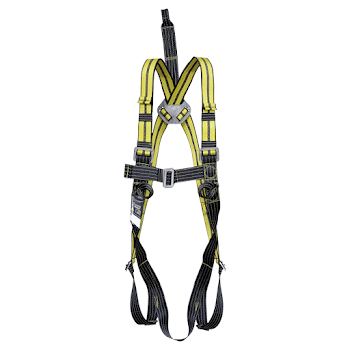
A harness sits against clothing and moves constantly, which makes it one of the more effective static generators a worker can wear. In a refinery, tank farm or mine that is a problem, and it is why an ATEX harness exists as a distinct product rather than an option. This one uses anti-static webbing certified to EN 1149-1 with stainless steel fittings for corrosion protection, rated for a 140 kg user including tools, and specified for frequent rather than occasional use.
Key Features
- Anti-static webbing to EN 1149-1: Prevents electrostatic discharge igniting an explosive atmosphere. The defining feature and the reason for the product.
- Two point attachment: Dorsal D-ring for fall arrest plus two chest textile loops, covering both fall arrest and frontal attachment.
- Extension strap on the dorsal D-ring: Makes the rear attachment easier to reach and connect single handed, which matters when working alone.
- Large back D-ring: Easier to locate and clip to, particularly with gloves.
- Stainless steel fittings: Corrosion protection for the chemical and marine environments where ATEX equipment is typically used.
- Adjustable shoulder and thigh straps with combination buckles: Fitted for a range of users and quick to adjust.
- Positioned sit strap: For comfort during extended wear.
- Max user weight 140 kg: Higher than the 100 kg of many harnesses, and including tools and equipment.
Technical Specifications
| Property |
Value |
| Product Code |
FA 10 109 00 |
| Configuration |
2 point full body harness |
| Attachments |
1 dorsal D-ring, 2 chest textile loops |
| Webbing |
Anti-static polyester |
| Fittings |
Alloy steel and stainless steel |
| Maximum User Weight |
140 kg including equipment |
| Usage |
Suitable for frequent use |
| Conformity |
ATEX 2014/34/EU, EN 1149-1, EN 13463-1, EN 14363-5 |
ATEX 2014/34/EU | EN 1149-1 Anti-Static | Category III PPE
Conforms to the ATEX Directive 2014/34/EU together with EN 1149-1 for electrostatic properties, EN 13463-1 and EN 14363-5. Category III personal protective equipment under Regulation (EU) 2016/425, supplied with a Declaration of Conformity. Requires inspection by a competent person at intervals not exceeding 12 months and immediate withdrawal after arresting a fall.
Suitable Applications
Specified where work at height coincides with a potentially explosive atmosphere: petrochemical and refinery work, fuel storage and tank farms, mining, chemical processing, grain and dust-generating industries, and gas distribution. In those environments a standard harness is not permitted, however good it is. The stainless fittings also suit the corrosive conditions common to the same sites. Rated for frequent use, so it is intended as everyday equipment rather than occasional issue.
More About This Product
The lanyard is where most fall protection systems are specified wrongly, and almost always in the same direction: a restraint lanyard used where fall arrest was needed.
It happens because the two look alike, cost similarly, hang in the same place in the store and are both described as lanyards. The difference is a folded pack of stitched webbing — the shock absorber — and on some designs it is tucked inside a cover where it is not obvious at a glance. A restraint lanyard is engineered on the assumption that it will never take a fall, and if it does, the forces reaching the body are far beyond what the human frame tolerates.
Fall Clearance: The Calculation Nobody Does
Ask most people how much clearance a 2 metre shock absorbing lanyard needs and they will say two metres. The real figure is a great deal more, and the gap between those two numbers is where people get hurt.
The calculation stacks up as follows. Lanyard length — as marked on the lanyard. Shock absorber deployment — the pack tears progressively and extends significantly. The figure for your specific lanyard is on its own label and must be read from there. The user's height below the attachment point — the dorsal D-ring is at shoulder height, so add roughly 1.5 m to reach the feet. A safety margin — because the calculation assumes ideal conditions and reality rarely provides them.
Added together these come to considerably more than the lanyard length, frequently more than double it. On a low working platform a shock absorbing lanyard may not prevent the ground being reached at all.
Where the clearance is not available, the answer is a retractable block, which arrests in a far shorter distance, or a restraint system where a fall is prevented rather than arrested.
How to Use the ATEX Harness
- Confirm the whole system is ATEX: Harness, lanyard, connectors and any anchor device. One non-ATEX component defeats the purpose.
- Adjust for a proper fit: Shoulder and thigh straps snug, the dorsal D-ring sitting between the shoulder blades. A loose harness allows a longer fall and worse load distribution.
- Use the dorsal D-ring for fall arrest: The chest loops are for frontal attachment, not for fall arrest unless the manual specifies otherwise.
- Check the 140 kg limit includes tools: User weight plus everything carried.
- Inspect before every use: Webbing, stitching, D-rings, buckles and adjusters.
- Keep it clean: Heavy contamination with oil or process residue may compromise the anti-static properties.
Warning: Category III PPE for trained, competent persons only. In an explosive atmosphere every item of the fall protection system must be ATEX suitable, not just the harness. Withdraw immediately after arresting a fall. Maximum user weight 140 kg including tools.
Safety Information
- For use only by trained and competent persons within a safe system of work.
- Maximum user weight 140 kg including tools and equipment.
- All components of the system must be ATEX suitable where an explosive atmosphere is present.
- Use the dorsal D-ring for fall arrest.
- Adjust for a snug fit with the dorsal D-ring between the shoulder blades.
- Inspect webbing, stitching, D-rings and buckles before every use.
- Withdraw immediately after arresting a fall.
- Heavy contamination may compromise anti-static properties.
- Inspection by a competent person required at intervals not exceeding 12 months.
- Store away from direct sunlight, heat sources and chemicals.
Inspection and Maintenance
Inspect as any full body harness, with contamination as the additional concern. Check the full length of every strap on both faces for cuts, abrasion, fraying and heat damage, examine the stitching at every junction and D-ring attachment closely, and confirm buckles and adjusters operate cleanly and hold their setting. The additional check is soiling: anti-static performance depends on the webbing, and heavy contamination with oil, paint or process residue may compromise it. In an ATEX environment a badly contaminated harness should be withdrawn rather than cleaned and returned. Clean with clean water only and dry naturally away from heat.
Downloads
Frequently Asked Questions
Q: Why does a harness need to be anti-static?
Because it is worn against clothing and moves constantly, which generates static charge readily. In an atmosphere where flammable gas, vapour or dust may be present, that discharge is an ignition source. Anti-static webbing to EN 1149-1 prevents the charge accumulating.
Q: Is the harness enough on its own?
No. Every item entering an ATEX area must be suitable, including the lanyard, connectors and anchor device. An ATEX harness on a standard lanyard is not an ATEX system.
Q: What is the extension strap on the dorsal D-ring for?
It brings the rear attachment point within easier reach, so a lanyard can be connected single handed without contortion. On a harness worn all day and clipped repeatedly, it is a genuine practical benefit.
Q: Does 140 kg include my tools?
Yes. The rating covers the user plus everything carried: tools, belt, equipment. It is a common oversight, and a fully loaded tool belt is easily 10 to 15 kg.