Product Overview
Important safety notice: The Camlok SL shear legs are NOT for lifting, lowering, or transporting persons under any circumstances. They are a material-handling lifting solution only. The supplied safety chain (preventing leg splay during a lift) must always be fitted at the rated length for the configuration in use — it is a critical safety component, not optional.
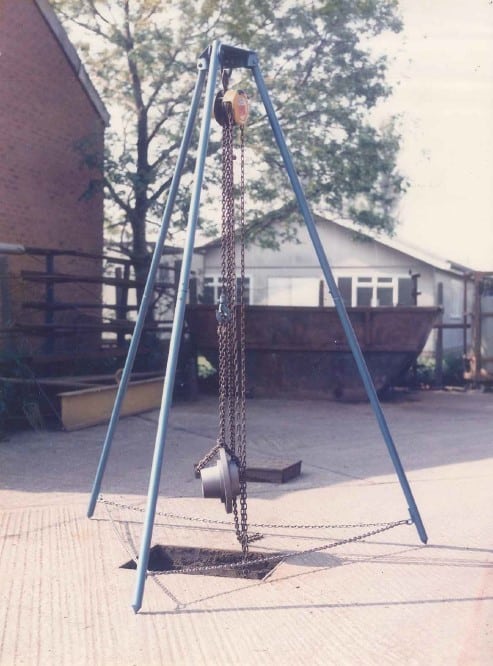
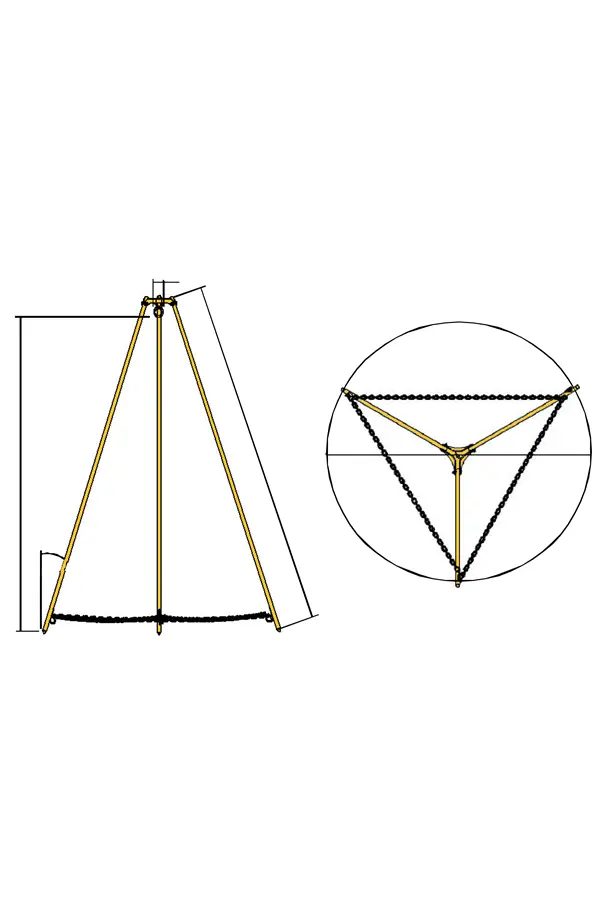
The Camlok SL shear legs are a portable, freestanding A-frame lifting solution for use where a fixed crane or overhead beam is not available. Available in 2-leg or 3-leg configurations, with foot options for flat (hard-surface) or spiked (soft-ground) deployment, the SL series covers WLL from 500 kg up to 3000 kg. Ideal for short-duration lifts at remote sites, in fabrication shops, workshops, and on construction projects where a temporary, transportable lifting frame is required.
Technical Specifications
| Model |
WLL |
Leg Configuration |
Foot Type |
| SL0.500/2 |
500 kg |
2-leg |
Flat |
| SL0.500/2 |
500 kg |
2-leg |
Spiked |
| SL1000/2 |
1000 kg |
2-leg |
Flat |
| SL1000/2 |
1000 kg |
2-leg |
Spiked |
| SL1000/3 |
1000 kg |
3-leg |
Flat |
| SL1000/3 |
1000 kg |
3-leg |
Spiked |
| SL2000/3 |
2000 kg |
3-leg |
Flat |
| SL2000/3 |
2000 kg |
3-leg |
Spiked |
| SL3000/3 |
3000 kg |
3-leg |
Flat |
| SL3000/3 |
3000 kg |
3-leg |
Spiked |
CE Marked, UKCA Compliant & LOLER 1998 Ready
The Camlok SL shear legs are CE marked, UKCA compliant, and manufactured to relevant European lifting standards. Fully compatible with LOLER 1998 and PUWER 1998 Regulations when correctly assembled, used within rated capacity, and inspected. Supplied with certification and assembly instructions.
Key Features
- Portable A-frame design — freestanding lifting solution for sites without a fixed crane or overhead beam — easily transported and assembled by a small team.
- Multiple configurations — 2-leg or 3-leg variants to suit your lifting geometry and site footprint.
- Foot options — flat feet for use on hard surfaces and concrete; spiked feet for soft ground, gravel, or unprepared sites.
- Capacity range — 500 kg up to 3000 kg WLL across the SL series.
- Compatible with chain blocks — integral lifting point at the apex accepts a chain hoist, lever block or other suspended lifting device.
- Tool-free assembly — sectional design assembles and dismantles quickly without specialist tools.
Suitable Applications
Maintenance and assembly work in fabrication shops and workshops, remote site lifting where mobile cranes are impractical, plant maintenance, motor and pump removals, water and sewer chamber lifts (with the 3-leg spiked configuration), agricultural and equestrian lifting, and short-duration construction lifts in confined or temporary work areas.
Where the load can be slung rather than gripped, slings and shackles are simpler and cheaper.
How to Use Safely
- Inspect all components before assembly. Check the legs, apex fitting, foot plates or spikes, locking pins, and any safety chain for damage, wear, deformation or corrosion. Do not use if defects are found.
- Select a stable, level ground location for the lift. For spiked feet, ensure the ground is suitable to anchor the spikes; for flat feet, ensure the surface is firm and load-bearing.
- Assemble the shear legs in accordance with the manufacturer's instructions. Confirm all locking pins are fully engaged and any safety chain (preventing leg splay) is correctly fitted at the rated length.
- Suspend a suitably rated chain block, lever hoist, or other lifting device from the apex lifting point.
- Carry out a test lift with a light load to verify stability before applying the full rated load.
- Do not exceed the rated WLL of the configuration. Lateral loads, off-centre lifts, or sudden shock loading must be avoided.
- After use, fully release the load, dismantle the frame, and store in dry conditions.
- The safety chain (preventing leg splay) must be fitted at the rated length for the configuration in use — a critical safety component, not optional.
Inspection and Maintenance
A visual inspection is required before every use. A thorough examination by a qualified engineer is required at least every 6 months in regular use, in accordance with LOLER 1998. Records of examination must be kept. Refer to the manufacturer's manual for detailed inspection and maintenance instructions, derating factors for use, and replacement schedules for any wearing components.
Warranty & Support
Supplied with manufacturer's certification, identification, and operating instructions. WOLFF Onsite offers post-sales support including spares, certified inspection, and replacement. Contact our team for advice on selection, sizing, and application-specific configurations.
Frequently Asked Questions
Q: How do I choose between 2-leg and 3-leg configurations?
A 2-leg configuration is suitable for straight-line lifts where load movement along the line of the legs is acceptable. A 3-leg (tripod) configuration provides greater stability and is recommended for vertical-only lifts, confined spaces, or where the load may swing slightly during the operation. 3-leg frames also have higher rated WLLs.
Q: When should I choose spiked feet over flat feet?
Choose spiked feet for use on soft ground, gravel, grass, or unprepared sites where the spikes can dig in and provide additional anchorage. Choose flat feet for use on concrete, paved surfaces, or any hard floor where spikes are inappropriate.
Q: Can I use the SL shear legs with my own chain block?
Yes — the apex lifting point accepts any suitably rated chain block, lever hoist, or other suspended lifting device. The chain block's WLL must equal or exceed the load to be lifted, and the shear legs' rated WLL must equal or exceed the combined load.
Q: Can the SL shear legs be used to lift people?
No. The SL shear legs are rated for material lifting only and must never be used for lifting, lowering, or transporting persons. For any application involving people, use equipment specifically certified for personnel lifting (such as man-riding cages on a certified crane).
Q: Is the safety chain mandatory?
Yes. The safety chain prevents the legs from splaying outwards under load and is a critical safety component of the SL system. The chain must be fitted at the rated length for the configuration in use before any lift. Do not use the shear legs without the safety chain correctly fitted.
Q: How often should the shear legs be inspected?
A visual inspection of all components is required before every assembly and use. A thorough examination by a qualified engineer is required at least every 6 months for shear legs in regular use, in accordance with LOLER 1998. Records of examination must be kept.