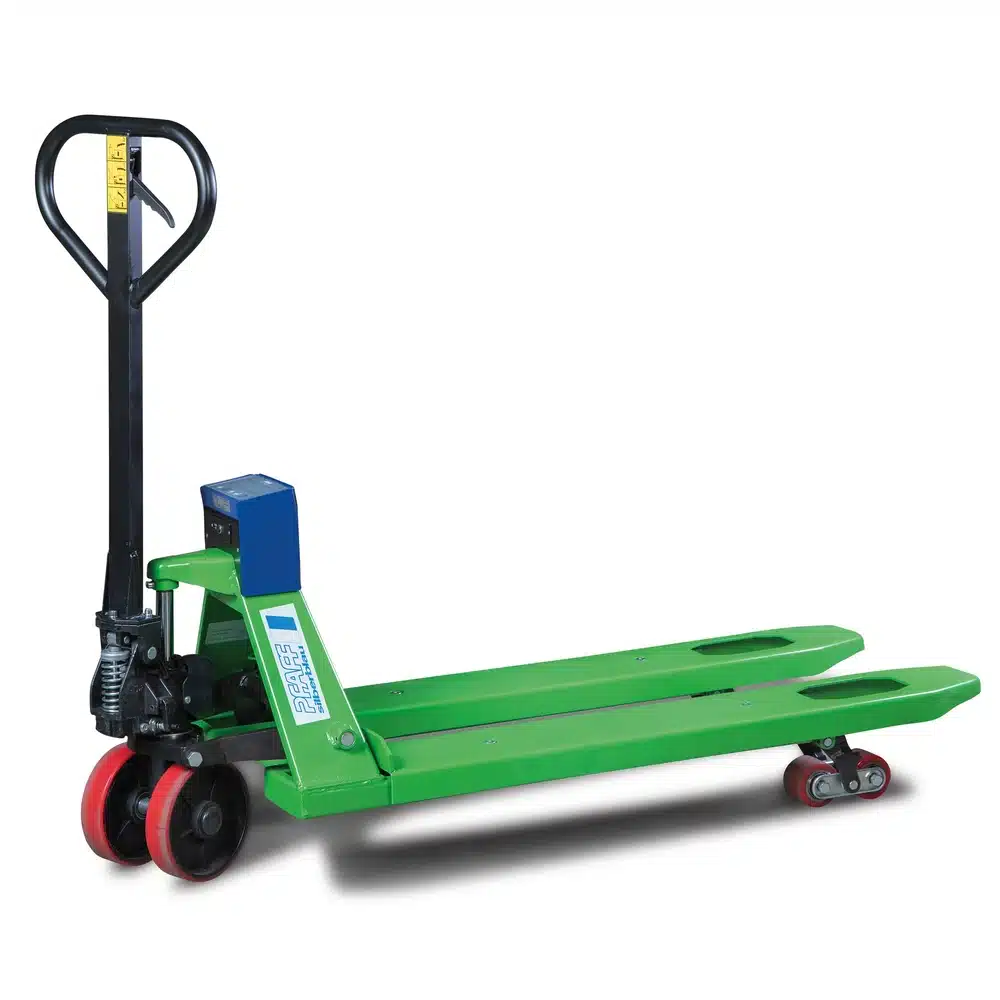
The Pfaff-Silberblau HU W-20 GREENLINE combines a 2,000 kg pallet truck with an integrated electronic weighing system, letting the operator transport and weigh a load in a single operation. Weighing transducers built into the fork structure feed an LCD display on the control handle, reading 0 to 2,000 kg in 5 kg increments with stepped accuracy — dramatically faster than transferring loads to a floor scale for goods-in checks, loading control and transport-weight verification. Two configurations are available: a standard 540 mm outside-fork model and a narrow-roller 570 mm version.
Key Features
- Integrated weighing system — weight transducers built into the fork structure, with a handle-mounted LCD readout. Weighing happens at the same time as transport — no separate weighing operation needed.
- 0 to 2,000 kg in 5 kg increments — fine enough for goods-in receipt checks, despatch verification, and internal stock-level management.
- Tiered accuracy — ±10 kg below 500 kg, ±20 kg between 500 and 1,000 kg, ±30 kg above 1,000 kg. Suitable for internal logistics and process control; not legal-for-trade.
- Factory-calibrated — the weighing system is calibrated before despatch. Re-calibration intervals depend on use intensity; typically annual.
- Easy-to-read LCD display — mounted on the control handle within natural line of sight. Visible in standard warehouse lighting; not optimised for direct sunlight.
- Standard 2,000 kg pallet truck functionality — functions as a normal hand pallet truck when the weighing system is not in use. Same fork dimensions, steering, and lift action as the standard range.
- Two roller configurations — standard 540 mm outside-fork model and 570 mm narrow-roller variant. Both at 2,000 kg capacity.
Technical Specifications
| Specification |
Value |
| Model |
Pfaff-Silberblau HU W-20 GL GREENLINE |
| Load Capacity (SWL) |
2,000 kg |
| Weighing Range |
0 to 2,000 kg |
| Weighing Resolution |
5 kg |
| Weighing Accuracy |
±10 kg (0 – 500 kg) / ±20 kg (500 – 1,000 kg) / ±30 kg (1,000 – 2,000 kg) |
| Display |
Easy-to-read LCD on handle |
| Fork Length |
1,150 mm |
| Outside Fork Width |
540 mm (Standard) / 570 mm (Narrow Roller variant) |
| Lowered Fork Height |
85 mm |
| Stroke (Lift Height) |
115 mm |
| Control Handle Height |
1,235 mm |
| Load Rollers |
80 × 57 mm (PUR/PUR) |
| Steering Rollers |
200 × 50 mm |
| Steering Angle |
105° each side |
| Country of Manufacture |
Germany |
Where distances are long or the same route is walked repeatedly, an electric pallet truck removes the effort; to lift pallets to height rather than move them at floor level, use a hand stacker.
CE Marked & EN 1757-2 Compliant
Supplied with an EC Declaration of Conformity under EU Machinery Directive 2006/42/EC. The integrated weighing system is factory-calibrated. Manufactured in compliance with EN 1757-2 and the harmonised standards DIN EN ISO 12100-1 and DIN EN ISO 12100-2. Note: the integrated scale is not approved for trade use under the Non-Automatic Weighing Instruments Regulations (NAWI) — suitable for internal weighing only.
More About This Product
The Pfaff-Silberblau HU W-20 GREENLINE combines a 2,000 kg pallet truck with an integrated electronic weighing system, allowing the operator to transport and weigh a load in a single operation. The weighing transducers are built into the fork structure and connected to an LCD display mounted on the control handle. The scale reads from 0 to 2,000 kg in 5 kg increments with stepped accuracy (±10 kg below 500 kg, ±20 kg between 500 and 1,000 kg, ±30 kg between 1,000 and 2,000 kg). For goods-in checks, loading control, and transport-weight verification, this is dramatically faster than transferring loads to a floor scale. Two configurations are available: a standard 540 mm outside-fork model and a narrow-roller 570 mm version.
Where Is the W-20 GL Used?
The integrated weigh-scale pallet truck is the right tool wherever transport and weighing happen in close sequence: goods-in receipt checking (verifying delivered weight against the despatch note); pre-load weight verification before tail-lift loading; internal stock control where weight-based inventory matters; recipe and batch weighing in production environments; and waste and recycling operations where waste streams are billed by weight.
The integrated system saves time over the alternative workflow of transferring the load onto a floor scale or platform scale and back again. For high-volume operations, the time saving compounds — an operation doing 50 goods-in checks per day saves typically 30 to 45 minutes of double-handling per shift.
It is not the right tool where legal-for-trade weighing is required. Customs declarations, weighbridge submissions, and certified-weight invoicing all require NAWI-approved equipment. The integrated scale here is for internal use only.
Recommended Pre-Use Checks
- Visually inspect the forks, frame, and connecting rods for damage.
- Check the load rollers and steering rollers for free rotation.
- Power on the display and confirm a stable zero reading with no load on the forks.
- Test the lift and lower functions through full travel.
- If a calibration weight is available, place it on the forks and confirm the reading is within the rated accuracy.
- Confirm the hydraulic system holds pressure for 30 seconds unladen.
- Inspect for hydraulic oil leaks — oil contamination of the load cells can cause drift.
- Verify the data plate and calibration certificate are current.
Safety Information
- Do not exceed the 2,000 kg safe working load.
- Do not use to lift personnel.
- Distribute the load evenly across both forks for accurate weighing — an off-centre load can read significantly low or high.
- The truck is not certified for legal-for-trade weighing — do not use as the basis for customer invoicing.
- Move at walking speed only. Pedestrian operation.
- Standard delivery is without parking brake.
- Rated for ambient temperature -10°C to +50°C. Temperature drift may affect weighing accuracy at the extremes of the range — re-zero after significant temperature changes.
- Inspect annually under PUWER 1998 and BGV D27. Re-calibrate the weighing system at the same interval (or more often if accuracy matters).
Downloads
Frequently Asked Questions
Q: Is the scale legal-for-trade?
No. The integrated scale is not approved under the Non-Automatic Weighing Instruments Regulations (NAWI), which means it cannot be used as the basis for customer invoicing or any trade transaction. It is intended for internal weighing — goods-in receipt checks, stock control, batch weighing, and load verification. For trade weighing, use a NAWI-approved platform scale or weighbridge.
Q: How accurate is it really?
In practice, well within the stated specification of ±10 kg below 500 kg, ±20 kg between 500 and 1,000 kg, and ±30 kg above 1,000 kg. For typical goods-in checking against a despatch note (where the despatch note itself is accurate to perhaps ±1% on a pallet), this is more than adequate. For higher-precision applications, a dedicated platform scale is the right tool.
Q: How often does it need calibration?
Annually at minimum, or whenever the weighing system has had a heavy impact (dropped load, collision damage). For applications where the weighing accuracy is critical to a business process, more frequent calibration is sensible — quarterly or even monthly checks against a known calibration weight are appropriate. Calibration can be carried out by a qualified scale technician or by Pfaff service.
Q: What is the difference between W-20 GL GREENLINE and W-20 SL SILVERLINE?
Both are integrated weighing pallet trucks at 2,000 kg capacity. The W-20 SL is the SILVERLINE-chassis variant with standard PUR/PA roller specification. The W-20 GL is the GREENLINE-chassis variant with PUR/PUR rollers (narrower 80 × 57 mm load rollers) and slightly different chassis geometry. Both perform the same weighing function; the choice between them is largely down to availability and specific roller preference for your floor type.
Q: Will the weighing system fail if the truck is dropped or impacted?
The load cells are protected within the fork structure and tolerant of normal use. A significant impact — for example dropping a load onto the forks from height, or a collision with a wall — can damage the cells or alter calibration. After any such event, check the zero reading and recalibrate before relying on the readings.
Q: Does the battery need charging?
The display unit runs on an internal battery (typically 9V or rechargeable lithium). Battery life depends on use pattern; typically several months between charges or replacements. The display indicates low battery before performance is affected. Spare batteries should be kept in stock.
Q: What is the typical use case?
Most common in food and beverage distribution (verifying despatch weights), pharmaceutical logistics (batch verification), chemical handling (recipe weighing of palletised raw materials), waste and recycling (weight-billed disposal), and any manufacturer doing weight-based inventory. The time saving over a separate floor scale is substantial in high-volume operations.