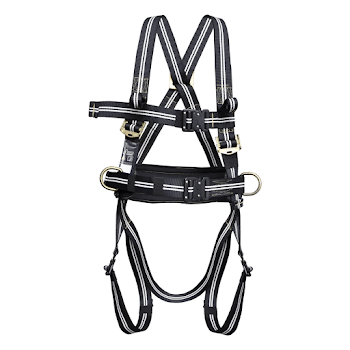
Welding needs both hands, and holding yourself in position at height uses at least one. The work positioning belt on this harness solves that: two side D-rings take a positioning lanyard, letting the welder lean back into the harness and work with both hands free and a stable stance. Everything else follows the 2 point Fire Free specification, with aramid webbing whose static strength has been tested after exposure to molten metal splashes.
Key Features
- Work positioning belt with two side D-rings: The reason to choose the 4 point. Take a positioning lanyard between them, lean back, and both hands are free with a stable stance.
- Aramid webbing: Inherently flame resistant, tested for static strength after molten metal splash exposure.
- Dual certified EN 361 and EN 358: Fall arrest and work positioning, which is what the side D-rings add.
- Dorsal D-ring plus two chest loops: Full fall arrest provision alongside the positioning function.
- Automatic buckles on chest and thigh straps: Quicker to don and adjust with gloves.
- Maximum user weight 140 kg: Including tools.
- Rated for frequent use.
Technical Specifications
| Property |
Value |
| Product Code |
FA 10 211 00 |
| Configuration |
4 point full body harness with work positioning belt |
| Attachments |
1 dorsal D-ring, 2 chest textile loops, 2 belt side D-rings |
| Webbing |
Aramid |
| Fittings |
Alloy steel |
| Maximum User Weight |
140 kg including equipment |
| Conformity |
EN 361, EN 358, ISO 9150, ISO 15025 |
EN 361 | EN 358 Work Positioning | ISO 9150 | ISO 15025 | Category III PPE
Conforms to EN 361 for full body harnesses and EN 358 for work positioning systems, together with ISO 9150 for molten metal splash and ISO 15025 for limited flame spread. Static strength of the webbing tested after exposure to molten metal splashes. Category III personal protective equipment under Regulation (EU) 2016/425. Requires inspection by a competent person at intervals not exceeding 12 months and immediate withdrawal after arresting a fall.
Suitable Applications
This is the specification for welders working at height from a fixed position: structural steel welding on site, shipbuilding and ship repair, tank and vessel fabrication, pipeline welding, and any hot work where the operative needs both hands and a stable stance for extended periods. The positioning belt turns awkward one-handed work into a manageable two-handed job. Where the work is access and movement rather than sustained welding from one spot, the 2 point FA 10 110 00 is lighter and considerably cheaper.
More About This Product
The lanyard is where most fall protection systems are specified wrongly, and almost always in the same direction: a restraint lanyard used where fall arrest was needed.
It happens because the two look alike, cost similarly, hang in the same place in the store and are both described as lanyards. The difference is a folded pack of stitched webbing — the shock absorber — and on some designs it is tucked inside a cover where it is not obvious at a glance. A restraint lanyard is engineered on the assumption that it will never take a fall, and if it does, the forces reaching the body are far beyond what the human frame tolerates.
Fall Clearance: The Calculation Nobody Does
Ask most people how much clearance a 2 metre shock absorbing lanyard needs and they will say two metres. The real figure is a great deal more, and the gap between those two numbers is where people get hurt.
The calculation stacks up as follows. Lanyard length — as marked on the lanyard. Shock absorber deployment — the pack tears progressively and extends significantly. The figure for your specific lanyard is on its own label and must be read from there. The user's height below the attachment point — the dorsal D-ring is at shoulder height, so add roughly 1.5 m to reach the feet. A safety margin — because the calculation assumes ideal conditions and reality rarely provides them.
Added together these come to considerably more than the lanyard length, frequently more than double it. On a low working platform a shock absorbing lanyard may not prevent the ground being reached at all.
Where the clearance is not available, the answer is a retractable block, which arrests in a far shorter distance, or a restraint system where a fall is prevented rather than arrested.
How to Use the 4 Point Fire Free Harness
- Understand the two systems: The dorsal D-ring is fall arrest. The side D-rings are work positioning. They are not interchangeable and the side rings must never be used for fall arrest.
- Use both side D-rings together: A positioning lanyard runs between them, around the structure. Using one alone loads the belt asymmetrically.
- Maintain fall arrest alongside positioning: Work positioning is not fall protection. The dorsal attachment must remain connected to a fall arrest system.
- Specify the whole system as flame resistant: Positioning lanyard and fall arrest lanyard both.
- Inspect after every hot work session: Burn marks, glazing and embedded spatter, on the belt as well as the harness.
- Adjust the belt properly: It should sit on the hips taking the load, not ride up around the waist.
Warning: The work positioning belt is not fall arrest equipment. Side D-rings must never be used to arrest a fall, and a fall arrest system must be maintained alongside the positioning system. Flame resistant does not mean fireproof.
Safety Information
- For use only by trained and competent persons within a safe system of work.
- Maximum user weight 140 kg including tools and equipment.
- Side D-rings are for work positioning only, never for fall arrest.
- A separate fall arrest system must be maintained while work positioning.
- Use both side D-rings together with a positioning lanyard between them.
- All textile components should be flame resistant where hot work is involved.
- Inspect for burn damage after every hot work session.
- Withdraw immediately after arresting a fall.
- Inspection by a competent person required at intervals not exceeding 12 months.
Inspection and Maintenance
Inspect as the 2 point harness, with the positioning belt added to the checklist. The belt takes sustained static load rather than the occasional shock a fall arrest harness sees, so it wears differently: check the belt webbing for abrasion where it bears against structure, the side D-rings for wear and elongation, and their attachment stitching closely. Then the flame resistance checks: burn marks, charring, glazing and embedded spatter across every strap and the belt, after each hot work session. On dark aramid webbing burn damage is easy to miss, so inspect in good light.
Downloads
Frequently Asked Questions
Q: Can I use the side D-rings to arrest a fall?
Never. Work positioning D-rings are designed for sustained static load holding you in place; they are not rated to arrest a fall and using them for it can cause serious injury. Fall arrest is the dorsal D-ring, and a fall arrest system must be maintained even while positioned.
Q: Is the extra over the 2 point worth it?
If your welders work from a fixed position at height, comfortably. Leaning back into a positioning belt with both hands free is the difference between welding properly and welding one-handed while holding on. For access and movement without sustained work at a point, the 2 point does the job.
Q: Does the positioning lanyard need to be flame resistant?
Yes. It sits right where spatter falls, and a standard polyester positioning lanyard is the weak point in an otherwise flame resistant system. The Fire Free range includes a 2 m adjustable positioning lanyard, FA 40 905 20, for exactly this.
Q: What is EN 358?
The standard for work positioning systems: belts and lanyards that hold a worker in place at height. It is distinct from EN 361, which covers fall arrest harnesses. This harness meets both, which is why it has two separate sets of attachment points.