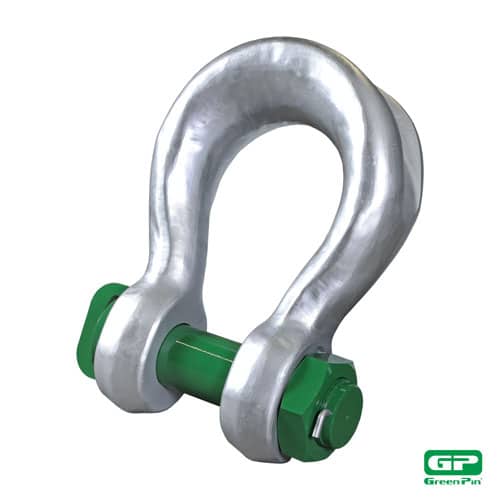
A shackle is the connector that joins one part of a lifting assembly to another — sling to load, sling to hook, leg to master link. Two decisions define which one you need, and both matter more than price.
Bow or dee. A bow shackle has a wide rounded body that accepts several sling legs and tolerates load from varying directions. A dee is narrow and intended for a single leg loaded in line with the body. Put a multi-leg sling in a dee shackle and you side load it, which is outside its rating.
Screw pin or safety pin. A screw collar pin threads in by hand and comes out the same way, ideal for connections made and broken repeatedly. What it will not tolerate is anything that can rotate the pin — vibration, a shifting load, or a sling moving against it can unscrew it over time. For anything left rigged, use the safety nut and bolt version.
Manufacturer specification. Grade 8 alloy steel body and pin, quenched and tempered. Hot dipped galvanised finish up to 55t. 75t and above shackle body silver painted, pin green painted. Minimum breaking load is 5 times the W.L.L. Temperature range -20ºC up to +200ºC. 5% forging tolerance on inside width and length.
Key Features
- Hot Dipped Galvanised finish: Identifies the range on site — never repaint a lifting or safety product
- Minimum breaking load 5 times the W.L.L.: The safety factor built into the rating
- Grade 8 alloy steel body and pin, quenched and tempered: As specified by the manufacturer
- Hot dipped galvanised finish up to 55t: As specified by the manufacturer
- 75t and above shackle body silver painted, pin green painted: As specified by the manufacturer
- Minimum breaking load is 5 times the W.L.L. Temperature range -20ºC up: As specified by the manufacturer
Technical Specifications
| Product Code |
W.L.L. (t) |
A (mm) |
B (mm) |
C (mm) |
D (mm) |
E (mm) |
F (mm) |
G (mm) |
H (mm) |
I (mm) |
J (mm) |
K (mm) |
L (mm) |
Weight (kg) |
| GPSL7 |
7 |
22 |
22 |
46 |
19 |
32 |
96 |
64 |
153 |
115 |
110 |
19 |
41 |
1.97 |
| GPSL12.5 |
12.5 |
28 |
28 |
61 |
25 |
44 |
120 |
82 |
197 |
151 |
146 |
24 |
54 |
4.27 |
| GPSL18 |
18 |
35 |
35 |
69 |
30 |
54 |
148 |
102 |
239 |
171 |
180 |
29 |
64 |
6.85 |
| GPSL30 |
30 |
40 |
42 |
90 |
35 |
69 |
165 |
126 |
279 |
207 |
200 |
34 |
79 |
12.5 |
| GPSL40 |
40 |
55 |
51 |
109 |
45 |
84 |
199 |
140 |
331 |
252 |
235 |
38 |
97 |
20.3 |
| GPSL55 |
55 |
60 |
57 |
115 |
55 |
90 |
240 |
160 |
389 |
294 |
270 |
45 |
100 |
30.4 |
| GPSL75 |
75 |
70 |
70 |
126 |
54 |
110 |
290 |
185 |
473 |
317 |
331 |
40 |
120 |
45 |
| GPSL125 |
125 |
85 |
80 |
156 |
85 |
137 |
366 |
220 |
583 |
413 |
390 |
40 |
150 |
92 |
| GPSL150 |
150 |
94 |
95 |
181 |
89 |
147 |
391 |
253 |
648 |
445 |
449 |
50 |
170 |
140 |
| GPSL200 |
200 |
110 |
105 |
201 |
100 |
158 |
481 |
280 |
759 |
480 |
500 |
50 |
205 |
205 |
| GPSL250 |
250 |
126 |
120 |
229 |
110 |
179 |
542 |
300 |
860 |
535 |
552 |
60 |
240 |
264 |
| GPSL300 |
300 |
135 |
134 |
246 |
134 |
195 |
601 |
350 |
946 |
590 |
620 |
70 |
265 |
360 |
| GPSL400 |
400 |
160 |
160 |
295 |
145 |
231 |
576 |
370 |
995 |
687 |
710 |
80 |
320 |
583 |
| GPSL500 |
500 |
170 |
180 |
330 |
160 |
263 |
681 |
450 |
1161 |
762 |
850 |
90 |
340 |
862 |
| GPSL600 |
600 |
190 |
200 |
360 |
170 |
289 |
741 |
490 |
1264 |
827 |
930 |
100 |
370 |
1,134 |
| GPSL700 |
700 |
200 |
215 |
392 |
190 |
315 |
751 |
540 |
1284 |
879 |
901 |
100 |
400 |
1,142 |
| GPSL800 |
800 |
218 |
230 |
420 |
200 |
342 |
851 |
554 |
1426 |
942 |
947 |
110 |
420 |
1,418 |
| GPSL900 |
900 |
242 |
255 |
466 |
220 |
368 |
851 |
580 |
1488 |
1023 |
1023 |
120 |
440 |
1,810 |
| GPSL1000 |
1000 |
260 |
270 |
490 |
240 |
399 |
851 |
614 |
1532 |
1103 |
1107 |
120 |
460 |
2,385 |
| GPSL1250 |
1250 |
285 |
300 |
510 |
260 |
452 |
931 |
650 |
1666 |
1227 |
1182 |
150 |
530 |
3,110 |
| GPSL1550 |
1550 |
285 |
320 |
550 |
280 |
483 |
950 |
680 |
1710 |
1300 |
1253 |
150 |
560 |
3,655 |
Full dimensional data and Working Load Limits for every size are given in the manufacturer information sheet.
Grade 8 | LOLER Ready
Grade 8 alloy steel body and pin, quenched and tempered. Hot dipped galvanised finish up to 55t. 75t and above shackle body silver painted, pin green painted. Minimum breaking load is 5 times the W.L.L. Temperature range -20ºC up to +200ºC. 5% forging tolerance on inside width and length. Under LOLER 1998, lifting accessories and Category III PPE require thorough examination by a competent person at intervals not exceeding 12 months, and immediate withdrawal after arresting a fall or any overload.
Suitable Applications
Joining slings to loads, connecting sling legs to master links, attaching to lifting points, and any connection in a lifting assembly. Bow shackles suit multi-leg slings and loads where the pull direction varies; dee shackles suit single legs loaded in line. Where the connection will be left rigged, subjected to vibration, or where anything could rotate the pin, specify the safety nut and bolt version.
More About This Product
Shackles are the most-handled component in any lifting operation, and that is precisely why they wear out first. A sling gets rigged and derigged; a shackle gets rigged, derigged, dropped, driven over, thrown into a box and picked up by whoever needs one. Most lifting gear fails from a single overload; shackles fail from accumulated inattention.
The grade markings matter more than most people realise. A Grade 6 high tensile shackle to BS EN 13889 and a Grade 8 alloy shackle look similar and share the same body shape, but the alloy version carries considerably more at the same size. Once a shackle is in a box with fifty others, the only way to tell them apart is the marking — which is why an unmarked shackle has to be scrapped no matter how good it looks.
Understanding the Load Path
A shackle has two distinct load-bearing elements and they do different jobs. The bow takes the sling; the pin takes the load. Reverse that — put the sling on the pin and the load on the bow — and two things happen. The sling bears on a smaller radius than it was designed for, and any movement in the sling starts to rotate the pin.
On a screw collar pin that rotation is the failure mechanism. A sling shifting under a settling load, or vibration transmitted from plant nearby, will slowly unscrew the pin over minutes or hours. It rarely happens quickly enough for anyone to see it happening.
The second consideration is angle. A shackle loaded in line with the pin carries its full rating. Loaded at an angle across the bow it carries substantially less, and published derating tables cover a limited range of angles — beyond that range no figure is published because none applies. On a multi-leg sling every leg is at an angle by definition, which is why the bow shackle exists and why putting a multi-leg sling into a dee shackle is a genuine mistake rather than a preference.
How to Use
- Screw the pin fully home: The pin must be completely engaged with the collar seated. A partially threaded pin carries a fraction of its rating.
- Load in line with the pin, not across it: Sling legs bear on the bow; the load bears on the pin. Never reverse that.
- Never use a screw pin where the pin could rotate: Vibration, a shifting load or a sling moving against the pin can unscrew it. Use the safety pin version.
- Watch the included angle on multi-leg slings: Wide angles increase leg loads substantially.
- Do not replace the pin with a bolt: The pin is a rated component matched to the body.
- Do not modify: Never weld, heat, machine, drill or repaint.
Warning: A screw collar pin can unscrew under vibration or if a sling moves against it. Never use a screw pin shackle for a connection left rigged, subject to vibration, or where anything could rotate the pin. Never substitute a bolt for the shackle pin.
Safety Information
- Never exceed the marked Working Load Limit.
- The pin must be screwed fully home with the collar seated.
- Do not use a screw pin where vibration or movement could rotate the pin.
- Load in line with the pin. Do not side load unless the shackle is rated for it.
- Never substitute a bolt or non-original pin.
- Derate for included angle on multi-leg slings.
- Withdraw any shackle showing wear beyond the manufacturer’s stated limit, distortion, bow spreading, thread damage or cracks.
- Never weld, heat treat, machine or repaint.
Inspection and Maintenance
Three checks. Measure the bow at its narrowest point and compare against original dimensions, since a shackle that has been overloaded spreads and the change can be subtle. Check the pin for straightness by rolling it on a flat surface, and inspect its thread and the tapped hole for damage, stripping and corrosion — a pin that will not seat fully cannot develop the rating. Look for wear at the crown and at the pin bearing points, which is where a shackle wears fastest, and withdraw at the manufacturer’s stated wear limit.
Downloads
Frequently Asked Questions
Q: Bow or dee shackle?
A bow shackle has a wide rounded body that accepts multiple sling legs and tolerates load from varying directions. A dee is narrow and takes a single leg loaded in line. Multi-leg slings need a bow; putting them in a dee side loads it, which is outside its rating.
Q: Screw pin or safety pin?
Screw pin for temporary connections made and broken repeatedly, since it fits and removes by hand. Safety nut and bolt for anything left rigged, subject to vibration, or where a sling could move against the pin and unscrew it.
Q: The split pin is missing on my safety shackle. Can I use it?
No. The split pin secures the nut, and without it the nut can back off. Fit the correct replacement from the manufacturer before use.