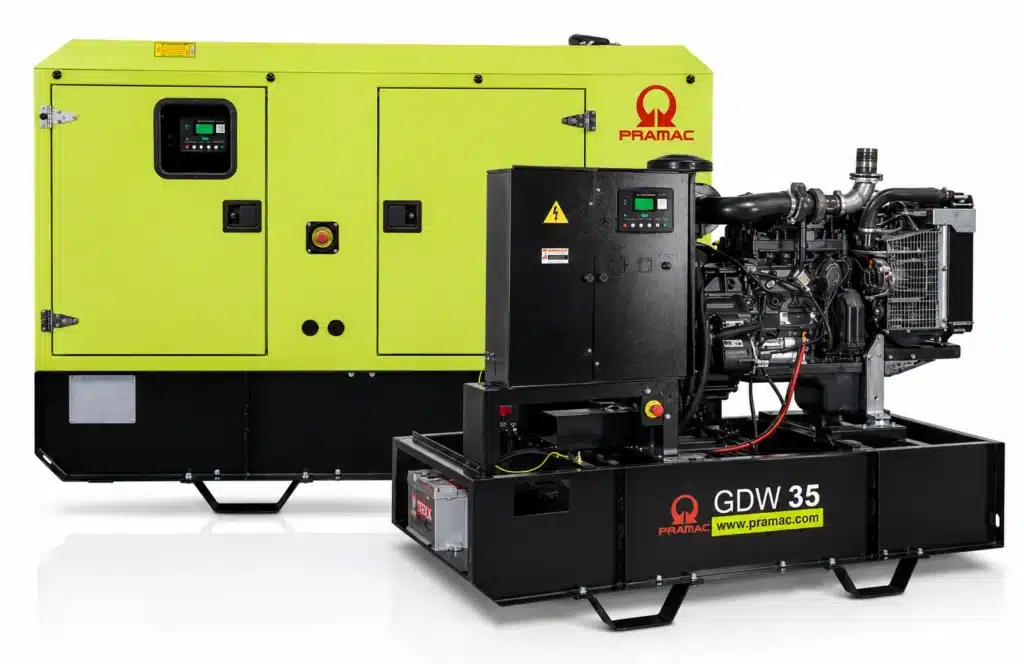
The GDW is Pramac's stationary industrial range and the most adaptable generator they build, spanning 10 to 820kVA in the full catalogue with sixteen models on the UK 2026 price list. It is a modular design rather than a fixed product: open, silent or extra silent canopy; manual, automatic or parallel control panel; fuel tanks giving 8 hours as standard, 24 hours, 48 hours or more; and a choice of alternator and accessory packages. That configurability is why the same series appears in industrial plants, data centres and residential standby installations.
Emissions ComplianceStage V certified. Every model in this range meets the Stage V non-road mobile machinery emissions standard, which is a condition of entry on many local authority, London and principal contractor sites.
Specification
| Specification |
Value |
| Output |
65kVA |
| Model |
GDW 65P |
| Product Code |
— |
| Fuel |
Diesel |
| Engine Brand |
Perkins |
| Engine Model |
1103A-33TG2 |
| Key Specification |
Mecc Alte ECP32 2M C |
| Configuration |
ACP+GCB2+BAT+MBS+PFT+LPT+PHS+OWS+MOP+RLP |
The GDW Series Industrial Diesel Generator Range
| Model |
Engine |
Engine Model |
Alternator |
Model |
Engine |
Engine Model |
Alternator |
| GDW 22P |
Perkins |
404J-22G |
ECP28 M C |
GDW 220P |
Perkins |
1106A-70TAG4 |
ECP38 2S C |
| GDW 35P |
Perkins |
1103A-33G |
ECP28 VL C |
GDW 280V |
Volvo |
TAD841GE |
ECO38 2M C |
| GDW 50P |
Perkins |
1103A-33TG1 |
ECP32 2S C |
GDW 335V |
Volvo |
TAD842GE |
ECO38 1L C |
| GDW 65P |
Perkins |
1103A-33TG2 |
ECP32 2M C |
GDW 375V |
Volvo |
TAD843GE |
ECO38 2L C |
| GDW 90P |
Perkins |
1104A-44TG2 |
ECP32 2L C |
GDW 420V |
Volvo |
TAD1343GE |
ECO40 1S C |
| GDW 110P |
Perkins |
1104C-44TAG2 |
ECP34 2S C |
GDW 460V |
Volvo |
TAD1344GE |
ECO40 2S C |
| GDW 150P |
Perkins |
1106A-70TG1 |
ECP34 2M C |
GDW 510V |
Volvo |
TAD1345GE |
ECO40 3S C |
| GDW 165P |
Perkins |
1106A-70TAG2 |
ECP34 1L C |
|
|
|
|
| GDW 200P |
Perkins |
1106A-70TAG3 |
ECO38 2S C |
|
|
|
|
All alternators are Mecc Alte. Standard configuration across the range: ACP (automatic control panel), GCB2 (genset circuit breaker panel 2), BAT (starting battery), MBS (manual battery switch), PFT (plastic fuel tank), LPT (leak proof tray), PHS (pre-heating system), OWS (oil water sensor), MOP (manual oil pump), RLP (roof lifting point).
Key Features
- Perkins below 220kVA, Volvo above — two of the most widely supported industrial engine brands, which matters for parts and service over a twenty year installation life.
- Deep Sea control units — high reliability and quick power response, and a controller that service engineers across the UK already know.
- Open, silent and extra silent versions — the acoustic specification is chosen to suit the site rather than being fixed by the model.
- Fuel autonomy from 8 to 48+ hours — standard tanks give 8 hours; 24 hour, 48 hour and larger options cover extended outages without refuelling.
- Manual, automatic or parallel control — from manual start through automatic mains failure to multiple sets running in parallel for larger or redundant installations.
- Oil water sensor and pre-heating as standard — specification aimed at a set that must start reliably after standing, which is the whole point of standby plant.
Suitable Applications
The GDW is specified for prime and standby power in industry, data centres, hospitals, water treatment, telecoms, agriculture and larger commercial premises. Sizing is a design exercise rather than a purchase decision: the set must cover the connected load including motor starting currents, and the fuel autonomy must match how long an outage is expected to last. Installation involves a base, exhaust routing, ventilation, fuel supply and electrical connection, so treat it as a project with a competent designer and installer rather than an item bought from a list.
How to Use
- Sizing and installation must be designed by a competent engineer against the actual connected load.
- Confirm the acoustic specification against the site's noise constraints before ordering.
- Specify fuel autonomy against expected outage duration, not just the standard 8 hour tank.
- Confirm the control panel option: manual, automatic mains failure, or parallel operation.
- Arrange installation, exhaust routing, ventilation and commissioning with load testing.
- Set an exercise schedule at commissioning and follow it.
Warning: Never operate a generator indoors, in a partially enclosed space, or anywhere exhaust can reach an occupied area. Exhaust contains carbon monoxide, which is colourless, odourless and fatal. An industrial generator installation requires designed exhaust routing and ventilation. This is not equipment that can be sited without engineering input.
Safety Information
- Operate only in the open air, well clear of doors, windows and air intakes.
- Never refuel a hot or running engine.
- Do not connect to a building's fixed wiring without a correctly specified changeover arrangement.
- Use only leads and connectors rated for the outlet, inspected before each use.
- Keep fuel and flammables away from the exhaust and hot surfaces.
- Earth the set in accordance with the site electrical arrangement.
- Never work on the set without isolating it and preventing automatic start.
- Ensure the installation includes correctly rated protection and earthing designed for the set.
Inspection and Maintenance
Standby sets fail when they are serviced but never exercised. Run under load on a defined schedule so faults appear before an outage does. Follow the Perkins or Volvo service schedule by running hours, check the oil water sensor and pre-heating system function, keep fuel treated and polished on long-standing installations, and record every exercise run and service. The installation falls under PUWER and the electrical installation under the Electricity at Work Regulations.
What's Included
- GDW generator to the configuration ordered
- Standard package: ACP, GCB2, BAT, MBS, PFT, LPT, PHS, OWS, MOP, RLP
- Operator and engine documentation
- Canopy type, fuel autonomy and control panel are specified at order
- Installation, base, exhaust routing and commissioning are NOT included
Frequently Asked Questions
Q: How do I size a GDW?
Against the connected load including motor starting currents, not the sum of nameplate ratings. Get it designed — an undersized set will fail under load and an oversized one runs inefficiently and wet-stacks.
Q: What is the difference between open, silent and extra silent?
The canopy specification. Open is the base machine; silent and extra silent add acoustic enclosures. The right choice depends on the site's noise constraints and how close the set sits to occupied areas.
Q: How long can it run without refuelling?
Standard tanks give 8 hours. 24 hour, 48 hour and larger options are available and should be specified against how long outages actually last in your location.
Q: Can multiple sets run together?
Yes. The parallel control panel option allows sets to operate in parallel, which is used for larger loads and for redundancy where a single set failing is unacceptable.