The
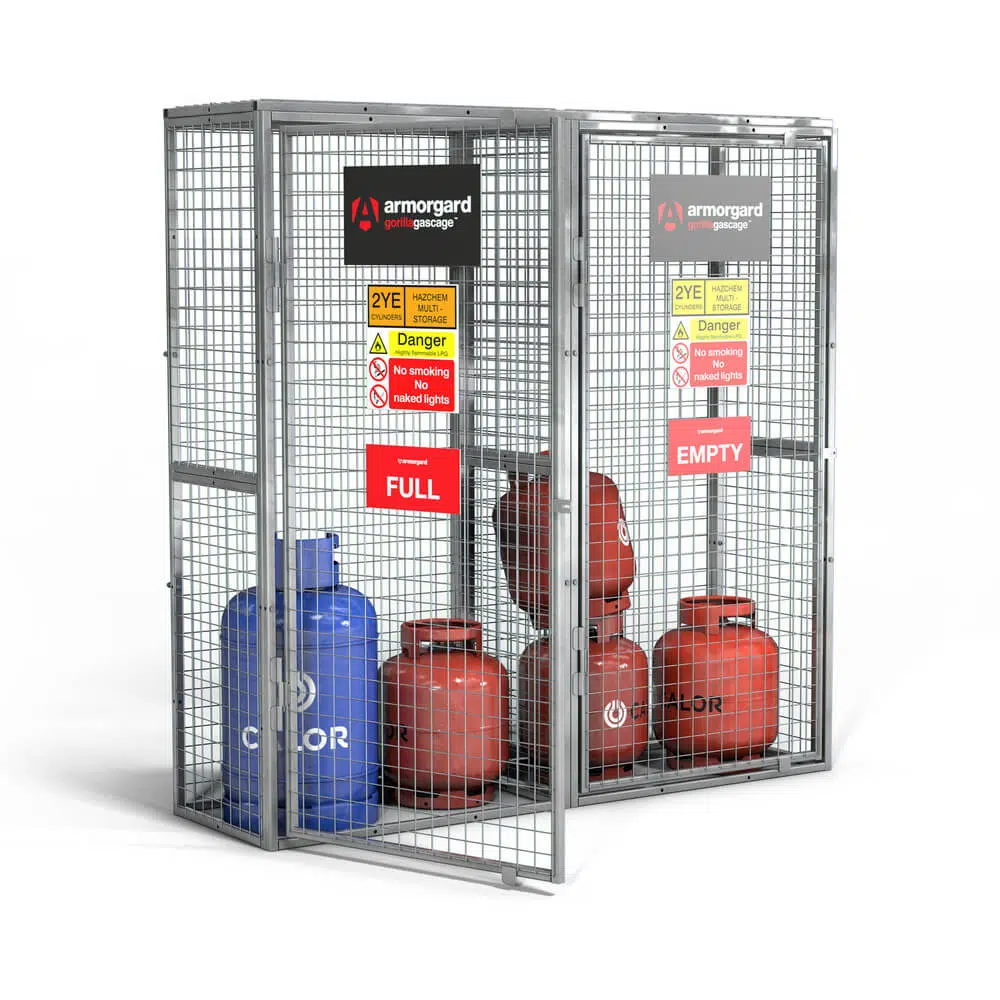
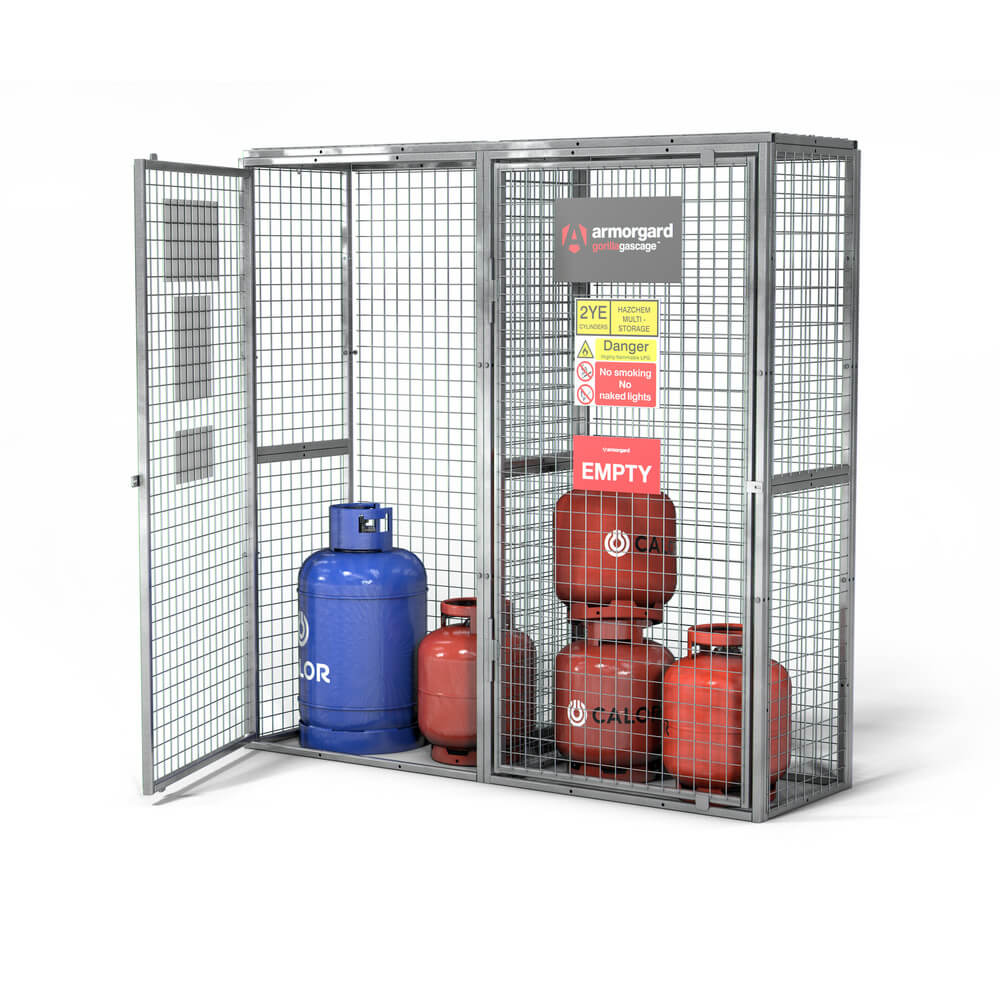
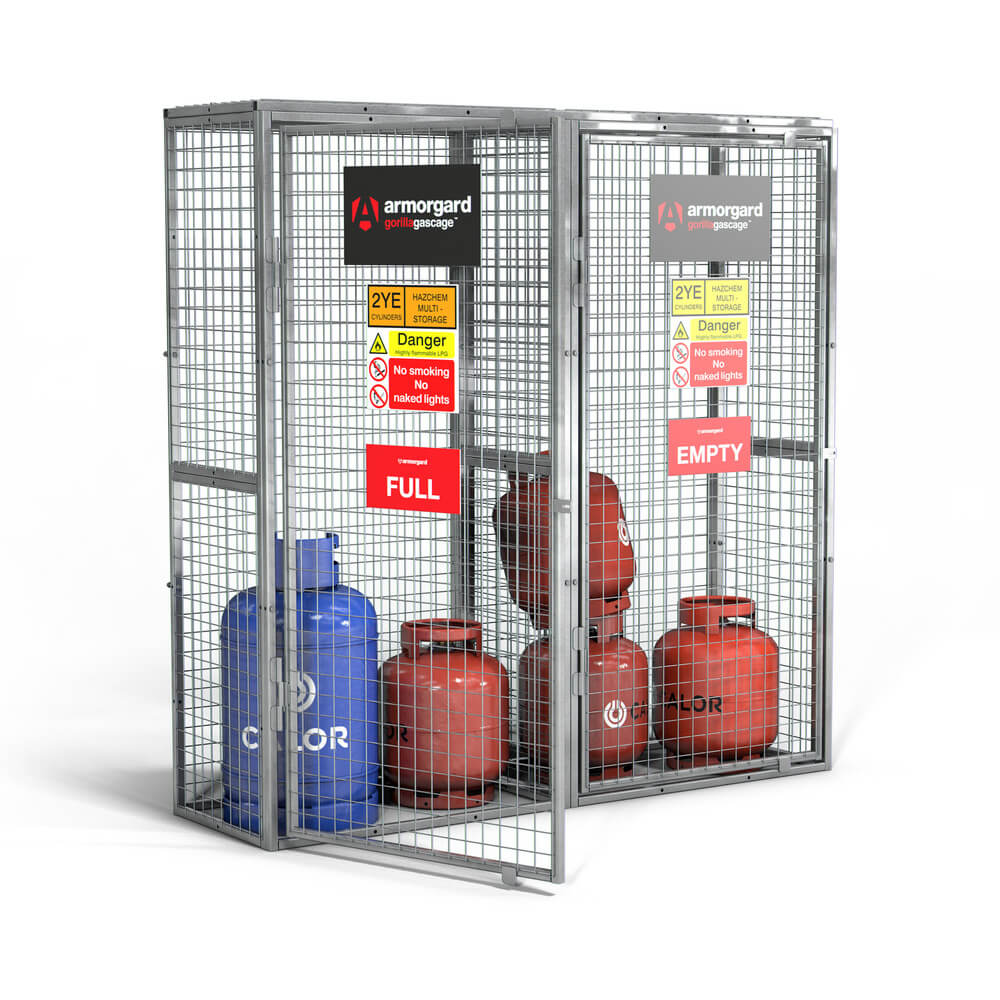
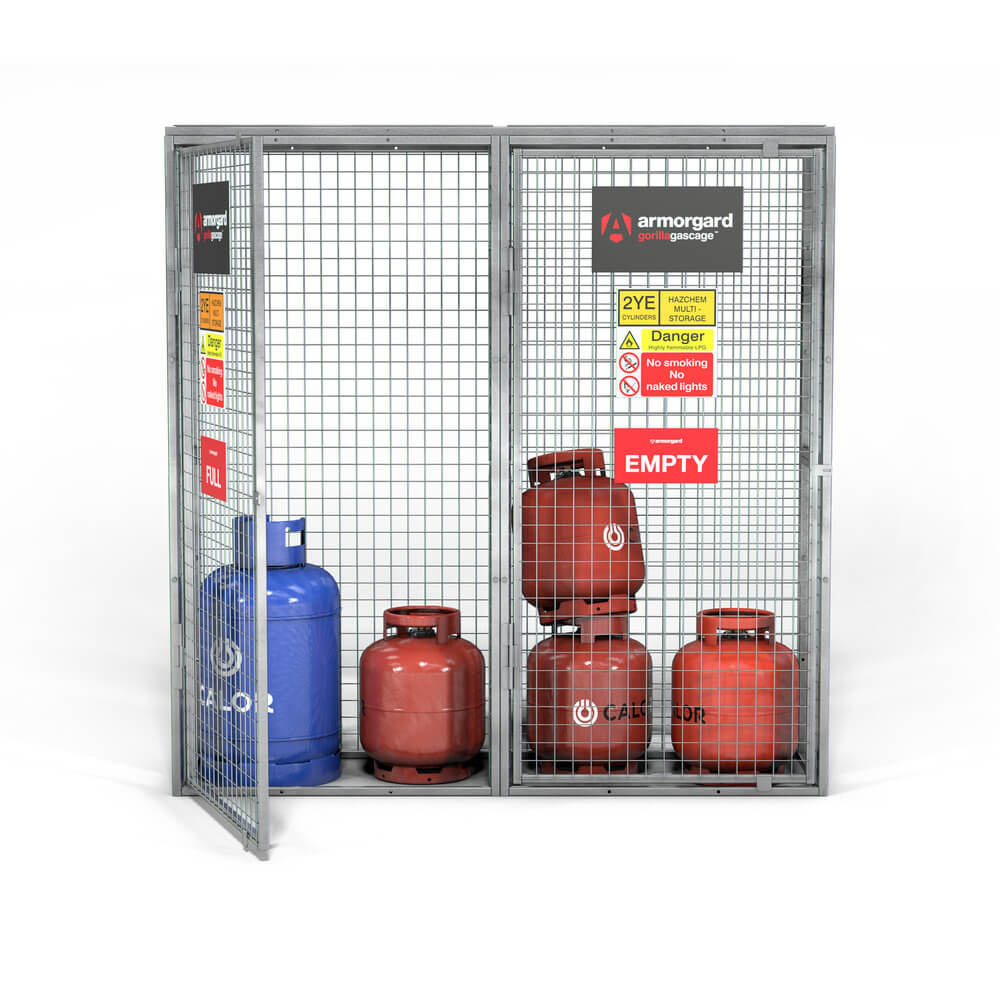
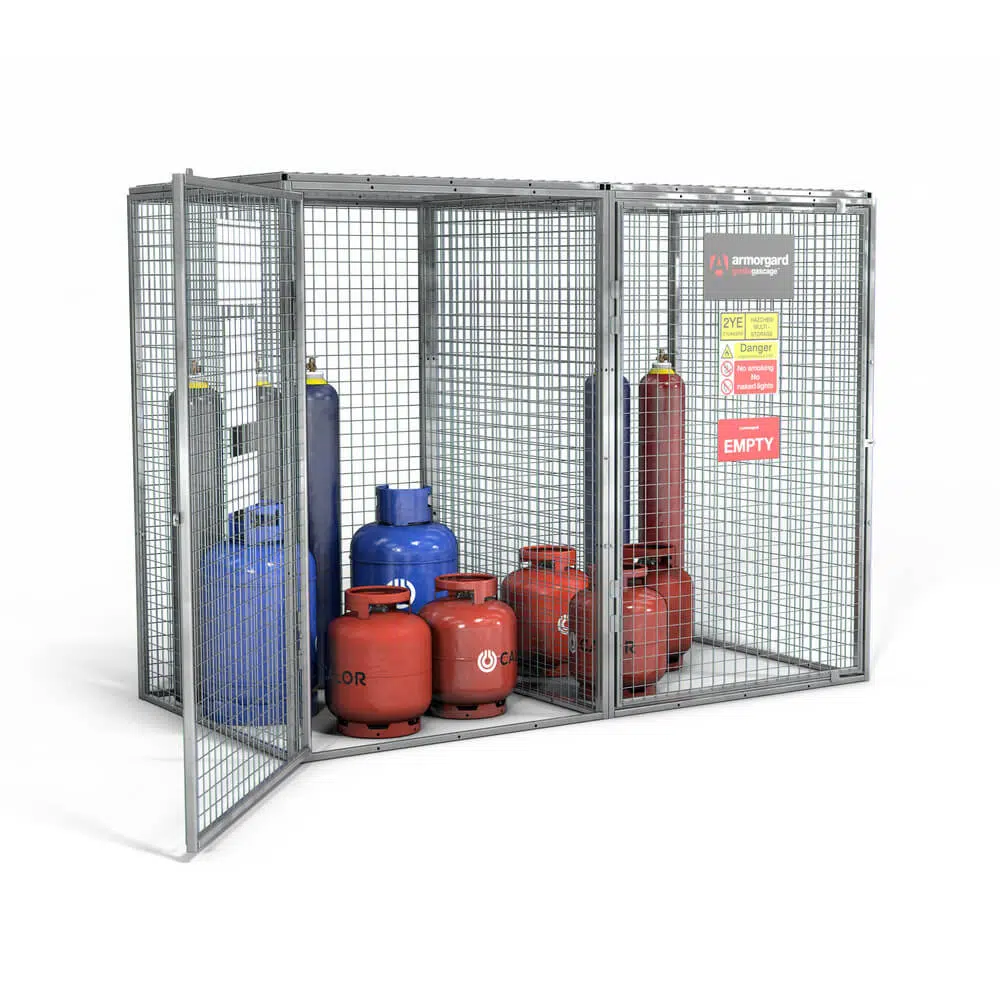
Armorgard Gorilla Gas Cage GGC33 features two separate compartments that segregate empty and full gas bottles, with clear "Empty" and "Full" signage and independent padlockable doors — ideal for gas bottle exchange operations, stock management and compliance. Each compartment provides 900 x 500 x 1800mm of internal storage, accommodating 2 x 19kg or 2 x 47kg bottles per side. Robustly constructed from 25mm box section steel and 3mm wire mesh with a hot-dip galvanised finish, COSHH compliant with modular bolt-together assembly.
Key Features
- Double compartment design - segregates empty and full gas bottles for safety and stock management.
- Clear "Empty" and "Full" signage - each compartment clearly labelled for easy identification.
- Separate padlockable doors - independent access to each compartment with individual padlock points.
- Accommodates 47kg bottles - full-height compartments with 1800mm internal clearance.
- COSHH compliant - meets relevant legislation for the safe storage of gas cylinders on site.
- Modular bolt-together design - individual galvanised panels bolt together for quick and easy assembly.
- Hot-dip galvanised finish - excellent durability and resistance to all weather conditions for long-term outdoor use.
- Robust construction - built from 25mm box section steel and 3mm wire mesh for maximum security.
- Ground fixing facility - can be bolted to the floor for added security and stability.
- Pre-fitted safety signage - hazard warning and "Empty"/"Full" signs included.
Technical Specifications
| Specification |
GGC33 |
| External Dimensions (W x D x H) |
1815 x 570 x 1835 mm |
| Internal Dimensions per Compartment (W x D x H) |
900 x 500 x 1800 mm (per compartment) |
| Weight |
120 kg |
| Total Bottle Capacity (19kg, 315x810mm) |
4 bottles (2 per compartment) |
| Total Bottle Capacity (47kg, 375x1290mm) |
4 bottles (2 per compartment) |
| Number of Compartments |
2 (labelled "Empty" and "Full") |
| Ventilation |
Yes - open mesh construction |
| Collapsible |
Yes - packs flat for storage/transport |
| Ground Fixing |
Facility for bolting to ground |
| Safety Signage |
Pre-fitted hazard warning and Empty/Full signs |
| Assembly |
Bolt-together (all fixings included) |
| Material |
25mm box section steel, 3mm wire mesh |
| Finish |
Hot-dip galvanised |
| Locking |
Separate padlock points per compartment (padlocks not included) |
| COSHH Compliant |
Yes |
COSHH Compliant | Hot-Dip Galvanised | 12-Month Warranty
The Gorilla Gas Cage meets relevant legislation for storing gas bottles and is COSHH compliant. The hot-dip galvanised finish provides excellent resistance to all weather conditions. All Armorgard products are built in the UK and come with a 12-month manufacturer's warranty.
More About This Product
The Armorgard Gorilla Gas Cage GGC33 features two separate compartments designed to segregate empty and full gas bottles, with clear "Empty" and "Full" signage on each cage and independent padlockable doors. This dual-compartment layout is ideal for gas bottle exchange operations, ensuring empty bottles are always stored separately from full ones for improved safety, stock management, and compliance. Each compartment provides 900 x 500 x 1800mm of internal storage, accommodating 2 x 19kg or 2 x 47kg bottles per side. Robustly constructed using 25mm box section steel and 3mm wire mesh with hot-dip galvanised finish. COSHH compliant with modular bolt-together assembly.
Suitable Applications
Outdoor storage of gas cylinders on construction sites, storage yards, plant depots, welding and fabrication shops, and anywhere cylinders must be kept secure, ventilated and away from ignition sources. The collapsible design suits sites that move: the cage packs flat between projects rather than needing storage as a fixed structure.
Cylinder storage is a COSHH matter and also a security one — gas cylinders are a common theft target and an uncontrolled cylinder store is a serious hazard. A cage addresses both.
Cylinders need ventilation rather than containment, which is why they are stored in a cage rather than a sealed cabinet — for liquids and solids see COSHH storage.
Storing Gas Cylinders Safely
Four things govern how gas cylinders are stored, and a cage addresses all of them.
Ventilation. Cylinders must be stored in the open air or in a well ventilated space so that any leak disperses rather than accumulating. The open mesh construction of a cage is not a compromise on security — it is the point. Never store cylinders in a sealed container or an unventilated cabinet.
Upright and restrained. Cylinders are stored and used upright, secured so they cannot fall. A falling cylinder can shear its valve, and a cylinder with a sheared valve becomes a projectile.
Separation of full and empty. Empty cylinders are not inert — they retain residual gas and pressure. Storing them separately from full ones is standard practice and is why the larger cages are supplied with two compartments labelled "Empty" and "Full".
Away from ignition sources and secure from access. No smoking, no hot work nearby, and locked against unauthorised access. Cylinders are a frequent theft target and an uncontrolled store is a hazard to anyone on site.
Hazard warning signage is pre-fitted so the store is identifiable to anyone approaching it, including the emergency services.
Safety Information
- Store and use gas cylinders upright and secured against falling.
- Store in the open air or a well ventilated space. Never in a sealed or unventilated enclosure.
- Keep full and empty cylinders separated.
- Keep clear of ignition sources; no smoking or hot work nearby.
- Keep the cage locked against unauthorised access.
- Ensure hazard warning signage remains legible.
- Bolt the cage to the ground where site conditions require it.
- Follow the gas supplier’s guidance and your site COSHH assessment.
Inspection and Maintenance
Hot-dip galvanising is durable but not indestructible. Check the coating for damage at the corners and around the fixings, since those are where impact damage occurs and where corrosion starts. On a collapsible cage that is erected and struck repeatedly, check the bolt holes for elongation and replace fixings rather than reusing damaged ones.
Confirm the hazard warning signage remains legible — it is what identifies the contents to anyone approaching, including the emergency services. Check the padlock hasp for distortion, since a forced hasp means the cage is no longer secure. Where the cage is bolted down, check the ground fixings have not worked loose.
Frequently Asked Questions
Q: What is the difference between the GGC33 and GGC66?
Both feature double compartments with "Empty" and "Full" signage. The GGC33 holds 4 bottles total (2 per side), while the larger GGC66 holds 18 bottles total (9 per side).
Q: Are padlocks included?
No, padlocks are not included. Each compartment has its own padlock point, so two padlocks are required for the GGC33.
Q: Can the GGC33 hold 47kg bottles?
Yes. Each compartment has 1800mm of internal height, providing clearance for 47kg propane cylinders (375mm diameter x 1290mm height).
Q: Why does the cage need to be open mesh?
Because gas cylinders must be stored where any leak can disperse. A sealed cabinet allows gas to accumulate, which is the hazard the storage arrangement exists to prevent. Open mesh gives ventilation and security together.
Q: Do I need to separate full and empty cylinders?
Yes, it is standard practice. Empty cylinders retain residual gas and pressure and are not inert. The larger cages are supplied with two compartments labelled Empty and Full for this reason.
Q: Can the cage be bolted down?
Yes, there is a facility for bolting to the ground. Worth doing where the cage is exposed to wind, could be struck by plant, or where theft is a concern.
Q: Is this COSHH compliant?
The cage is designed to meet the relevant legislation for safe gas cylinder storage on site. Compliance in practice also depends on how it is used — ventilation, separation, distance from ignition sources and control of access are all part of your site COSHH assessment.