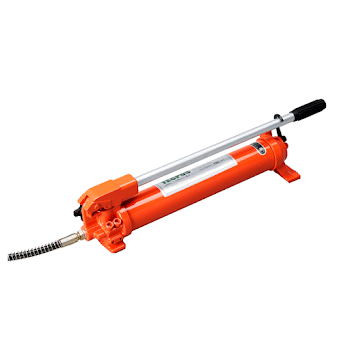
A two-stage hand pump does the sensible thing: it moves a large volume of oil quickly while there is no load, then switches automatically to high pressure once the cylinder meets resistance. Without that, taking up the travel on a long-stroke cylinder by hand would be a very long afternoon.
Reservoir capacity is the specification that decides which pump you need. It must hold enough oil to fill your cylinder through its full stroke, with margin. This is the 1,600 cc model.
The Range Compared
| Model |
Reservoir |
Hand Effort |
cc/stroke Low |
cc/stroke High |
Weight |
List |
| ESP08 |
800 cc |
— |
— |
— |
— |
£474.37 |
| THPA-1B |
800 cc |
0.5–4.7 cc |
5–85 cc |
— |
— |
£263.60 |
| THPA-1C |
1,600 cc |
2.0 cc |
16.5 cc |
44 kg |
8 kg |
£337.94 |
| ESP17 |
1,700 cc |
2.47 cc |
32.7 cc |
35 kg |
7.2 kg |
£555.47 |
| ESP25 |
2,500 cc |
2.94 cc |
41 cc |
38.5 kg |
8.6 kg |
£752.10 |
| ESP50 |
5,000 cc |
2.94 cc |
41 cc |
38.5 kg |
14.5 kg |
£1,501.58 |
All models 700 bar maximum working pressure. Note the THPA-1C is supplied with hose; confirm at order whether the ESP models are.
Key Features
- Two-stage operation: High volume at low pressure to close the gap, then high pressure for the working lift. Automatic changeover.
- 700 bar working pressure: The standard for hydraulic lifting and pressing equipment.
- 1,600 cc reservoir: Match this to your cylinder's oil capacity, which is the primary selection criterion.
- No power supply needed: The hand pump's real advantage on a remote site or inside a structure.
- Certification available to 2.1 with Declaration of Conformity.
700 Bar Maximum Working Pressure | Certification 2.1 and DoC Available
Maximum working pressure 700 bar. Every component in the system — hoses, couplers, gauges and cylinder — must be rated to the highest pressure the system can generate. Hydraulic equipment at 700 bar requires trained operators and regular inspection.
Suitable Applications
Powers single and double acting cylinders for lifting, pressing, bending, cutting and pulling: machinery installation and alignment, bearing and bush removal, structural jacking, rail and track work, and any site work without a power supply. Pairs with the Tecpos TSSC Shorty cylinder range and THS hoses.
More About This Product
Hydraulic cylinders are specified on tonnage and chosen on geometry. A large cylinder that will not fit in the gap is no more use than no cylinder at all, which is why the collapsed height and the stroke are usually the numbers that decide the purchase.
The second consideration is what happens after the lift. A cylinder holds a load only while the system holds pressure, and hydraulic systems lose pressure through seals, through leaks and through valves that are not quite seated. Cribbing is not belt and braces; it is the only thing supporting the load once the pump stops.
Pressure, Force and Working Safely at 700 Bar
Force is pressure multiplied by area, which is why a modest cylinder at 700 bar develops tonnages that seem out of proportion to its size. As an illustration of the arithmetic, a ram of 100 square centimetres at 700 bar produces in the order of 70 tonnes. Work from your cylinder’s own rating. The equipment is small; the energy stored in the system is not.
Every component must be rated to the highest pressure the system can generate. A 700 bar pump feeding a 350 bar hose is not half a system, it is an accident with a delay on it. Hoses, couplers, gauges, valves and the cylinder itself all need checking, and the circuit is limited by whichever is lowest.
Injected hydraulic fluid is a surgical emergency. At 700 bar a pinhole leak produces a jet that penetrates skin without the operator necessarily feeling it as more than a sting, and the fluid then causes tissue damage that develops over hours. The entry wound looks trivial and the injury is not. Anyone who suspects fluid injection needs a hospital immediately and needs to say what fluid it was. This is why leaks are located with a piece of cardboard and never with a hand.
A cylinder lifts; it does not support. Crib as the load rises, block it before anyone approaches, and never rely on a closed valve to hold a load with people underneath. Valves seat imperfectly, seals weep, and a load that settles two millimetres overnight has told you something about the system you would rather have learned differently.
How to Use the Hand Pump
- Match the reservoir to the cylinder: It must hold enough oil for the full stroke, with margin.
- Check every component is rated to 700 bar: The system is limited by its lowest rated part.
- Bleed the system: Air gives a spongy action and unpredictable movement.
- Let the two-stage action work: Pump freely to take up the approach, then continue as it changes to high pressure.
- Never work under a load supported only by a cylinder: Crib or use rated stands.
- Release under control: Open the release valve slowly and watch the load.
Warning: 700 bar systems store considerable energy. Injected hydraulic fluid is a surgical emergency requiring immediate hospital treatment, even where the entry wound looks trivial. Never search for a leak by hand — use cardboard. Never work under a load supported only by a hydraulic cylinder.
Safety Information
- For use by trained operators only.
- Never exceed 700 bar working pressure.
- All hoses, couplers and gauges must be rated to system pressure.
- Never search for a hydraulic leak by hand.
- Never work under a load supported only by a cylinder.
- Use only the specified hydraulic oil.
- Bleed air from the system before working.
- Withdraw any component showing leakage, damage or corrosion.
Inspection and Maintenance
Hydraulic equipment announces its condition through leaks and through feel. Check for weeping around the pump body, the release valve and every connection, since a system that leaks under pressure will lose load. Test the pumping action through both stages and feel for sponginess, which indicates air or a failing seal. Inspect hoses along their full length for abrasion, bulging, kinking and exposed reinforcement — a 700 bar hose showing braid is finished. Keep oil at the correct level with the specified grade, and keep the reservoir sealed, since dirt is what destroys hydraulic components.
Downloads
Frequently Asked Questions
Q: Which reservoir size do I need?
Enough oil to fill your cylinder through its full stroke, with margin. Work out the cylinder's oil capacity from its datasheet and choose a pump that comfortably exceeds it. Too small and you run out mid-stroke; oversized simply costs more and weighs more.
Q: What does two-stage mean?
The pump delivers a large volume at low pressure to close the gap quickly, then switches automatically to a small volume at high pressure for the working lift. It is the difference between a few minutes of pumping and a very long afternoon.
Q: THPA or ESP series?
Compare the low-pressure cc per stroke figure, which decides how quickly you close the gap. The ESP17 moves roughly twice the oil per stroke of the THPA-1C for less hand effort, at a higher price. The THPA-1C is listed as supplied with hose, which changes the real cost comparison.