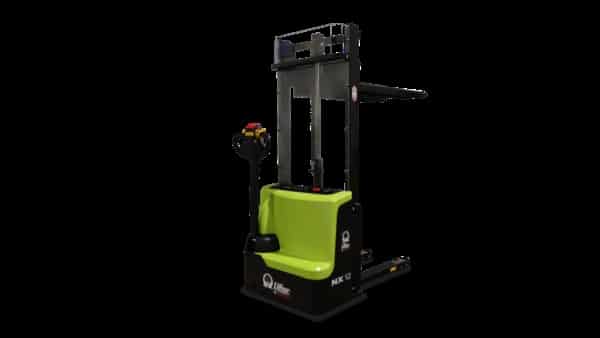
The NX is Pramac's value fully electric stacker: professional build and ergonomics aimed squarely at light duty work, without the cost of the intensive-use LX. It is compact enough to work in narrow aisles and tight spaces, which is what it is designed around. Variable speed control lets the operator match travel to the space rather than working in one gear, lifting runs at up to 0.2 m/s with lowering between 0.1 and 0.2 m/s, and a fault code display means a stoppage can be diagnosed rather than guessed at. Battery and component access is deliberately straightforward to keep downtime short.
Manufacturer Assurance
Lifter by Pramac is backed by over 40 years of material handling equipment manufacture. All Lifter by Pramac products are designed to meet 100% compliance with current standard regulations, and are subject to internal quality testing for reliability and durability.
Technical Specifications
| Model |
Product Code |
Capacity |
Lift Height |
Nominal / Residual |
Mast |
Lead Time |
| NX 12/09 |
HN012000000 |
1200 kg |
810 mm |
1200 / 1200 kg |
Simplex |
Factory order |
| NX 12/16 |
HN312000000 |
1200 kg |
1510 mm |
1200 / 1200 kg |
Simplex |
2-3 days |
| NX 12/20 |
HN412000000 |
1200 kg |
1910 mm |
1200 / 1200 kg |
Simplex |
Factory order |
| NX 12/25 |
HN512000000 |
1200 kg |
2410 mm |
1200 / 1200 kg |
Duplex |
2-3 days |
| NX 12/29 |
HN612000000 |
1200 kg |
2810 mm |
1200 / 800 kg |
Duplex |
2-3 days |
| NX 12/35 |
HN712000000 |
1200 kg |
3410 mm |
1200 / 600 kg |
Duplex |
2-3 days |
Available in mono-mast and wide-mast versions. Mast options run from 900mm simplex up to 3500mm. A lithium-ion option is available on the 25, 29 and 35 models at £250. Lifting speed up to 0.2 m/s; lowering 0.1 to 0.2 m/s.
Key Features
- Variable speed control — travel speed is proportional rather than fixed, so the operator can creep into a tight bay and move at pace down an open aisle.
- Fault code display — a stoppage shows a code rather than nothing, which shortens diagnosis and avoids a call-out for something simple.
- Compact for narrow aisles — streamlined dimensions aimed at restricted environments where a full-size stacker will not manoeuvre.
- Mono-mast and wide-mast versions — wide mast gives better load visibility; mono-mast is more compact. Choose on aisle width and what the operator needs to see.
- Easy battery and component access — designed so routine maintenance does not need the machine stripped, which keeps it working.
- Lithium option on the taller models — the 25, 29 and 35 accept lithium-ion for £250, giving opportunity charging for multi-shift use.
Suitable Applications
The NX suits warehouses, stockrooms and light manufacturing running regular but not continuous stacking, particularly where aisles are tight. It is the natural step up from the semi-electric TX when travel distances grow, and the sensible alternative to the LX where the duty does not justify an intensive-use machine. The 12/16 and the 25, 29 and 35 models are stock items on 2-3 day lead time, which makes the NX the quickest electric stacker in the range to get hold of.
How to Use
- Check the load is within the residual capacity at the height you intend to lift to, not just the nominal rating.
- Confirm battery charge and that the forks and mast are clear of damage.
- Enter the pallet squarely with the forks fully lowered and drive them home.
- Raise just clear of the floor to travel; never travel with the load at height.
- Position square to the racking, check overhead clearance, then raise to the required level.
- Enter the racking, set the load down, withdraw squarely and lower fully before moving off.
- Return the truck to the charge point at the end of the shift.
Warning: Residual capacity drops with height on the taller masts: 800kg at 2810mm and 600kg at 3410mm, against a 1200kg nominal rating. Operators must work to the residual figure for their model and lift height.
Safety Information
- Only trained and authorised operators should use a stacker.
- Never travel with the load raised; lower fully before moving.
- Never allow anyone to stand or pass under raised forks.
- Check overhead clearance and floor condition before lifting.
- Observe the residual capacity at height, which is lower than the nominal rating.
- Charge only in a well-ventilated area and lower the forks before charging.
Inspection and Maintenance
Check the mast channels, chains, rollers and forks before each shift, along with battery charge and the brake. Chains stretch and must be inspected and adjusted at the manufacturer's interval — a neglected chain is the most common serious fault on a stacker. Keep the mast clear of debris and wrap. Stackers are lifting equipment as well as work equipment, so they fall under LOLER as well as PUWER: keep inspection records and arrange thorough examination at the required interval.
What's Included
- NX electric stacker in the model and mast ordered
- Battery and charging arrangement as specified
- Operator manual
- Lithium option on the 25, 29 and 35 models is charged separately
Frequently Asked Questions
Q: NX or LX?
The NX is built for light duty at good value; the LX is built for intensive multi-shift use with a bigger battery, operator platform options and higher capacities. If the truck runs all day every day, specify the LX.
Q: What does variable speed control give me?
Travel speed responds proportionally to the tiller control rather than being fixed, so the operator can move slowly into a bay and quickly along an aisle. It reduces both damage and cycle time.
Q: Mono-mast or wide-mast?
Wide mast gives better visibility of the forks and load. Mono-mast is narrower and more compact. Choose on your aisle width and how much the operator needs to see at height.
Q: Is lithium worth the £250?
If you run more than one shift, yes — lithium can be opportunity charged in breaks without harming the battery. For single-shift work the standard battery is fine.