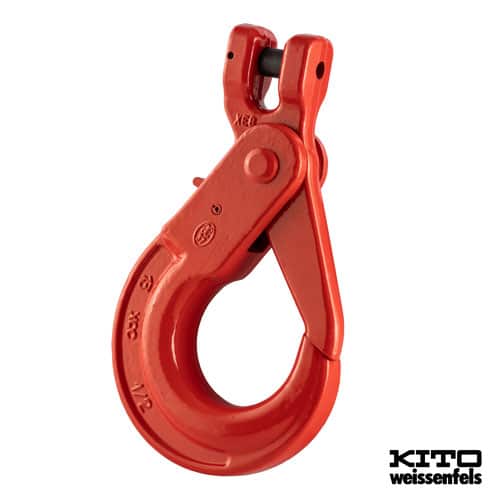
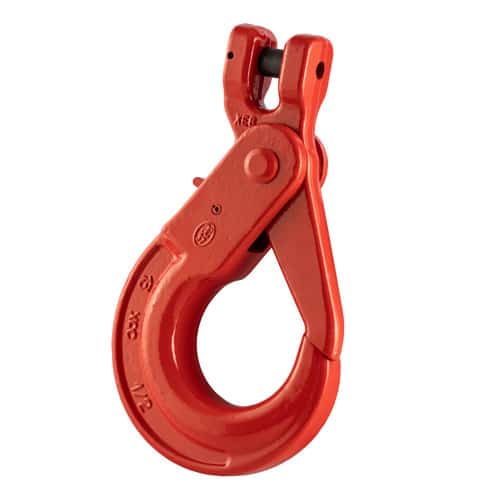
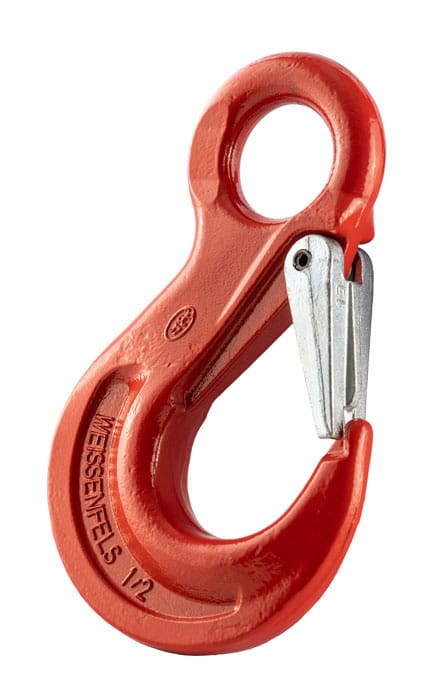
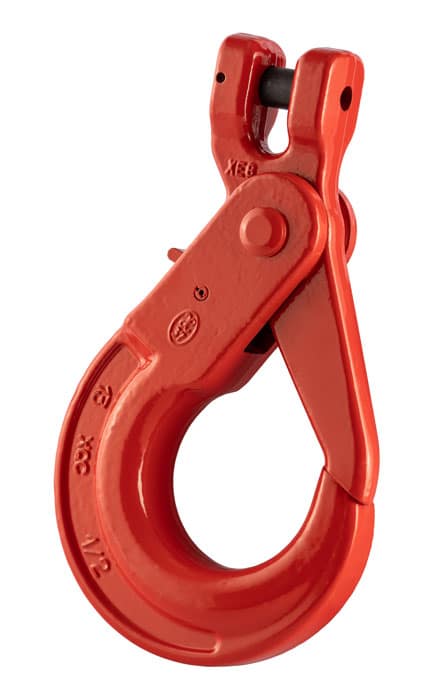
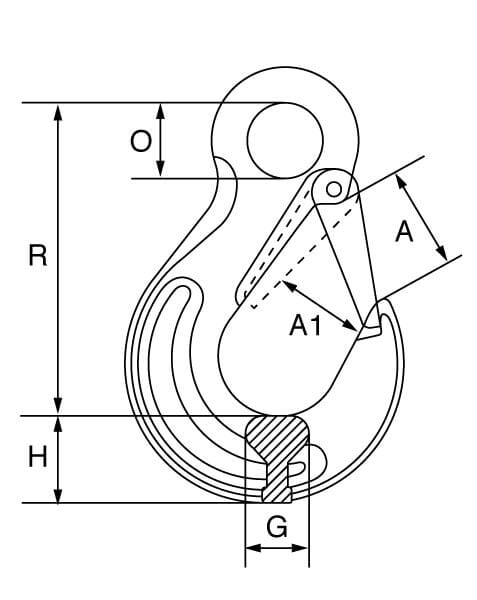
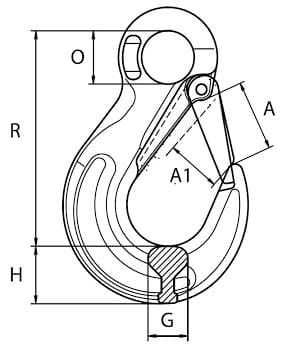
The standard terminal fitting on a chain sling leg — the part that actually connects to the load. An eye connects through a coupling link, so the hook can be replaced without disturbing the rest of the sling — useful on a fleet where hooks wear faster than chain.
The safety catch stops the load coming off the hook when the sling goes slack, which happens more often than people expect: as a load lands, as it settles, as a multi-leg sling takes up unevenly. It retains the load; it does not carry it.
On temperature: Kito Grade 8 runs to +400 °C where the Cobra Grade 8 range stops at +200 °C. For foundry, forge and heat treatment work that is the deciding difference, with reductions in Working Load Limit above +200 °C.
Key Features
- Safety catch fitted: Retains the load when the sling goes slack. Replacement catch kits available — a broken catch is a repair, not a scrap.
- Eye fitting: Connects via a coupling link, so the hook can be swapped without disturbing the assembly
- BS EN 1677-2: The sling hook standard
- -40 °C to +400 °C: Twice the upper range of Cobra Grade 8, with derating above +200 °C
- 9 sizes: Chain 6 mm through 32 mm
- Red painted finish: Identifies Grade 8 — never repaint a lifting fitting
Technical Specifications
| Product Code |
Chain Dia (mm) |
Part No. |
D (mm) |
E (mm) |
F (mm) |
G (mm) |
H (mm) |
O (mm) |
O1 (mm) |
R (mm) |
| G8ESH6 |
6 |
WA29S |
18 |
10 |
20 |
16.5 |
21 |
25 |
19 |
84.5 |
| G8ESH8 |
7/8 |
WA30S |
24 |
11 |
25 |
19 |
27 |
32 |
25 |
106 |
| G8ESH10 |
10 |
WA31S |
30 |
16 |
34 |
26 |
33 |
40 |
31 |
131 |
| G8ESH13 |
13 |
WA32S |
38 |
19 |
43 |
33 |
42 |
48 |
39 |
164 |
| G8ESH16 |
16 |
WA33S |
44 |
25 |
50 |
40 |
50 |
55 |
45 |
182.5 |
| G8ESH20 |
20 |
WA34S |
53 |
27 |
55 |
48 |
54 |
61 |
54 |
205 |
| G8ESH22 |
22 |
WA35S |
60 |
30 |
60 |
50 |
61 |
71 |
61 |
225 |
| G8ESH26 |
26 |
WA36S |
72 |
36 |
70 |
60 |
69 |
84 |
73 |
265 |
| G8ESH32 |
32 |
WA37S |
80 |
39 |
76 |
71 |
89 |
95 |
87 |
259 |
Working Load Limits and full dimensional data are in the user information sheet. The 20 mm hook suits both 19 mm and 20 mm chain.
BS EN 1677-2 | Grade 8 | Safety Catch | -40 °C to +400 °C | LOLER Ready
Conforms to BS EN 1677-2. Grade 8 alloy steel with a red painted finish. Marked with material grade, manufacturer’s identification, size, product ID mark and traceability code, and supplied with a certificate. Rated -40 °C to +400 °C, with reductions in Working Load Limit above +200 °C. Under LOLER 1998, thorough examination by a competent person at intervals not exceeding 12 months.
Suitable Applications
The terminal fitting on single and multi-leg Grade 8 chain sling assemblies for general lifting: fabrication, machinery handling, construction, plant maintenance and materials handling. The wide temperature rating specifically suits foundry, forge and heat treatment work, and cold store at the other extreme. Keep the assembly to one grade throughout.
More About This Product
Shackles are the most-handled component in any lifting operation, and that is precisely why they wear out first. A sling gets rigged and derigged; a shackle gets rigged, derigged, dropped, driven over, thrown into a box and picked up by whoever needs one. Most lifting gear fails from a single overload; shackles fail from accumulated inattention.
The grade markings matter more than most people realise. A Grade 6 high tensile shackle to BS EN 13889 and a Grade 8 alloy shackle look similar and share the same body shape, but the alloy version carries considerably more at the same size. Once a shackle is in a box with fifty others, the only way to tell them apart is the marking — which is why an unmarked shackle has to be scrapped no matter how good it looks.
Understanding the Load Path
A shackle has two distinct load-bearing elements and they do different jobs. The bow takes the sling; the pin takes the load. Reverse that — put the sling on the pin and the load on the bow — and two things happen. The sling bears on a smaller radius than it was designed for, and any movement in the sling starts to rotate the pin.
On a screw collar pin that rotation is the failure mechanism. A sling shifting under a settling load, or vibration transmitted from plant nearby, will slowly unscrew the pin over minutes or hours. It rarely happens quickly enough for anyone to see it happening.
The second consideration is angle. A shackle loaded in line with the pin carries its full rating. Loaded at an angle across the bow it carries substantially less, and published derating tables cover a limited range of angles — beyond that range no figure is published because none applies. On a multi-leg sling every leg is at an angle by definition, which is why the bow shackle exists and why putting a multi-leg sling into a dee shackle is a genuine mistake rather than a preference.
How to Use
- Match the chain size and grade: One diameter, one grade throughout the assembly.
- Check the safety catch springs fully closed: Against the hook nose, with no gap.
- Seat the load in the throat: Load bears in the throat, never on the tip. Tip loading is the classic cause of hook failure.
- Derate above +200 °C: Use the figures in the user information sheet.
- Do not modify: Never weld, heat, machine, drill or repaint.
Warning: Never tip load a sling hook. Never use one with a missing or damaged safety catch — replacement catch kits are available and a repair takes minutes.
Safety Information
- Never exceed the marked Working Load Limit.
- Use components of the same grade throughout the assembly.
- Load must bear in the throat, never on the tip.
- Confirm the safety catch closes fully before every lift.
- The safety catch retains the load, it does not carry it.
- Operating range -40 °C to +400 °C, with derating above +200 °C.
- Withdraw any hook showing throat opening, wear beyond the manufacturer’s stated limit, distortion or cracks.
- Never weld, heat treat, machine or repaint.
- Thorough examination by a competent person required at intervals not exceeding 12 months under LOLER 1998.
Inspection and Maintenance
Measure the throat opening against the original dimension at every thorough examination, since throat opening is the classic evidence of overload and develops progressively. Confirm the safety catch springs closed under its own tension and sits against the nose with no gap; a catch that closes sluggishly usually has grit or corrosion in the pivot. Check the tip and throat bearing surfaces for gouging and wear and withdraw at the manufacturer’s stated wear limit. Inspect the eye for elongation and wear where the coupling link bears. On assemblies used at temperature, look for heat discolouration and scaling, and confirm the grade marking remains legible.
Downloads
Frequently Asked Questions
Q: Eye or clevis hook?
A clevis pins directly to the chain end link, so no coupling link is needed: cheaper, shorter and one fewer component to inspect. An eye connects via a coupling link, which makes it easier to replace without disturbing the assembly.
Q: What does the safety catch actually do?
It stops the load coming off the hook when the sling goes slack — as a load lands or settles, or when a multi-leg sling takes up unevenly. It retains the load, it does not carry it.
Q: Grade 8 or Grade 10?
Grade 10 carries about 25% more for the same size, so a lighter assembly does the same work. Grade 8 costs less and is the more common stock item. Whichever you choose, keep the assembly consistent.
Q: Kito or Cobra Grade 8?
Same grade and capacity. Kito runs to +400 °C where Cobra stops at +200 °C, so for hot work Kito is the one. Otherwise choose on price and availability.