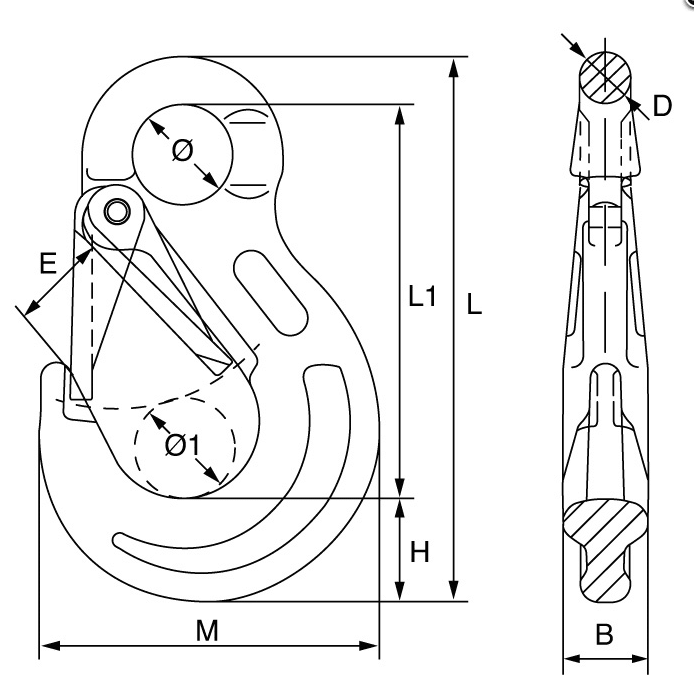
The eye sling hook is the standard termination for a chain sling leg. The eye takes a coupling link or component connector, the throat takes the load, and the spring-loaded safety catch prevents the load slipping off the hook nose when the sling goes slack. Manufactured from Grade 10 alloy steel to BS EN 1677-2 with a 25% capacity uplift over Grade 8, in the Cobra Plus blue finish, for chain sizes 6 mm through 32 mm.
Key Features
- Safety catch fitted as standard: The sprung catch closes across the throat and stops the load coming off when tension is released. This is the moment most sling accidents happen, as the load lands and the leg goes slack.
- Grade 10 alloy steel: Meets the Working Load Limit performance requirements of BS EN 1677-2 plus 25% of loads, giving materially more capacity than the same hook in Grade 8.
- Eye termination: The closed eye connects via coupling link or component connector, making the hook replaceable without rebuilding the sling.
- Wide throat opening: Dimension Ø runs from 20.5 mm on the 6 mm size to 81.5 mm on the 32 mm, so the hook accepts substantial lifting points and shackle bows.
- Nine chain sizes: 6, 8, 10, 13, 16, 20, 22, 26 and 32 mm.
- Full traceability marking: Marked with material grade, manufacturer's identification, size, product ID mark and traceability code.
Technical Specifications
| Product Code |
Chain Dia (mm) |
B (mm) |
d (mm) |
E (mm) |
H (mm) |
L (mm) |
L1 (mm) |
M (mm) |
Ø (mm) |
Ø1 (mm) |
| G100ESH6 |
6 |
16.5 |
10 |
18.5 |
21 |
111 |
80 |
68 |
20.5 |
20 |
| G100ESH8 |
8 |
17 |
11 |
25.5 |
27 |
137 |
99 |
87 |
25 |
26.4 |
| G100ESH10 |
10 |
24 |
16 |
29.5 |
33 |
170 |
120 |
105 |
35 |
30 |
| G100ESH13 |
13 |
33 |
19 |
38 |
43.5 |
219 |
154 |
133 |
43 |
40 |
| G100ESH16 |
16 |
40 |
24.5 |
44 |
50 |
260 |
185.5 |
158 |
51 |
50 |
| G100ESH20 |
20 |
48 |
27 |
50 |
56 |
298 |
215 |
190 |
55 |
63 |
| G100ESH22 |
22 |
50 |
29 |
64 |
62 |
330 |
239 |
214 |
60 |
70 |
| G100ESH26 |
26 |
60 |
35 |
70 |
75 |
376 |
265 |
245 |
70 |
77 |
| G100ESH32 |
32 |
71 |
39 |
82 |
89 |
458 |
331 |
270 |
81.5 |
77 |
All dimensions in millimetres. Ø is the throat opening. Working Load Limits by chain size are given on the specification sheet below. The 26 mm and 32 mm sizes are available to order.
BS EN 1677-2 | Grade 10 | +25% Over Grade 8 | LOLER Ready
Manufactured from Grade 10 alloy steel and meeting the Working Load Limit performance requirements of BS EN 1677-2 plus 25% of loads. Each hook is marked with material grade, manufacturer's identification, size, product ID mark and traceability code, and supplied with a certificate. Under LOLER 1998, lifting accessories require thorough examination by a competent person at intervals not exceeding 12 months, or 6 months where used to lift persons.
Suitable Applications
The eye sling hook is the general purpose termination for chain slings across construction, plant maintenance, steel fabrication, quarrying and general engineering. It suits single and multi-leg chain slings, direct attachment to lifting eyes, shackles and padeyes, and any lift where the hook must be attached and detached repeatedly. The safety catch makes it the right choice wherever the sling may go slack while still attached, which covers most landing and positioning work. Where a positively locking termination is required, or where the hook cannot be observed during the lift, a self locking hook is the better choice.
More About This Product
Shackles are the most-handled component in any lifting operation, and that is precisely why they wear out first. A sling gets rigged and derigged; a shackle gets rigged, derigged, dropped, driven over, thrown into a box and picked up by whoever needs one. Most lifting gear fails from a single overload; shackles fail from accumulated inattention.
The grade markings matter more than most people realise. A Grade 6 high tensile shackle to BS EN 13889 and a Grade 8 alloy shackle look similar and share the same body shape, but the alloy version carries considerably more at the same size. Once a shackle is in a box with fifty others, the only way to tell them apart is the marking — which is why an unmarked shackle has to be scrapped no matter how good it looks.
Understanding the Load Path
A shackle has two distinct load-bearing elements and they do different jobs. The bow takes the sling; the pin takes the load. Reverse that — put the sling on the pin and the load on the bow — and two things happen. The sling bears on a smaller radius than it was designed for, and any movement in the sling starts to rotate the pin.
On a screw collar pin that rotation is the failure mechanism. A sling shifting under a settling load, or vibration transmitted from plant nearby, will slowly unscrew the pin over minutes or hours. It rarely happens quickly enough for anyone to see it happening.
The second consideration is angle. A shackle loaded in line with the pin carries its full rating. Loaded at an angle across the bow it carries substantially less, and published derating tables cover a limited range of angles — beyond that range no figure is published because none applies. On a multi-leg sling every leg is at an angle by definition, which is why the bow shackle exists and why putting a multi-leg sling into a dee shackle is a genuine mistake rather than a preference.
How to Use the Eye Sling Hook
- Match to the chain size: Select by nominal chain diameter. A G100ESH13 is for 13 mm Grade 10 chain.
- Check the safety catch works: Before every lift, confirm the catch springs fully closed across the throat and is not bent, missing or seized.
- Seat the load in the throat: The load bears in the throat, not on the tip. Tip loading dramatically reduces capacity and is a common cause of hook failure.
- Never load the safety catch: The catch retains the load, it does not carry it. Any load bearing on the catch means the hook is wrongly engaged.
- Watch the sling angle: On multi-leg slings, wider included angles increase the load in each leg above the share of the mass being lifted.
- Do not modify: Never weld, heat, machine, drill or repaint a Grade 10 hook.
Warning: Never tip load a sling hook. Never use a hook with a missing, damaged or seized safety catch. Never exceed the Working Load Limit for the chain size, and derate for sling angle on multi-leg assemblies.
Safety Information
- Use only with Grade 10 chain and components of the matching size.
- The load must bear in the throat of the hook, never on the tip.
- The safety catch retains the load, it does not carry it. Never allow load to bear on the catch.
- Withdraw from service any hook with a missing, bent or seized safety catch.
- Withdraw any hook showing throat opening, distortion, cracks, wear beyond the manufacturer’s stated limit of original dimensions or illegible marking.
- Never weld, heat treat, machine or repaint. Repainting conceals cracks and wear.
- Do not use above +200 °C or below -20 °C.
- Thorough examination by a competent person required at intervals not exceeding 12 months under LOLER 1998.
Inspection and Maintenance
Throat opening is the measurement that matters on a sling hook, and it is the one most often skipped. A hook that has been overloaded opens gradually at the throat, which is not obvious by eye but is immediately apparent when measured against the original dimension. Record the throat opening at first use and check it at each thorough examination. Beyond that, inspect the safety catch for spring tension and free movement, the throat and tip for gouges and wear, the eye for elongation where the coupling link bears, and the marking for legibility. Withdraw anything worn beyond 10% of original dimensions. Safety catches are replaceable as a spare part, so a hook with a damaged catch need not be scrapped, but the replacement must be the correct part for the hook.
Frequently Asked Questions
Q: Eye sling hook or clevis sling hook?
The eye version connects through a coupling link or component connector, which adds a component but makes the hook easy to replace. The clevis version connects directly to the chain end link with a pin, giving a shorter, lighter termination with one fewer part. Clevis is more compact, eye is more flexible for reconfiguring assemblies.
Q: What is the difference between a sling hook and a self locking hook?
A sling hook has a sprung safety catch that stops the load falling off when the sling goes slack, but the catch can be pushed open. A self locking hook has a mechanism that positively locks closed under load and can only be released deliberately with the load removed. Use self locking where the hook is out of sight during the lift or where accidental release would be serious.
Q: Can I replace a damaged safety catch?
Yes, catch kits are available as spare parts and replacing one does not scrap the hook. It must be the correct kit for the hook size and grade. A hook running without a catch, or with a catch from a different hook, should be withdrawn until correctly fitted.
Q: How do I know if the hook has been overloaded?
Measure the throat opening against the original dimension. Overloading stretches the hook open, and a measurable increase means it has been loaded beyond its limit even if it looks serviceable. This is why recording the original throat opening at first use is worth the two minutes it takes.
Q: Why are the 26 mm and 32 mm sizes not priced?
They are available to order rather than held in stock. Contact us with your requirement and we will confirm price and lead time.