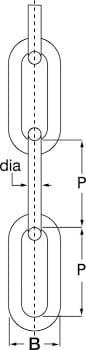
Commercial quality long link chain in mild steel, dimensioned generally to DIN 763. The long link form gives a lighter, more open chain than short link for the same bar diameter, which makes it easier to handle, quicker to feed through fittings and less prone to jamming. Available in six sizes from 5 mm to 16 mm, each offered self colour or hot dipped galvanised, and sold by the metre.
Key Features
- Long link form to DIN 763: Longer pitch than short link chain of the same bar diameter, giving fewer links per metre, lower weight and easier handling.
- Two finishes: Self colour for indoor and dry use, hot dipped galvanised for outdoor, coastal and wet service. Product codes differ by finish, so specify which you need when ordering.
- Six sizes: 5 mm, 7 mm, 8 mm, 10 mm, 12 mm and 16 mm nominal bar diameter.
- Open link profile: The longer link accepts hooks, shackles and fittings more readily than short link chain, and feeds more freely through guides and sprockets.
- Hot dipped galvanised option: Full immersion galvanising rather than electroplating, giving substantially better outdoor life than a zinc plated chain.
- Sold by the metre: Weight per metre is quoted for each size, from 0.43 kg on the 5 mm through to 5.9 kg on the 16 mm.
Technical Specifications
| Product Code (Self Colour) |
dn (Galvanised) |
P (mm) |
B (mm) |
Weight (mm) |
(kgs/mtr) |
| CMSCLLSC5 |
CMSCLLG5 |
5 |
35 |
20 |
0.43 |
| CMSCLLSC7 |
CMSCLLG7 |
7 |
49 |
28 |
0.86 |
| CMSCLLSC8 |
CMSCLLG8 |
8 |
52 |
32 |
1.1 |
| CMSCLLSC10 |
CMSCLLG10 |
10 |
65 |
40 |
1.75 |
| CMSCLLSC12 |
CMSCLLG12 |
12 |
78 |
48 |
2.95 |
| CMSCLLSC16 |
CMSCLLG16 |
16 |
100 |
64 |
5.9 |
dn is nominal bar diameter, P is internal link pitch, B is external link width. No Working Load Limit is published because this chain is not proof tested and is not a lifting product.
Commercial Quality — Not For Lifting
This chain is commercial quality mild steel. It is not proof tested, carries no Working Load Limit and is not certified as a lifting accessory. It must not be used for lifting, load restraint in transit, overhead suspension of loads, or any application where failure could cause injury or damage. For lifting, use a certified Grade 8, Grade 80 or Grade 10 alloy chain to BS EN 818. WOLFF Onsite supplies certified lifting chain across all three grades.
Suitable Applications
Commercial long link chain is general purpose hardware. It suits fencing, gates and barriers, animal tethering and agricultural work, boat mooring and general marine use in the galvanised finish, guard chains and safety barriers on plant and machinery, drainage grating and manhole cover retention, garden and landscaping features, decorative and architectural applications, and any general fastening or containment role where no rated capacity is needed. Where the chain must restrain, suspend or lift a load whose failure would cause harm, a certified lifting or lashing chain is required instead.
More About This Product
Shackles are the most-handled component in any lifting operation, and that is precisely why they wear out first. A sling gets rigged and derigged; a shackle gets rigged, derigged, dropped, driven over, thrown into a box and picked up by whoever needs one. Most lifting gear fails from a single overload; shackles fail from accumulated inattention.
The grade markings matter more than most people realise. A Grade 6 high tensile shackle to BS EN 13889 and a Grade 8 alloy shackle look similar and share the same body shape, but the alloy version carries considerably more at the same size. Once a shackle is in a box with fifty others, the only way to tell them apart is the marking — which is why an unmarked shackle has to be scrapped no matter how good it looks.
Understanding the Load Path
A shackle has two distinct load-bearing elements and they do different jobs. The bow takes the sling; the pin takes the load. Reverse that — put the sling on the pin and the load on the bow — and two things happen. The sling bears on a smaller radius than it was designed for, and any movement in the sling starts to rotate the pin.
On a screw collar pin that rotation is the failure mechanism. A sling shifting under a settling load, or vibration transmitted from plant nearby, will slowly unscrew the pin over minutes or hours. It rarely happens quickly enough for anyone to see it happening.
The second consideration is angle. A shackle loaded in line with the pin carries its full rating. Loaded at an angle across the bow it carries substantially less, and published derating tables cover a limited range of angles — beyond that range no figure is published because none applies. On a multi-leg sling every leg is at an angle by definition, which is why the bow shackle exists and why putting a multi-leg sling into a dee shackle is a genuine mistake rather than a preference.
How to Use Commercial Long Link Chain
- Confirm the application is non-lifting: This chain has no rated capacity. Satisfy yourself that failure would not cause injury or significant damage before use.
- Choose the finish for the environment: Self colour will rust rapidly outdoors and should be kept to dry indoor use or painted. Hot dipped galvanised is the correct choice for anything exposed to weather.
- Size by link dimensions, not strength: Select using bar diameter, pitch and width against the fittings and guides the chain must pass through, since strength is not declared.
- Cut cleanly: Cut with a chain cutter, angle grinder or bolt croppers. Grind any burrs flush so the chain does not snag or cut hands in use.
- Use compatible fittings: Connect with commercial quality quick links, shackles or connecting links sized to the bar diameter. Do not mix commercial chain with rated lifting fittings, as it invites the assembly being mistaken for lifting equipment.
- Avoid shock and abrasion: Mild steel chain has limited toughness. Avoid arrangements that impose sudden shock loading or drag the chain over sharp edges.
Warning: This chain must not be used for lifting applications. It is not proof tested, has no Working Load Limit and is not certified under LOLER. Never use commercial quality chain to lift, suspend or restrain a load overhead, or to secure a load for transport.
Safety Information
- Not to be used for lifting applications under any circumstances.
- No Working Load Limit is declared. Do not estimate or assume a capacity.
- Do not use for load restraint in transit, where a rated lashing chain to EN 12195 is required.
- Do not use overhead or above personnel.
- Do not weld, heat treat or attempt to harden mild steel chain.
- Do not mix with certified lifting components in the same assembly.
- Self colour chain corrodes quickly outdoors. Use galvanised or protect with paint.
- Inspect for stretched, opened, cracked or heavily corroded links and replace affected lengths.
Inspection and Maintenance
Commercial chain requires no formal examination regime, since it is not a lifting accessory, but sensible periodic checks extend its life considerably. Look for links that have stretched or opened, weld points that show cracking, and corrosion that has begun to reduce bar diameter rather than merely discolour the surface. Self colour chain in outdoor use should be oiled or painted, and will still need replacing far sooner than galvanised. Galvanised chain lasts well but should be checked where it passes through guides or over edges, since the coating wears through at contact points first and corrosion then starts locally. Replace any length showing distorted links rather than cutting out and rejoining, as a commercial chain repaired with a connecting link is only as strong as the link.
Frequently Asked Questions
Q: What is the difference between long link and short link chain?
The link pitch. For the same bar diameter, long link chain to DIN 763 has a longer, more open link than short link chain to DIN 766. Long link is lighter per metre, easier to handle and passes fittings more readily. Short link is more compact, more flexible around small radii and works better through sprockets and narrow guides. For general fencing, tethering and barrier work, long link is usually the more economical choice.
Q: Why can I not use this for lifting?
Lifting chain must be alloy steel, heat treated, proof tested, individually certified and marked, and manufactured to BS EN 818. This chain is untested commercial mild steel with none of those things, so there is no basis on which to determine a safe load, and using it as a lifting accessory would breach LOLER. Our Grade 8, Grade 80 and Grade 10 chains are the correct products for lifting.
Q: Should I order self colour or galvanised?
Self colour is bare steel and will begin to rust within days outdoors, so it suits dry indoor use or applications where it will be painted. Hot dipped galvanised carries a thick zinc coating applied by immersion and will give years of service outdoors, including coastal and marine environments. The price difference is modest against the difference in life, so galvanised is usually worth it for anything exposed.
Q: What does "sizes generally to DIN 763" mean?
The chain is dimensioned to match DIN 763 long link sizes so it fits fittings and guides designed around that standard. It is not certified to DIN 763 as a performance standard, and the phrase "generally to" reflects that this is a dimensional reference rather than a compliance claim.
Q: How is it supplied?
By the metre, cut from reels. Weight per metre is given in the specification table so you can calculate the total weight of a run before ordering, which matters for both delivery and for whatever the chain is being fixed to.