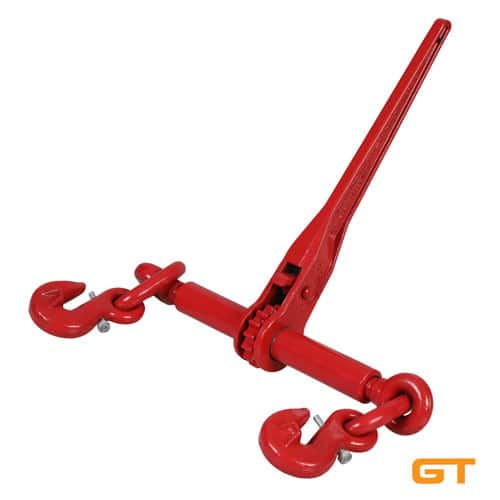
Securing a load on a vehicle is a different discipline from lifting one, governed by a different standard and expressed in different units. A loadbinder tensions a chain over a load and holds it there; what matters is Lashing Capacity rather than Working Load Limit, and BS EN 12195-3 rather than the lifting standards.
This is the range that meets that standard properly. **Marked with both L.C. and M.B.F.** — Lashing Capacity and Minimum Breaking Force — where the standard loadbinders carry only an L.C. mark. Fitted with **reinforced grab hooks complete with safety securing pins**, which stop a hook jumping off the chain when the load settles and the tension momentarily drops. That happens on the road far more than people expect.
Key Features
- BS EN 12195-3 compliant: The European standard for chain lashing assemblies, which increasingly matters for cross-border haulage and for demonstrating compliance in an inspection.
- Reinforced grab hooks with safety securing pins: The pin retains the hook on the chain if tension drops momentarily, which is when a plain grab hook can jump free.
- Marked with L.C. and M.B.F.: Lashing Capacity and Minimum Breaking Force both marked, as the standard requires.
- Thread securing device: Prevents the threads winding fully out and the binder coming apart.
- 169 mm take-up: Enough travel to tension a chain properly and retension after the load settles.
- Ratchet action: Controlled, progressive tensioning rather than the sudden throw of a lever binder.
- Four sizes: 8, 10, 13 and 16 mm chain.
Technical Specifications
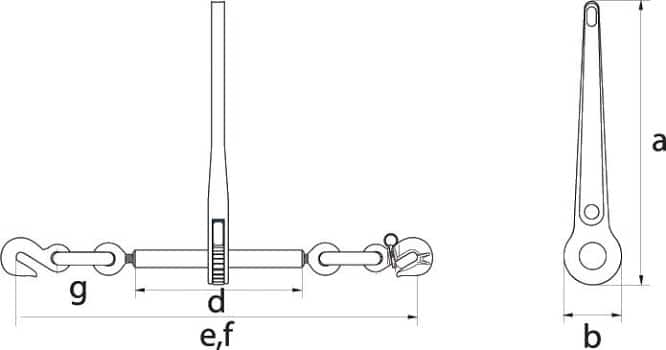
| Product Code |
Chain (mm) |
A (mm) |
B (mm) |
C (mm) |
d (mm) |
E (mm) |
F (mm) |
G (mm) |
Take-up (mm) |
List |
| LBREN8 |
8 |
355 |
66 |
16 |
252 |
742 |
573 |
11 |
169 |
£35.47 |
| LBREN10 |
10 |
355 |
66 |
16 |
252 |
789 |
620 |
13 |
169 |
£40.38 |
| LBREN13 |
13 |
355 |
66 |
16 |
252 |
— |
— |
— |
169 |
£53.13 |
| LBREN16 |
16 |
355 |
66 |
16 |
252 |
— |
— |
— |
169 |
£84.54 |
Lashing Capacity by size is marked on each binder and given in the safety information sheet.
BS EN 12195-3 | LOAD RESTRAINT — NOT LIFTING | L.C. and M.B.F. Marked
Meets the performance requirements of BS EN 12195-3 for chain lashing assemblies. Loadbinders are load restraint equipment and must never be used for lifting. They are rated in Lashing Capacity, not Working Load Limit, and the two are not interchangeable. Marked with L.C., M.B.F., manufacturer's identification, size and product ID mark.
Suitable Applications
Used for securing loads on vehicles and trailers: plant and machinery transport, steel and structural sections, containers and skips, timber and pipe loads, and any cargo restrained with chain rather than webbing. The BS EN 12195-3 compliance matters particularly for operators subject to inspection or working across Europe, where demonstrating that the lashing assembly meets the standard is part of the paperwork rather than an afterthought.
More About This Product
Textile slings are the most-used lifting accessory on most sites and the one most casually treated. They are light, cheap relative to chain, and forgiving of handling — right up until they are not. The failure mode is a cut, and a cut can be introduced in a second and go unnoticed until the sling is under load.
That is why the safety factor is 7:1 rather than the 4:1 used on chain fittings. Steel wears gradually and visibly; textile is either intact or damaged, and the transition can happen in one lift against a sharp corner. The higher factor is not generosity, it is an acknowledgement of how these things actually fail.
Hitch Configurations and What They Do to Capacity
The Working Load Limit marked on a sling is for a straight vertical lift. Every other configuration changes it, and two of them change it in opposite directions.
Choke hitch — passing the sling through its own eye around the load — grips well and stops the load sliding, but it pinches the sling at the choke point and reduces capacity against the vertical rating — the sling’s own label gives the choke figure. It is the most common hitch and the most commonly forgotten derating.
Basket hitch — both eyes on the hook with the sling passing under the load — puts two legs under the load and can carry more than the vertical rating when the legs are truly vertical — the sling label gives the basket figure. As soon as the legs angle inwards that advantage falls away, and at a wide enough angle the basket carries no more than a single vertical leg.
Multi-leg configurations follow the same geometry. The included angle is what matters, not the number of legs, and wide angles are the commonest cause of overload on a sling set that has been correctly specified in every other respect.
The sling label carries the figures for each configuration. It is worth reading before the lift rather than after.
How to Use the Loadbinder
- Never use for lifting: This is restraint equipment rated in Lashing Capacity. It has no Working Load Limit and must not be used in a lifting application.
- Match the binder to the chain size: 8, 10, 13 or 16 mm.
- Engage the grab hooks and fit the safety pins: The pins are the reason to buy this version. Use them.
- Tension progressively: Ratchet the binder up steadily rather than in sudden pulls.
- Re-check after the first few miles: Loads settle and tension drops. Retension before continuing.
- Do not extend the handle: The ratchet handle is sized for the binder. Adding leverage over-tensions the chain.
Warning: Loadbinders are for load restraint only and must never be used for lifting. Never extend the ratchet handle to increase tension. Always fit the safety securing pins on the grab hooks.
Safety Information
- Load restraint only. Never use for lifting.
- Rated in Lashing Capacity, not Working Load Limit.
- Match the binder to the chain diameter.
- Fit the safety securing pins on both grab hooks.
- Never extend the handle to increase leverage.
- Retension after the load has settled.
- Withdraw any binder with a damaged thread, distorted hooks or a faulty ratchet.
- Never weld, heat treat or modify.
- Inspect before every use.
Inspection and Maintenance
The thread and the ratchet mechanism are the wear items. Wind the binder through its full travel and confirm it runs smoothly with no binding, stripping or slipping, and check the securing device that prevents the threads winding out is intact. Inspect both grab hooks for throat opening, wear and distortion, and confirm the safety securing pins are present and function. Look for bending in the frame, which indicates over-tensioning, usually from someone extending the handle. Keep the thread clean and lightly oiled, since a binder used in road salt will seize otherwise.
Downloads
Frequently Asked Questions
Q: Can I use a loadbinder for lifting?
No, never. Loadbinders are restraint equipment rated in Lashing Capacity, which is not a Working Load Limit and is not calculated the same way. They are not certified as lifting accessories and using one to lift is both unsafe and outside any certification you hold.
Q: What is the difference between L.C. and W.L.L.?
Lashing Capacity is the maximum force a restraint component may be tensioned to in service. Working Load Limit is the maximum load a lifting accessory may carry. They are derived differently, apply to different standards, and are not interchangeable in either direction.
Q: Why choose the EN version over the standard ratchet binder?
BS EN 12195-3 compliance, M.B.F. marking as well as L.C., and reinforced grab hooks with safety securing pins. If you are subject to inspection, working across Europe, or simply want the hooks retained when tension drops, the EN version is worth the few pounds difference.
Q: Why do the hooks need securing pins?
Because a grab hook holds by tension. When a load settles on the road and tension momentarily drops, a plain grab hook can jump off the chain and the restraint is lost without anyone knowing until the next check. The pin retains it.