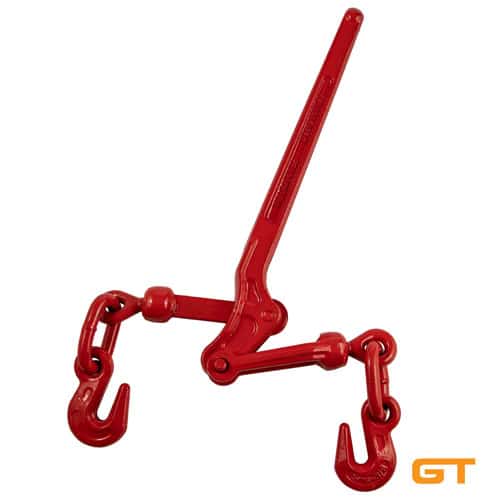
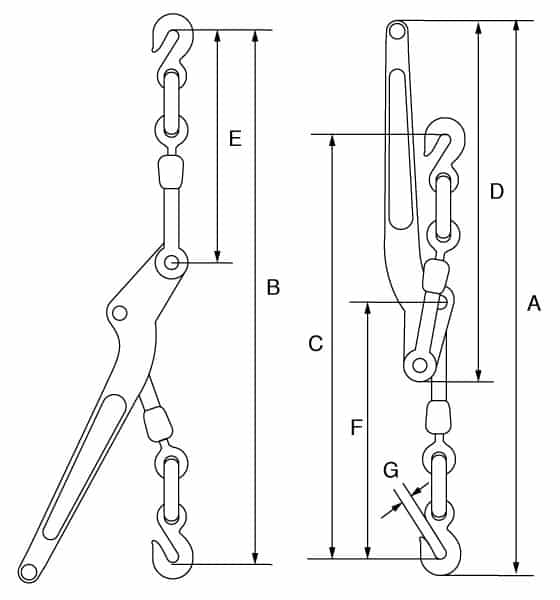
The choice between a lever and a lever loadbinder comes down to how the tension goes on and how it comes off, and both matter more than they sound.
A **ratchet binder** tensions progressively, a click at a time, and releases the same way. You can feel what you are doing and stop where you want. Releasing is controlled, which matters because a chain under several tonnes of tension holds a lot of stored energy.
A **lever binder** throws the tension on in one movement. It is faster, and hauliers who bind loads all day often prefer it. It is also the one that catches people out: a lever binder released carelessly whips its handle back, and that handle is 470 to 794 mm long. Injuries from lever binder handles are common enough that many operators have moved to ratchets for that reason alone.
Key Features
- Progressive ratchet tensioning: Controlled application and, more importantly, controlled release.
- 155 to 170 mm take-up: Enough travel to tension and retension after settling.
- Drop forged, quenched and tempered: Carbon steel, forged rather than fabricated.
- Grab hooks fitted: Ready to use on chain.
- Thread securing device: Prevents the threads winding fully out.
- Three chain ranges: 8–10 mm, 10–13 mm and 13–16 mm, each covering two chain sizes.
- Marked with L.C.: Lashing Capacity, manufacturer's identification, size and product ID mark.
Technical Specifications
| Code |
Type |
Chain |
A (mm) |
d (mm) |
Take-up (mm) |
List |
| LBR810 |
Ratchet |
8–10 mm |
355 |
254 |
170 |
£34.07 |
| LBR1013 |
Ratchet |
10–13 mm |
355 |
254 |
170 |
£36.97 |
| LBR1316 |
Ratchet |
13–16 mm |
355 |
254 |
155 |
£46.69 |
| LBDF68 |
Lever |
1/4–5/16" |
470 |
290 |
95 |
enquire |
| LBDF810 |
Lever |
5/16–3/8" |
630 |
406 |
114 |
£26.99 |
| LBDF1012 |
Lever |
3/8–1/2" |
715 |
475 |
114 |
£43.03 |
| LBDF1316 |
Lever |
1/2–5/8" |
794 |
533 |
120 |
enquire |
Note the lever binders are sized in inches and the ratchet binders in millimetres. The lever binders also offer more take-up: 155–170 mm against 95–120 mm.
LOAD RESTRAINT ONLY — NOT LIFTING | Marked with Lashing Capacity
Drop forged, quenched and tempered. Marked with L.C., manufacturer's identification, size and product ID mark. Loadbinders are load restraint equipment and must never be used for lifting. They are rated in Lashing Capacity, not Working Load Limit. For BS EN 12195-3 compliance, see the LBREN range.
Suitable Applications
Both types secure loads on vehicles and trailers: plant and machinery transport, steel sections, containers, timber and pipe. The choice is practical rather than technical. Ratchet binders suit anyone who values controlled release and works with high tensions; lever binders suit high-volume work where speed matters and the operator is experienced with them. Where BS EN 12195-3 compliance is required, neither of these ranges meets it and the LBREN range is needed.
More About This Product
Textile slings are the most-used lifting accessory on most sites and the one most casually treated. They are light, cheap relative to chain, and forgiving of handling — right up until they are not. The failure mode is a cut, and a cut can be introduced in a second and go unnoticed until the sling is under load.
That is why the safety factor is 7:1 rather than the 4:1 used on chain fittings. Steel wears gradually and visibly; textile is either intact or damaged, and the transition can happen in one lift against a sharp corner. The higher factor is not generosity, it is an acknowledgement of how these things actually fail.
Hitch Configurations and What They Do to Capacity
The Working Load Limit marked on a sling is for a straight vertical lift. Every other configuration changes it, and two of them change it in opposite directions.
Choke hitch — passing the sling through its own eye around the load — grips well and stops the load sliding, but it pinches the sling at the choke point and reduces capacity against the vertical rating — the sling’s own label gives the choke figure. It is the most common hitch and the most commonly forgotten derating.
Basket hitch — both eyes on the hook with the sling passing under the load — puts two legs under the load and can carry more than the vertical rating when the legs are truly vertical — the sling label gives the basket figure. As soon as the legs angle inwards that advantage falls away, and at a wide enough angle the basket carries no more than a single vertical leg.
Multi-leg configurations follow the same geometry. The included angle is what matters, not the number of legs, and wide angles are the commonest cause of overload on a sling set that has been correctly specified in every other respect.
The sling label carries the figures for each configuration. It is worth reading before the lift rather than after.
How to Use the Loadbinder
- Never use for lifting. Restraint equipment rated in Lashing Capacity.
- Match the binder to the chain size.
- Tension progressively: On a lever, click by click. On a lever, be ready for the throw.
- Release with control, especially on a lever binder: Stand clear of the handle path. A released lever handle moves fast and travels a long way.
- Retension after settling: Check after the first few miles.
- Never extend the handle: On either type. Over-tensioning bends the frame and damages the chain.
Warning: Lever type loadbinders store considerable energy and the handle can whip back on release, causing serious injury. Stand clear of the handle path and release under control. Never extend the handle on either type. Never use a loadbinder for lifting.
Safety Information
- Load restraint only. Never use for lifting.
- Rated in Lashing Capacity, not Working Load Limit.
- Stand clear of the handle path when releasing a lever binder.
- Match the binder to the chain diameter.
- Never extend the handle to increase leverage.
- Retension after the load has settled.
- Withdraw any binder with a bent frame, damaged thread, distorted hooks or a faulty ratchet.
- Never weld, heat treat or modify.
- Inspect before every use.
Inspection and Maintenance
Check the thread runs smoothly through its full travel with no binding or stripping, and confirm the securing device preventing the threads winding out is intact. On a lever binder, test that the pawl engages positively at every click and that the release operates cleanly, since a lever that slips under load is dangerous. On a lever binder, check the over-centre action and the handle for bending, which is the clearest sign someone has extended it. Inspect both grab hooks for throat opening and wear. Keep threads clean and oiled against road salt.
Downloads
Frequently Asked Questions
Q: Ratchet or lever?
Ratchet for controlled tensioning and, more importantly, controlled release. Lever for speed, if the operator is experienced. The safety case favours the ratchet: a lever binder handle released carelessly whips back hard and the handles are 470 to 794 mm long. Many operators have moved to ratchets for that reason.
Q: Do I need the BS EN 12195-3 version?
If you are subject to inspection, working across Europe, or want the M.B.F. marking and safety securing pins on the grab hooks, yes. The LBREN range meets the standard; these do not. The difference is a few pounds per binder.
Q: Why do the ratchet binders have more take-up?
155 to 170 mm against 95 to 120 mm on the levers. More take-up means more room to tension a chain that has settled, so you can retension without re-rigging. On a long haul with a settling load that matters.
Q: Can I use a loadbinder to lift?
No. Loadbinders are rated in Lashing Capacity for restraint, not Working Load Limit for lifting, and they are not certified as lifting accessories. It is one of the more common misuses of transport equipment and it is not a grey area.