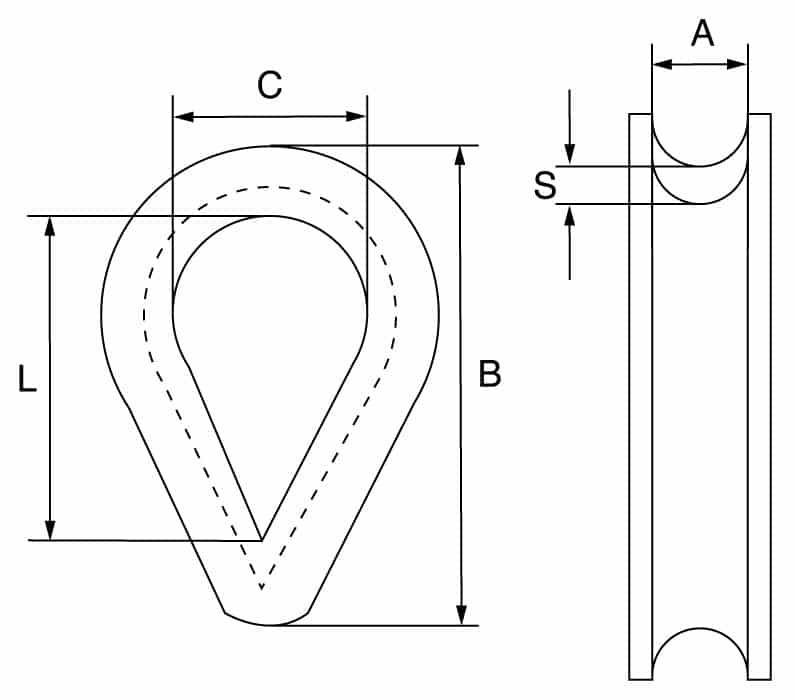
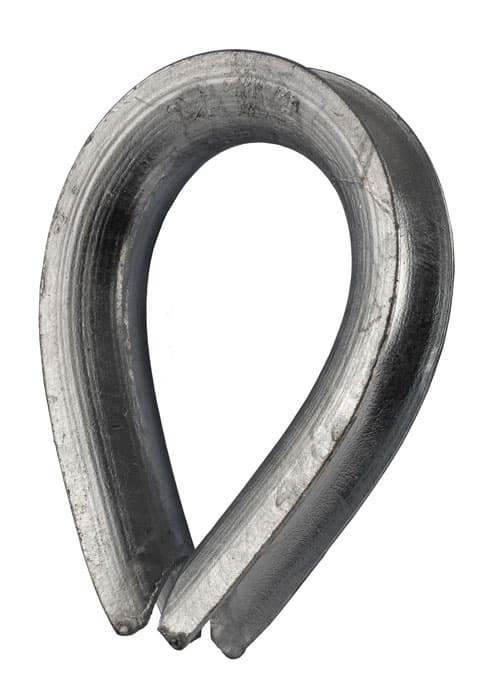
The commercial thimble does the same job as a lifting thimble — protecting a rope eye from crushing and wear — in general, non-lifting work. It suits both wire and fibre rope, comes in 17 sizes from 4 mm, and starts at 20p.
**It must not be used in lifting applications.** GT state that explicitly, and it is the whole basis of the distinction between this range and the TBS and TUS thimbles. Those meet BS EN 13411-1; this one does not. The products look similar, sit next to each other in the same category, and cost roughly half as much — so the difference is worth being deliberate about.
For anything that lifts a load, buy TBS or TUS. For a fence line, a fibre rope eye, a tensioned cable that carries nothing but itself, this range is correct and cheaper.
Key Features
- Suits wire and fibre ropes: Wider application than the lifting thimbles, which are for wire rope.
- 17 sizes from 4 mm: Including smaller sizes than the lifting range offers.
- Electro galvanised: Corrosion protection appropriate to general use, though less durable than the hot dipped finish on the lifting range.
- From 20p: Roughly half the cost of the equivalent lifting thimble.
- Protects the rope eye: Same function, same benefit, in non-lifting service.
Technical Specifications
| Product Code |
Rope Dia (mm) |
A (mm) |
B (mm) |
C (mm) |
D (mm) |
E (mm) |
Weight (kgs/100) |
| TC4 |
4 |
30 |
21 |
13 |
7 |
4 |
0.4 |
| TC5 |
5 |
33 |
23 |
14 |
8 |
5 |
0.8 |
| TC6 |
6 |
39 |
25 |
16 |
10 |
6 |
1.4 |
| TC7 |
7 |
43 |
28 |
18 |
11 |
7 |
1.8 |
| TC8 |
8 |
51 |
38 |
24 |
12 |
8 |
2.8 |
| TC10 |
10 |
54 |
46 |
30 |
14 |
10 |
4.8 |
| TC12 |
12 |
76 |
57 |
38 |
18 |
12 |
8 |
| TC14 |
14 |
82 |
60 |
40 |
20 |
14 |
10 |
| TC16 |
16 |
89 |
64 |
42 |
22 |
16 |
15 |
| TC18 |
18 |
102 |
69 |
45 |
26 |
18 |
22 |
| TC20 |
20 |
115 |
79 |
51 |
28 |
20 |
25 |
| TC22 |
22 |
127 |
89 |
54 |
30 |
22 |
32 |
| TC24 |
24 |
140 |
102 |
64 |
34 |
26 |
46 |
| TC26 |
26 |
152 |
105 |
64 |
34 |
28 |
66 |
| TC28 |
28 |
165 |
115 |
73 |
38 |
30 |
77 |
| TC30 |
30 |
178 |
121 |
79 |
44 |
32 |
80 |
| TC32 |
32 |
203 |
133 |
93 |
46 |
34 |
130 |
For lifting applications use the TBS range (BS EN 13411-1) or TUS range (BS EN 13411-1 and US Fed. Spec. FF-T 276-b type 3).
NOT FOR LIFTING APPLICATIONS | For Wire and Fibre Ropes | Electro Galvanised
Mild steel, electro galvanised. Suitable for wire and fibre ropes in general applications. This thimble is not for use in lifting applications. Where a thimble is required in a lifting assembly, specify the TBS or TUS ranges which meet BS EN 13411-1.
Suitable Applications
General rope work where nothing is being lifted: fencing and barrier lines, fibre rope eyes, guy lines on non-load-bearing structures, agricultural and marine general work, tensioned cables carrying only their own weight, and decorative or architectural wire work. Wherever a rope eye needs protecting but the assembly is not a lifting accessory.
More About This Product
Wire rope terminations are where most of a wire rope assembly's cost and nearly all of its risk sits. The rope itself is a commodity; the termination is where craft is involved and where efficiency is either preserved or thrown away.
The numbers are worth knowing. A properly made swaged or spelter termination retains close to the rope's full breaking load. A correctly fitted wedge socket retains a high proportion. A gripped termination with the right number of grips, correctly spaced and torqued, retains rather less — and a gripped termination done carelessly retains very little indeed. The rope has not changed; the termination has.
Termination Efficiency and the Thimble's Job
Efficiency is the proportion of the rope's breaking load a termination preserves, and it varies more than most people expect. That is why a lifting sling is swaged in a workshop and a guy wire is gripped in the field — the applications tolerate different efficiencies.
On a gripped termination three things determine the result and all three are commonly got wrong. The number of grips rises with rope diameter and is specified, not estimated. The spacing is specified by the manufacturer and set out in the instruction sheet. The torque must be applied and then reapplied after the assembly has been loaded once, because wire rope beds down under first load and grips that were tight become loose. A gripped termination inspected a week after fitting and never retorqued is a common finding.
And the orientation: saddle on the live rope, U-bolt on the dead tail. Reversed, the U-bolt crushes the part of the rope carrying the load. The rigger's phrase is never saddle a dead horse, and it exists because the mistake is easy to make and hard to see afterwards.
The thimble does a different job. Without one, a rope eye bends around the pin at a radius far tighter than the rope tolerates, and is crushed between pin and load. The thimble holds the eye at an acceptable radius and takes the bearing itself. A flattened thimble at inspection means the eye has been carrying load it was never meant to.
How to Use the Commercial Thimble
- Confirm the application is not lifting: If anything is being raised or suspended, this is the wrong thimble.
- Match the thimble to the rope size: 4 mm to 26 mm.
- Seat the rope fully in the groove: All the way round.
- Secure the eye correctly: Ferrule, splice or the correct number of grips.
- Consider the finish: Electro galvanising is less durable than hot dipped. For exposed outdoor work, the hot dipped TBS may last considerably longer even in a non-lifting role.
Warning: This thimble is not for lifting applications. It does not meet BS EN 13411-1. For any assembly that lifts or suspends a load, use the TBS or TUS lifting grade thimbles.
Safety Information
- Not for use in lifting applications.
- Match the thimble size to the rope.
- The rope must seat fully in the groove.
- Replace any thimble that is distorted, cracked or has worked loose.
- For lifting applications, use TBS or TUS thimbles meeting BS EN 13411-1.
Inspection and Maintenance
Check the thimble remains seated in the eye and has not worked loose. Inspect for distortion at the crown and cracking at the point of maximum curvature. Electro galvanising breaks down faster than hot dipped, so on outdoor assemblies check for rust staining and undercutting of the coating, and consider whether a hot dipped thimble would give better service life even in a non-lifting role.
Downloads
Frequently Asked Questions
Q: Why can I not use this for lifting?
Because it does not meet BS EN 13411-1, the standard for thimbles in lifting applications. GT state explicitly that it is not for lifting use. The TBS and TUS ranges are the lifting grade equivalents and cost roughly twice as much, which on a component costing pence is not a reason to compromise.
Q: How do I tell them apart once fitted?
You largely cannot, which is the problem. Keep them separated in stores and buy by code rather than by eye. If there is any doubt about a thimble in an existing lifting assembly, treat it as suspect.
Q: Can I use it with fibre rope?
Yes, and that is one of its advantages: it suits both wire and fibre rope where the lifting thimbles are specified for wire. Fibre rope eyes benefit from a thimble just as wire ones do.