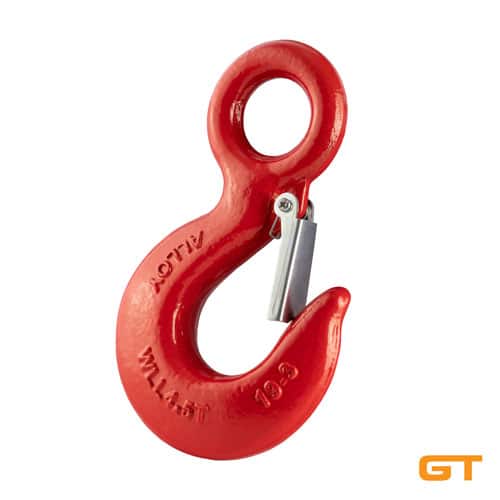
A large eye hook can be turned to the right orientation before the lift begins, which removes the twist that builds up in a wire rope assembly and lets the hook be presented squarely to the load. That is genuinely useful and it is why large eye hooks exist.
**What it will not do is large eye under load.** GT state that explicitly, and it matters. A plain large eye like this one turns freely when slack and locks solid the moment weight comes onto it. It relieves twist before the lift, not during it. If you need rotation with the load applied — because the load turns as it leaves the ground, or because twist accumulates through the lift — you need a ball bearing large eye hook, such as the Cobra CG8SSH range.
Key Features
- Swivel for positioning: Turn the hook to the correct orientation and relieve accumulated twist before taking the load.
- Safety catch fitted: Prevents the load coming off the hook when the sling goes slack.
- Alloy steel, quenched and tempered: With a red painted finish.
- 4.5:1 minimum breaking load.
- CE and UKCA marked with W.L.L., manufacturer's identification and product ID mark.
- Seven capacities: 1 to 11 tonnes.
- Eye hook alternative: The AHE range is the same hook without the large eye, at roughly half the price.
Technical Specifications
| Large Eye Hook |
W.L.L. |
List |
Eye Hook |
W.L.L. |
List |
| AHS1 |
1 t |
£5.74 |
AHE1 |
1 t |
£3.11 |
| AHS1.5 |
1.5 t |
£8.20 |
AHE1.5 |
1.5 t |
£4.03 |
| AHS2 |
2 t |
£12.01 |
AHE2 |
2 t |
£6.66 |
| AHS3 |
3 t |
£12.90 |
AHE3 |
3 t |
£8.51 |
| AHS4.5 |
4.5 t |
£24.17 |
AHE4.5 |
4.5 t |
£16.89 |
| AHS7 |
7 t |
£49.63 |
AHE7 |
7 t |
£30.42 |
| AHS11 |
11 t |
£77.30 |
AHE11 |
11 t |
£54.86 |
| — |
— |
— |
AHE22 |
22 t |
enquire |
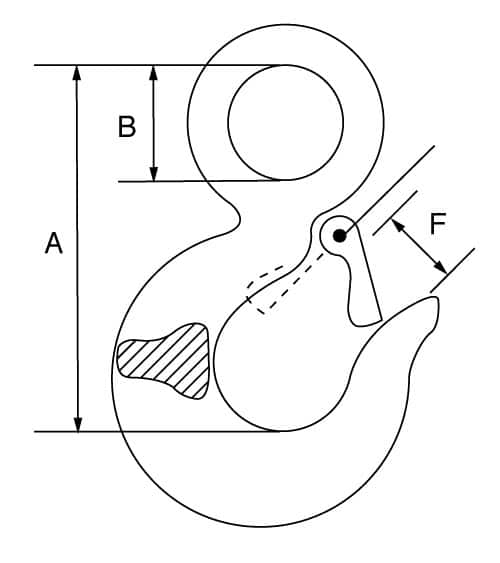
Both ranges: alloy steel, quenched and tempered, red painted finish, safety catch fitted, MBL 4.5 x W.L.L. Full dimensional data is on the specification sheet.
Alloy Steel | MBL 4.5 x W.L.L. | CE and UKCA | DOES NOT SWIVEL UNDER LOAD
Alloy steel, quenched and tempered, with a minimum breaking load of 4.5 times the Working Load Limit. Marked with CE, UKCA, W.L.L., manufacturer's identification and product ID mark. The large eye is for positioning before the lift and does not rotate under load. Where rotation under load is required, a ball bearing large eye hook is needed. Under LOLER 1998, thorough examination by a competent person at intervals not exceeding 12 months.
Suitable Applications
Used as the terminal fitting on wire rope slings and assemblies, and as a general purpose lifting hook where the orientation needs setting before the lift. The large eye version suits wire rope assemblies particularly, since wire rope has a natural tendency to twist and being able to take that out before loading makes for a cleaner lift. Where the hook orientation is fixed and known, the AHE eye hook does the same job for around half the price.
More About This Product
Wire rope terminations are where most of a wire rope assembly's cost and nearly all of its risk sits. The rope itself is a commodity; the termination is where craft is involved and where efficiency is either preserved or thrown away.
The numbers are worth knowing. A properly made swaged or spelter termination retains close to the rope's full breaking load. A correctly fitted wedge socket retains a high proportion. A gripped termination with the right number of grips, correctly spaced and torqued, retains rather less — and a gripped termination done carelessly retains very little indeed. The rope has not changed; the termination has.
Termination Efficiency and the Thimble's Job
Efficiency is the proportion of the rope's breaking load a termination preserves, and it varies more than most people expect. That is why a lifting sling is swaged in a workshop and a guy wire is gripped in the field — the applications tolerate different efficiencies.
On a gripped termination three things determine the result and all three are commonly got wrong. The number of grips rises with rope diameter and is specified, not estimated. The spacing is specified by the manufacturer and set out in the instruction sheet. The torque must be applied and then reapplied after the assembly has been loaded once, because wire rope beds down under first load and grips that were tight become loose. A gripped termination inspected a week after fitting and never retorqued is a common finding.
And the orientation: saddle on the live rope, U-bolt on the dead tail. Reversed, the U-bolt crushes the part of the rope carrying the load. The rigger's phrase is never saddle a dead horse, and it exists because the mistake is easy to make and hard to see afterwards.
The thimble does a different job. Without one, a rope eye bends around the pin at a radius far tighter than the rope tolerates, and is crushed between pin and load. The thimble holds the eye at an acceptable radius and takes the bearing itself. A flattened thimble at inspection means the eye has been carrying load it was never meant to.
How to Use the Hook
- Position the large eye before taking load: Set the orientation and relieve twist while slack. It will not turn once loaded.
- Check the safety catch: Must spring fully closed against the hook nose.
- Seat the load in the throat: Load bears in the throat, never on the tip.
- Do not use to rotate a suspended load: The large eye locks under load and is not designed for it.
- Match the hook rating to the assembly: The assembly is limited by its weakest component.
- Do not modify: Never weld, heat, machine, drill or repaint.
Warning: This hook does not large eye under load. If your load rotates as it lifts, or twist accumulates during the lift, a ball bearing large eye hook is required. Never tip load. Never use a hook with a missing or damaged safety catch.
Safety Information
- Never exceed the marked Working Load Limit.
- The large eye does not rotate under load. Position before lifting.
- Load must bear in the throat, never on the tip.
- Confirm the safety catch springs fully closed before every lift.
- The safety catch retains the load, it does not carry it.
- Withdraw any hook showing throat opening, wear beyond the manufacturer’s stated limit, distortion or cracks.
- Never weld, heat treat, machine or repaint.
- Thorough examination by a competent person required at intervals not exceeding 12 months under LOLER 1998.
Inspection and Maintenance
Measure the throat opening against the original dimension, since throat opening is the classic sign of overload on any hook and is progressive rather than sudden. Check the tip and throat for gouging and wear, and withdraw at the manufacturer’s stated wear limit. Confirm the safety catch springs closed under its own tension and sits against the nose with no gap. On the large eye version, check the large eye turns freely by hand when unloaded — a seized large eye removes the only reason to have bought it — and inspect the large eye joint for wear and play. Confirm markings remain legible.
Downloads
Frequently Asked Questions
Q: If it sits, why can I not turn the load?
Because a plain large eye locks solid once weight comes onto it. It turns freely when slack, which lets you set the orientation and take twist out of a wire rope before you lift. Under load it holds. For rotation with the load applied you need a ball bearing large eye, such as the Cobra CG8SSH range.
Q: Swivel or eye hook?
The large eye costs roughly 50% more and lets you set the hook orientation and relieve twist before lifting, which is genuinely useful on wire rope assemblies. If the orientation is fixed and known, the AHE eye hook does the same job for less.
Q: Why 4.5:1 rather than 4:1 or 5:1?
It is the factor GT specify for this alloy steel hook range. Chain fittings typically use 4:1,
eyebolts 5:1 and
shackles 6:1. Different components under different standards carry different factors, which is worth knowing when comparing across a catalogue.
Q: Why is the 3 tonne barely more than the 2 tonne?
£12.90 against £12.01 on the large eye, a difference of 89p for 50% more capacity. Worth taking the 3 tonne unless there is a specific reason not to. The same pattern appears on the eye hook range but less sharply.