Chain grade is the most consequential decision in building a sling assembly, and the trade-off is straightforward. **Grade 8 carries about 25% more than Grade 8 at the same link diameter**, so a lighter chain does the same job — which matters when a rigger is carrying it up a ladder. **Grade 8 is rated to -40 °C**, twenty degrees colder than Grade 8, and costs less.
The finish is how you tell them apart in a busy stores, and GT use three distinct ones:
| Grade | Finish | Temperature | |---|---|---| | Grade 8 (G100C) | Black electrophoresis | -20 °C to +200 °C | | Grade 80 (G80C) | Black lacquered | -20 °C to +200 °C | | Grade 8 (G8CB) | Black electrophoresis | -20 °C to +200 °C |
**One thing to watch:** the chain is rated -20 °C across all three grades here, where the Cobra Grade 8 *fittings* are rated -40 °C. If you are assembling for cold work, the chain may be the limiting component rather than the hooks, which is the opposite of what most people assume.
Key Features
- 25% higher capacity than Grade 8: Meets BS EN 818-2 plus 25% of loads, so a smaller and lighter chain carries the same working load.
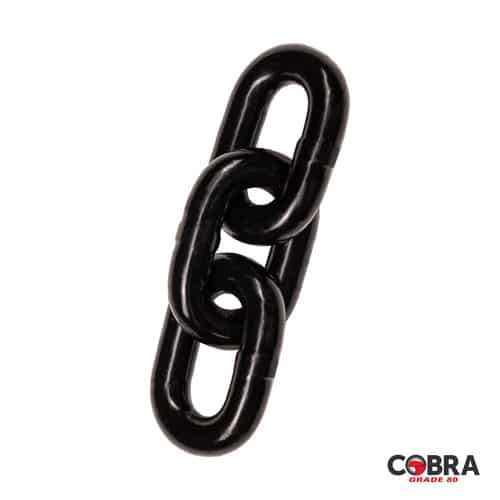
- Black electrophoresis finish: Immediate visual identification of Grade 8, which matters when three grades are in the same stores.
- Seven sizes: 6, 8, 10, 13, 16, 20 and 22 mm.
- Full traceability marking: Material grade, manufacturer's identification and traceability code.
- Matched fittings available: The full Cobra Grade 8 range of hooks, links and connectors.
Technical Specifications
| Product Code |
dn (mm) |
D (mm) |
W1 (mm) |
W2 (mm) |
Weld Dia (mm) |
Weight (kgs/mtr) |
Min Packing Qty (mtr) |
| G8CB6 |
6 |
18 |
7.8 |
22.2 |
6.6 |
0.8 |
500 |
| G8CB7 |
7 |
21 |
9.1 |
25.9 |
7.7 |
1.1 |
500 |
| G8CB8 |
8 |
24 |
10.4 |
29.6 |
8.8 |
1.4 |
400 |
| G8CB10 |
10 |
30 |
13 |
37 |
11 |
2.2 |
300 |
| G8CB13 |
13 |
39 |
16.9 |
48.1 |
14.3 |
3.8 |
150 |
| G8CB16 |
16 |
48 |
20.8 |
59.2 |
17.6 |
5.7 |
100 |
| G8CB20 |
20 |
60 |
26 |
74 |
22 |
9 |
75 |
| G8CB22 |
22 |
66 |
28.6 |
81.4 |
24.2 |
10.9 |
50 |
| G8CB26 |
26 |
78 |
33.8 |
96.2 |
28.6 |
15.2 |
50 |
| G8CB32 |
32 |
96 |
41.6 |
118 |
35.2 |
24.1 |
50 |
Prices per metre. Working Load Limits by size and grade are given in the user information sheets.
BS EN 818-2 +25% of Loads | Grade 8 | -20 °C to +200 °C | LOLER Ready
Grade 8 alloy steel meeting the Working Load Limit performance requirements of BS EN 818-2 plus 25% of loads. Marked with material grade, manufacturer's identification and traceability code. Note the chain is rated -20 °C where some Cobra Grade 8 fittings are rated -40 °C; in a mixed assembly the lowest rating governs. Under LOLER 1998, thorough examination by a competent person at intervals not exceeding 12 months.
Suitable Applications
Short link chain is the basis of chain sling assemblies and is also used extensively for load restraint on vehicles. Grade 8 suits work where weight matters — overhead rigging, repeated manual handling of slings, and any assembly carried to position by hand. Grade 8 and Grade 80 suit general lifting and load restraint where the extra capacity is not needed and cost matters more. All three require matched fittings of the same grade; mixing grades derates the assembly to the lowest.
More About This Product
Shackles are the most-handled component in any lifting operation, and that is precisely why they wear out first. A sling gets rigged and derigged; a shackle gets rigged, derigged, dropped, driven over, thrown into a box and picked up by whoever needs one. Most lifting gear fails from a single overload; shackles fail from accumulated inattention.
The grade markings matter more than most people realise. A Grade 6 high tensile shackle to BS EN 13889 and a Grade 8 alloy shackle look similar and share the same body shape, but the alloy version carries considerably more at the same size. Once a shackle is in a box with fifty others, the only way to tell them apart is the marking — which is why an unmarked shackle has to be scrapped no matter how good it looks.
Understanding the Load Path
A shackle has two distinct load-bearing elements and they do different jobs. The bow takes the sling; the pin takes the load. Reverse that — put the sling on the pin and the load on the bow — and two things happen. The sling bears on a smaller radius than it was designed for, and any movement in the sling starts to rotate the pin.
On a screw collar pin that rotation is the failure mechanism. A sling shifting under a settling load, or vibration transmitted from plant nearby, will slowly unscrew the pin over minutes or hours. It rarely happens quickly enough for anyone to see it happening.
The second consideration is angle. A shackle loaded in line with the pin carries its full rating. Loaded at an angle across the bow it carries substantially less, and published derating tables cover a limited range of angles — beyond that range no figure is published because none applies. On a multi-leg sling every leg is at an angle by definition, which is why the bow shackle exists and why putting a multi-leg sling into a dee shackle is a genuine mistake rather than a preference.
How to Use the Chain
- Keep the whole assembly one grade: Mixing Grade 8 and Grade 8 components derates the entire sling to Grade 8 and it must be marked accordingly.
- Check the temperature rating of every component: The chain is -20 °C here; some fittings are -40 °C. The lowest rating governs.
- Never knot or shorten by wrapping: Use a grab hook or shortening clutch. A knotted chain loses substantial capacity.
- Recertify any assembly built or altered: Proof testing and certification by a competent person is required.
- Inspect link by link: Chain fails at a single link, and that link is usually the one nobody looked at.
- Do not modify: Never weld, heat, machine or repaint. Repainting conceals cracks.
Warning: Never mix chain grades within an assembly without derating to the lower grade and recertifying. Never repaint chain — the finish identifies the grade, and paint conceals the cracks and wear an inspection is looking for.
Safety Information
- Never exceed the Working Load Limit for the size and grade.
- Use fittings of the same grade throughout the assembly.
- Never knot, twist or shorten by wrapping.
- Withdraw any chain showing stretch, wear beyond the manufacturer’s stated limit of nominal diameter, nicks, gouges, cracks or bent links.
- Measure a defined length periodically to check for stretch.
- Never weld, heat treat, machine or repaint.
- Operating range -20 °C to +200 °C for this chain.
- Assemblies built or altered require proof testing and recertification.
- Thorough examination by a competent person required at intervals not exceeding 12 months under LOLER 1998.
Inspection and Maintenance
Chain is inspected link by link, and the whole length matters because a single bad link is a failure. Measure the link diameter at the bearing points and withdraw at the manufacturer’s stated wear limit. Check for stretch by measuring a defined number of links against the original length, since elongation indicates overload and is the clearest evidence of it. Look for nicks, gouges, cracks, bent or twisted links, and heat discolouration. Pay particular attention to links that habitually seat in a grab hook, which wear faster than the rest. Never repaint: the finish identifies the grade and fresh paint hides exactly what you are looking for.
Downloads
Frequently Asked Questions
Q: Grade 8, Grade 80 or Grade 8?
Grade 8 and Grade 80 are the same strength grade under different naming conventions; both meet BS EN 818-2. Grade 8 carries about 25% more for the same link size, so a lighter chain does the same work. Choose Grade 8 where weight matters, Grade 8/80 where cost does.
Q: How do I tell the grades apart?
By finish: Grade 8 is black electrophoresis, Grade 80 black lacquered, Grade 8 black electrophoresis. That plus the grade marking on the links. It is also why you must never repaint chain — the colour is doing a job.
Q: Can I mix grades in one assembly?
You can physically, but the whole assembly must then be derated to the lower grade and marked accordingly, and recertified. In practice it is simpler and safer to keep an assembly to one grade throughout.
Q: Why is this chain -20 °C when Grade 8 fittings are -40 °C?
All three chains here are rated -20 °C, while some Cobra Grade 8 fittings carry -40 °C. In a mixed assembly the lowest rating governs, so for cold work the chain may be the limiting component. Check the marking on every part rather than assuming the range figure.