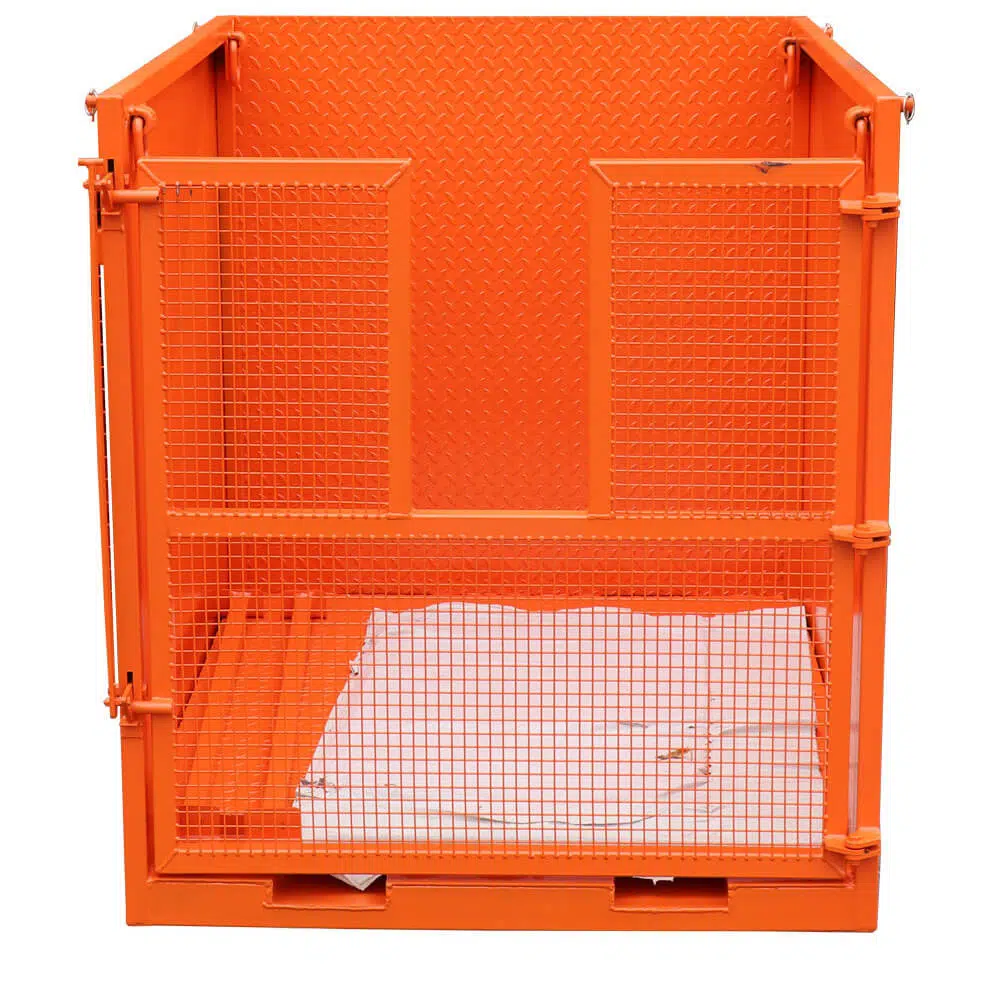
The Conquip Crane Forks Cage is an industry-approved, fail-safe method for lifting pallets of blocks and bricks, developed with leading UK contractors following near-misses where Crane Forks were used with restraint nets alone. The large 1200mm by 1300mm internal area accommodates all common pallet sizes, a robust latch mechanism prevents the door opening once shut, and the cage is lightweight enough to keep cage plus pallet within the Working Load Limit of Conquip Crane Forks. Ramped access allows unloading with a pallet truck on scaffold loading bays and CantiDecks.
Key Features
- Large internal area of 1200mm by 1300mm accommodates all common pallet sizes including standard UK and Euro pallets
- Lightweight construction keeps the loaded cage within the Working Load Limit of Conquip Crane Forks
- Robust latch mechanism prevents the door from opening after it has been shut
- Ramped access allows pallet-truck unloading on scaffold loading bays, CantiDeck systems, or areas with reduced ceiling height
- Gate access enables straightforward unloading with Conquip Crane Forks
- Mesh side panels provide visibility of the load while containing materials securely
- Lifting points engineered for use with Conquip Crane Forks as a paired solution
- Manufactured in the UK to BS EN 13155 and certified for crane lifting
Technical Specifications
| Product Code |
CA147AC-02000 |
| External Length |
1540mm |
| External Width |
1390mm |
| External Height |
1290mm |
| Internal Length |
1200mm |
| Internal Width |
1300mm |
| Internal Height |
1200mm |
| Empty Weight |
440kg |
| Working Load Limit |
2000kg |
| Construction |
Welded steel frame with mesh side panels |
| Access |
Hinged gate plus ramp option |
| Standard |
BS EN 13155 |
LOLER-compliant | CE-marked
Working Load Limit 2000kg. Factor of Safety 4. Manufactured in the UK to BS EN 13155.
More About This Product
The Conquip Crane Forks Cage is an industry-approved, fail-safe method for lifting pallets of blocks and bricks around site. The concept was developed in collaboration with leading UK contractors and lifting personnel following near-misses where Crane Forks were used with restraint nets alone. The cage features a large internal area of 1200mm length by 1300mm width, accommodating all common pallet sizes, and a robust latch mechanism that prevents door opening once shut. The cage is lightweight enough to ensure that the cage plus a pallet of bricks or block packs remains within the Working Load Limit of Conquip Crane Forks. Ramped access allows the unit to be unloaded with a pallet truck on a scaffold loading bay, a CantiDeck, or anywhere with reduced ceiling height. Gate access provides easy unloading with Conquip Crane Forks. Compatible with Conquip Crane Forks, this is the safest method for transporting palletised material to height.
Suitable Applications
The Crane Forks Cage is the best-practice solution for any site lifting palletised bricks, blocks, or block packs to height. It is widely used on housebuilding sites, RC frame construction, infrastructure projects, and any site where Conquip Crane Forks are deployed for material handling. The cage was used as best practice on the Northern Line Extension project, demonstrating its suitability for high-profile, safety-critical environments. It performs particularly well during blind lifts into shafts, where the solid walls and cage structure offer security that nets cannot match.
Banding secures the pack but is not a lifting point. For loads that must be suspended rather than carried, see jibs and hooks.
How to Use
- Position Conquip Crane Forks under the cage and engage the lifting tines fully
- Open the hinged gate or lower the access ramp depending on loading method
- Load the pallet of bricks or blocks centrally into the cage using a forklift or pallet truck
- Close the gate fully, ensuring the latch mechanism engages and locks
- Verify the load is centred and stable, then signal the crane operator to lift
- At the destination, ground the cage on a stable surface before opening
- Open the gate or deploy the ramp and remove the palletised load using a pallet truck
Warning:
Always verify the latch is fully engaged before lifting. Never exceed the 2000kg Working Load Limit. Inspect the cage before each use for damage to the frame, hinges, or latch mechanism. Lifting must be carried out by competent personnel in accordance with LOLER 1998.
Safety Information
- Working Load Limit must not be exceeded under any circumstances
- Pre-use inspection required before each lift, with a thorough examination every six months under LOLER 1998
- Latch mechanism must be fully engaged with the gate closed before lifting
- Cage must only be used with Conquip Crane Forks; not approved for use with other lifting attachments
- Ground personnel must remain clear of the lift zone during all crane operations
- Damaged cages must be removed from service immediately and inspected by a competent person before further use
Frequently Asked Questions
Q: What is the difference between this cage and using Crane Forks with a restraint net?
The Crane Forks Cage is a safer method than Crane Forks paired with a Safety Restraint Net. Nets can snag or tear, and if not fitted correctly they can allow the load to shift during a lift. If materials become loose mid-lift, they can fall straight through a loose net, endangering personnel below. The cage provides solid containment that eliminates this risk.
Q: What sized pallets fit inside the cage?
The cage has internal dimensions of 1200mm by 1300mm, which accommodates all common standard pallet sizes including UK and Euro pallets.
Q: Why should I choose the Crane Forks Cage over alternatives?
It was developed specifically for transporting pallets of bricks and blocks safely with Conquip Crane Forks. It provides a fail-safe method for lifting materials, eliminating the risk of dropped loads. Ramped access allows unloading with a pallet truck without removing the Crane Forks, and it is compliant with LOLER regulations.
Q: Is it compatible with my existing Conquip Crane Forks?
Yes — the cage is engineered specifically for use with Conquip Crane Forks, making it a cost-effective addition to existing lifting equipment.