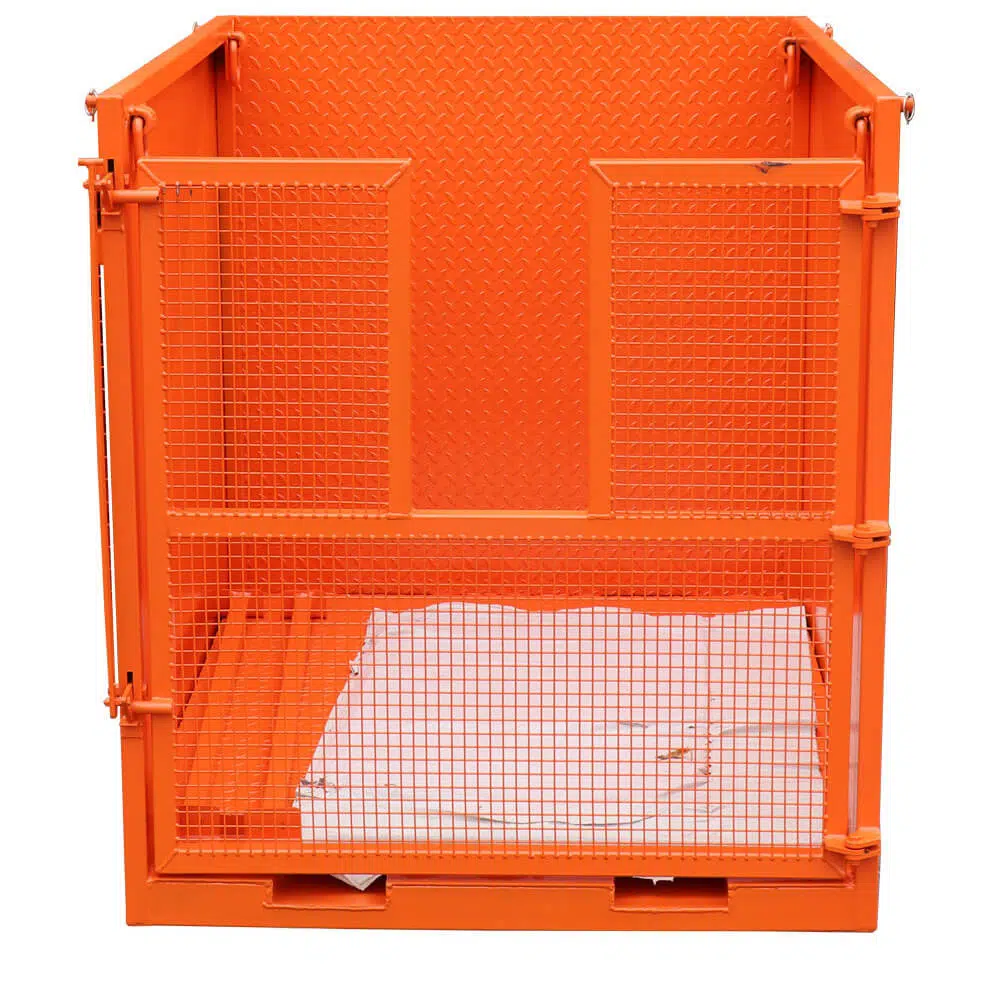
Conquip Crane Forks are a self-levelling crane attachment for lifting palletised material, brick packs and similar loads with a tower or mobile crane. A spring-loaded lifting eye keeps the forks balanced regardless of load weight, and adjustable fork tine width accommodates different pallet sizes. Both fixed and telescopic height versions are available to suit different load heights and clearance requirements.
Key Features
- Spring-loaded lifting eye self-levels the forks regardless of load weight, ensuring a balanced lift every time.
- Adjustable fork tine width via collared eye bolts to accommodate different pallet sizes and types.
- Telescopic version offers adjustable height (1975 to 2600 mm) for flexibility with taller loads or restricted overhead clearance; Fixed version is lighter and lower cost where height adjustment is not required.
- Hooks on the top arm for securing a Safety Restraint Net around the load.
- Forks rest fully self-levelled on the ground when not in use, making storage simple and safe.
- UK manufactured with forged and rated lifting points.
Technical Specifications
| Product Code |
Type |
Length (mm) |
Width (mm) |
Height (mm) |
Min Height (mm) |
Weight (kg) |
WLL (kg) |
| CA102-02000 |
Fixed Height |
1180 |
940 |
1960 |
N/A |
150 |
2000 |
| CA103AG-02000 |
Telescopic Height |
1200 |
950 |
2600 |
1975 |
190 |
2000 |
WLL = Working Load Limit.
2000kg WLL
Self-levelling spring-loaded design | Adjustable fork tine width | Fixed or telescopic height | UK manufactured
More About This Product
Always pair Crane Forks with a Safety Restraint Net
to prevent material falling from the forks during the lift. For an even safer fail-safe lift, pair with a Conquip Crane Forks Cage so the load is fully contained.
Suitable Applications
Crane Forks are widely used on housebuilding, RC frame and infrastructure projects for lifting palletised materials, brick and block packs and other typical site loads where a forklift or telehandler can't reach — for example, transferring brick packs from a stockyard to a working scaffold deck. The Telescopic version is the usual choice for varied load heights, while the Fixed version is preferred for repetitive lifts of similar-sized loads.
Banding secures the pack but is not a lifting point. For loads that must be suspended rather than carried, see jibs and hooks.
How to Use
- Position the Crane Forks on level ground; the spring-loaded lifting eye self-levels the forks ready for loading.
- Adjust the fork tine width via the collared eye bolts to match the pallet being lifted.
- Slide the forks under the pallet from the appropriate side.
- Fit a Safety Restraint Net around the load and secure to the hooks on the top arm — this is mandatory before any lift.
- For the Telescopic version, set and lock the height to suit the load and any overhead clearance.
- Attach the crane to the spring-loaded lifting eye using a suitably rated chain sling or shackle.
- The slinger and banksman confirm the lift is balanced before the crane operator lifts.
- Lift, transport and lower the load to the destination, with the slinger guiding placement.
- Withdraw the forks once the load is firmly on its destination surface.
Warning:
A Safety Restraint Net is mandatory for every lift to prevent material falling from the forks. For maximum safety, use a Crane Forks Cage instead. Never exceed the 2000 kg working load limit. Never lift personnel with Crane Forks.
Safety Information
- A Safety Restraint Net is mandatory for every lift — never lift without it.
- Inspect the spring-loaded lifting eye, fork tines, eye bolts and net hooks before each shift.
- The crane operator, slinger and banksman must hold appropriate certification.
- Use a chain sling rated above the loaded weight, attached to the lifting eye.
- Confirm crane capacity at the lift radius is suitable for the loaded forks.
- Keep ground personnel clear of the lift path during transport.
- Do not exceed the 2000 kg working load limit.
- For the Telescopic version, ensure the height is locked positively before any lift.
- Crane Forks are not rated for personnel lifting under any circumstances.
Frequently Asked Questions
Q: Fixed or Telescopic — which should I choose?
Choose Fixed Height if your loads are similar height and you don't need adjustment — it is lighter (150 kg) and lower cost. Choose Telescopic Height if your loads vary, or where overhead clearance is restricted on certain levels — adjustable from 1975 mm to 2600 mm.
Q: Do I need a Safety Restraint Net?
Yes — a Safety Restraint Net is mandatory for every lift with Crane Forks. The net is secured around the load via hooks on the top arm and prevents materials sliding off the forks during the lift. For an even safer fail-safe lift, use a Crane Forks Cage instead — the load is fully contained inside the cage.
Q: What pallet sizes will the forks accept?
Fork tine width is adjustable via collared eye bolts, so the forks accommodate standard, euro and other pallet sizes within the working load limit.
Q: How does self-levelling work?
The lifting eye is mounted on a spring-loaded mechanism that automatically aligns the forks horizontally regardless of load weight. This means a balanced lift every time without manual adjustment, and the forks rest fully level on the ground when set down.
Q: Can I lift personnel?
No. Crane Forks are rated for materials only and must never be used to lift people under any circumstances. For personnel lifting, use a Conquip Access Cage.