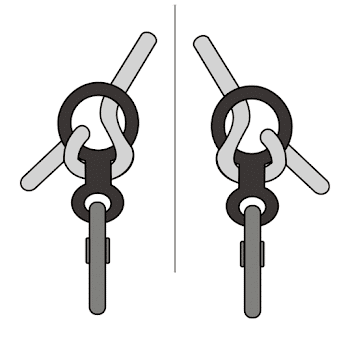
The oldest and simplest descender design, and still in every rescue bag for good reason: it has no moving parts. Nothing to seize with grit, nothing to freeze, nothing to jam, nothing that stops working because it has sat in a bag for three years. Rope is threaded around the two eyes and friction does the rest, controlled entirely by how the operator holds the tail.
That last point is the trade-off, and it should be stated plainly. **There is no self braking.** Let go of the rope and descent continues. It is a tool for a trained operator making a controlled self evacuation, not a substitute for the self braking grip descender on working rope access.
At 50 kN breaking strength it is considerably stronger than most items in the range, which is what happens when a component is a solid piece of aluminium with no mechanism in it.
Key Features
- No moving parts: Nothing to fail. That reliability is why a figure of 8 remains standard in emergency kits despite the availability of better working descenders.
- 50 kN breaking strength: Substantially higher than most rope access hardware.
- Two eye diameters: 52 mm and 26 mm, giving different rope threading options and friction settings.
- 9–11 mm rope compatibility: A narrower range than the powered descender, so check your rope.
- Compact at 145 mm: Fits in a pocket or on a harness without noticing.
- Black anodised aluminium: Light with a hard surface against rope wear.
Technical Specifications
| Property |
Value |
| Product Code |
FA 70 004 00 |
| Type |
Manual descender, self evacuation |
| Rope Compatibility |
9 – 11 mm |
| Large Eye Inside Diameter |
52 mm |
| Small Eye Inside Diameter |
26 mm |
| Length |
145 mm |
| Breaking Strength |
50 kN |
| Material |
Aluminium, black anodised |
Note the 9–11 mm range differs from the 10.5–12 mm of the grip descender and the 10–12 mm of the ascenders. Check compatibility with your rope.
Manual Descender | No Self Braking | Trained Operators Only
A manual descender with no self braking function. Descent is controlled entirely by the operator's grip on the tail rope. It is intended for self evacuation by trained personnel and is not a substitute for a self braking descender in working rope access. Rope access requires specific training and an independent back-up system. Inspection by a competent person at intervals not exceeding 12 months.
Suitable Applications
Carried as emergency self evacuation equipment in rescue kits, confined space bags, tower and mast kits, and by rope access technicians as a back-up to their primary descender. Its value is reliability rather than control: it will work after years in a bag when a mechanical device might not. It is also used in training and in some rescue techniques where its simplicity is an advantage. For routine working descent, the self braking grip descender is the correct tool.
More About This Product
The anchorage is the part of a fall protection system people think about last and should think about first. Most sites can produce a harness and a lanyard within minutes; producing a certified, assessed anchor point is a different matter, and it is what genuinely determines whether the system works.
The forces involved are the reason. Arresting a fall is a dynamic event, and the load a falling person imposes on an anchor is many times their body weight — which is why BS EN 795 exists as a standard in its own right, and why the structure the anchor attaches to has to be assessed separately by someone competent to do it. The anchor may be certified; the beam, the tube, the roof purlin almost certainly is not.
Anchor Position, Fall Factor and Swing
Where the anchor sits changes the severity of a fall more than any other single decision.
Fall factor is the ratio of fall distance to the length of lanyard available to absorb it. An anchor above the head gives the lowest factor and the gentlest arrest. An anchor at foot level gives a factor 2 fall — the worst case, generating forces a shock absorber may struggle to control, and it is what happens when someone clips onto something convenient at their feet rather than something suitable above them.
Pendulum swing is the second consideration and the one that catches people out. An anchor directly overhead means a fall goes straight down. An anchor off to one side means the faller swings, and the swing can be more dangerous than the drop — into structure, into plant, or across a surface at speed. A swing that ends against a steel column is not survivable simply because the harness held.
The practical rule is to position the anchor as high as practicable and as close to directly overhead as the work allows, and to reassess it every time the work position moves.
How to Use the Figure of 8
- Train before you rely on it: Controlling descent by grip alone is a skill. It must be practised in a safe environment first.
- Thread correctly: The rope wraps around the eyes in a specific pattern. Incorrect threading gives too little friction.
- Keep the brake hand on the tail: Descent speed is controlled entirely by how the tail rope is held. Never release it.
- Watch for rope twist: A figure of 8 imparts twist into the rope, which accumulates on long descents.
- Maintain an independent back-up: A separate safety line with a back-up device.
- Check rope diameter: 9 to 11 mm, which is narrower than the rest of the range.
Warning: This descender has no self braking function. Releasing the tail rope means uncontrolled descent. It must only be used by trained personnel who have practised with it, and always with an independent back-up on a separate safety line.
Safety Information
- For use only by trained and certified personnel.
- No self braking. The operator controls descent entirely.
- Never release the tail rope during descent.
- Use only with 9 to 11 mm rope.
- An independent back-up on a separate safety line is required.
- Be aware of rope twist accumulating on long descents.
- Inspect for wear grooving and cracking before every use.
- Inspection by a competent person required at intervals not exceeding 12 months.
Inspection and Maintenance
With no mechanism, inspection is about the metal itself. Examine both eyes for wear grooving where the rope runs, since a groove develops a sharp edge that damages rope. Check the whole body for cracking, particularly at the waist between the two eyes where section is smallest and stress concentrates. Look for deep gouges from grit and for any distortion. A figure of 8 that has developed a sharp edge in its rope channel must be withdrawn, as it will cut the sheath of the rope running over it.
Downloads
Frequently Asked Questions
Q: Figure of 8 or grip descender?
The grip descender for working rope access: it self brakes, controls speed and protects against panic gripping. The figure of 8 for emergency self evacuation and as a back-up: no moving parts means nothing to fail after years in a bag. Many technicians carry both for exactly those reasons.
Q: Why is it so much stronger at 50 kN?
Because it is a solid piece of aluminium with no mechanism. Devices with cams, springs and moving parts are limited by those components; a figure of 8 has none, so its strength is simply that of the metal.
Q: Why does it twist the rope?
The threading path wraps the rope around itself, which imparts twist as it runs through. On a short descent it is unnoticeable; on a long one the twist accumulates and the rope below can kink. It is a known characteristic of the design rather than a fault.
Q: Can I use it with 12mm rope?
No. It is rated for 9 to 11 mm, which is narrower than the grip descender's 10.5 to 12 mm. If you run 12 mm rope, this device is not compatible and the friction will be excessive.