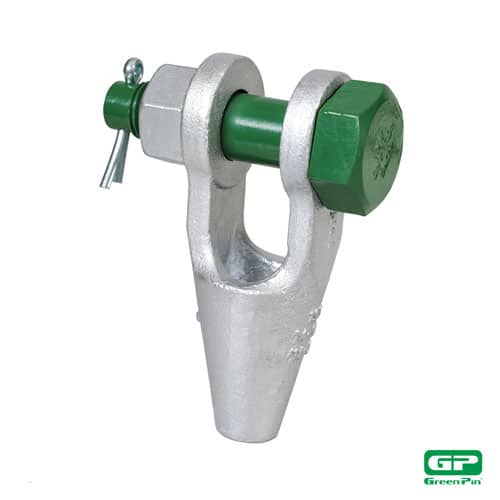
A wire rope termination is where the rope becomes a usable assembly, and how it is formed decides how much of the rope's strength survives.
Spelter and swaged terminations achieve close to the rope's full breaking load, because the load is transferred over a long length. Wedge sockets are field-fittable and reusable, achieving a high proportion. Wire rope grips are the field-serviceable option needing only a spanner, but the efficiency depends entirely on the number of grips, their spacing and their torque being right.
Thimbles protect the eye itself. A wire rope eye without one bends tightly around the pin and is crushed under load, and the eye fails long before the rest of the rope has done any real work.
Manufacturer specification. High tensile steel. Hot dipped galvanised finish. Temperature range -40ºC up to +200°C. Marked with CE, manufacturers ID, size, product ID mark and traceability code. Full CAD support available upon request.
Key Features
- Hot Dipped Galvanised finish: Identifies the range on site — never repaint a lifting product
- High tensile steel: As specified by the manufacturer
- Hot dipped galvanised finish: As specified by the manufacturer
- Temperature range -40ºC up to +200°C. Marked with CE, manufacturers ID: As specified by the manufacturer
- Full CAD support available upon request: As specified by the manufacturer
Technical Specifications
| Product Code |
Number |
M.B.L. (t) |
Wire Rope Dia (mm) |
A (mm) |
B (mm) |
C (mm) |
D (mm) |
E (mm) |
F (mm) |
Weight (kgs) |
| GPOSSB196 |
196 |
8 |
6 - 7 |
109 |
69 |
19 |
16 |
33 |
9 |
0.4 |
| GPOSSB197 |
197 |
12 |
8 - 10 |
124 |
83 |
21 |
21 |
35 |
12 |
0.8 |
| GPOSSB198 |
198 |
20 |
11 - 13 |
143 |
101 |
26 |
25 |
37 |
15 |
1.3 |
| GPOSSB199 |
199 |
25 |
14 - 16 |
172 |
124 |
33 |
30 |
49 |
19 |
2.32 |
| GPOSSB100 |
100 |
45 |
18 - 19 |
205 |
138 |
38 |
35 |
58 |
21 |
3.81 |
| GPOSSB104 |
104 |
60 |
20 - 22 |
235 |
148 |
44 |
41 |
68 |
24 |
5.56 |
| GPOSSB108 |
108 |
85 |
23 - 26 |
275 |
176 |
51 |
51 |
76 |
28 |
9.9 |
| GPOSSB111 |
111 |
105 |
27 - 30 |
306 |
193 |
57 |
57 |
85 |
32 |
13.8 |
| GPOSSB115 |
115 |
136 |
31 - 36 |
338 |
210 |
63 |
64 |
95 |
38 |
18.4 |
| GPOSSB118 |
118 |
150 |
37 - 39 |
394 |
230 |
76 |
70 |
127 |
41 |
26.9 |
| GPOSSB120 |
120 |
170 |
40 - 42 |
418 |
244 |
76 |
76 |
126 |
44 |
32 |
Full dimensional data and Working Load Limits for every size are given in the manufacturer information sheet.
LOLER Ready
High tensile steel. Hot dipped galvanised finish. Temperature range -40ºC up to +200°C. Marked with CE, manufacturers ID, size, product ID mark and traceability code. Full CAD support available upon request. Under LOLER 1998, lifting accessories require thorough examination by a competent person at intervals not exceeding 12 months, and immediate withdrawal after any overload.
Suitable Applications
Forming and protecting wire rope terminations across lifting slings, standing and running rigging, guy wires and stays, winch ropes, and marine and architectural work. The choice between a swaged, spelter, wedge or gripped termination depends on whether it is made in a workshop or in the field, and how much of the rope's strength the application needs.
More About This Product
Wire rope terminations are where most of a wire rope assembly's cost and nearly all of its risk sits. The rope itself is a commodity; the termination is where craft is involved and where efficiency is either preserved or thrown away.
The numbers are worth knowing. A properly made swaged or spelter termination retains close to the rope's full breaking load. A correctly fitted wedge socket retains a high proportion. A gripped termination with the right number of grips, correctly spaced and torqued, retains rather less — and a gripped termination done carelessly retains very little indeed. The rope has not changed; the termination has.
Termination Efficiency and the Thimble's Job
Efficiency is the proportion of the rope's breaking load a termination preserves, and it varies more than most people expect. That is why a lifting sling is swaged in a workshop and a guy wire is gripped in the field — the applications tolerate different efficiencies.
On a gripped termination three things determine the result and all three are commonly got wrong. The number of grips rises with rope diameter and is specified, not estimated. The spacing is specified by the manufacturer and set out in the instruction sheet. The torque must be applied and then reapplied after the assembly has been loaded once, because wire rope beds down under first load and grips that were tight become loose. A gripped termination inspected a week after fitting and never retorqued is a common finding.
And the orientation: saddle on the live rope, U-bolt on the dead tail. Reversed, the U-bolt crushes the part of the rope carrying the load. The rigger's phrase is never saddle a dead horse, and it exists because the mistake is easy to make and hard to see afterwards.
The thimble does a different job. Without one, a rope eye bends around the pin at a radius far tighter than the rope tolerates, and is crushed between pin and load. The thimble holds the eye at an acceptable radius and takes the bearing itself. A flattened thimble at inspection means the eye has been carrying load it was never meant to.
How to Use
- Match the fitting to the rope diameter exactly: Undersized will not seat, oversized will not grip.
- Fit a thimble in every eye: It holds the rope at a radius it can tolerate and takes the bearing load instead of the wire.
- On grips: saddle on the live end, U-bolt on the dead tail: Never the reverse. The old phrase is never saddle a dead horse.
- On grips: use the correct number and spacing: This rises with rope diameter. Follow the instruction sheet; do not estimate.
- Retorque after first loading: Wire rope beds down and grips must be retightened.
- Inspect the rope at the termination: It is where broken wires appear first.
Warning: On a gripped termination, never reverse the saddle and U-bolt — the U-bolt must bear on the dead tail, not the live rope. The number of grips, their spacing and their torque all determine whether the termination holds.
Safety Information
- Match the fitting to the rope diameter exactly.
- Fit a thimble in every eye.
- On gripped terminations, fit the saddle to the live end and use the correct number of grips.
- Retorque gripped terminations after first loading.
- Withdraw any termination showing a pulled tail, broken wires, crushing or corrosion.
- Where used as a lifting accessory, thorough examination at intervals not exceeding 12 months under LOLER 1998.
Inspection and Maintenance
Inspect the rope where it enters the termination, since that is where broken wires appear first: run a gloved hand along it feeling for protruding wire ends, which are the primary rejection criterion, and look for crushing, birdcaging and corrosion. On gripped terminations check every grip for correct torque, since they loosen as the rope beds down, and look for the dead tail having pulled through. On thimbles look for flattening at the crown, which means the rope has been taking load it should not have. Confirm swaged and spelter terminations show no cracking, movement or drawn rope.
Downloads
Frequently Asked Questions
Q: Do I really need a thimble?
On any wire rope eye that connects to a
shackle, hook or pin, yes. Without one the rope bends tightly around the pin and is crushed under load, and the eye fails long before the rest of the rope.
Q: Which way round do wire rope grips go?
Saddle on the live rope, U-bolt on the dead tail. Reversed, the U-bolt crushes the rope that is carrying the load.
Q: Grips or a swaged ferrule?
A ferrule is stronger, more consistent and neater, but needs a press. Grips can be fitted in the field with a spanner. For lifting assemblies, ferrules; for field-formed guy wires and stays, grips.