A swivel lets a rope or chain assembly unwind rather than transmitting twist into the load, and the bearing type decides whether it can do that under load.
A plain swivel turns freely when slack and locks solid the moment weight comes on. It relieves twist before the lift, not during it. A needle or thrust bearing swivel keeps turning with the load applied, because the bearing carries the load while the swivel rotates.
That distinction is the whole selection decision. If the load rotates as it leaves the ground, or twist accumulates through the lift, a plain swivel will not help.
Manufacturer specification. Carbon steel. Black painted finish. Minimum breaking load is 5 times the W.L.L. Marked with CE, W.L.L, manufacturers ID, size and traceability code.
Key Features
- Black finish: Identifies the range on site — never repaint a lifting product
- Minimum breaking load 5 times the W.L.L.: The safety factor built into the rating
- Carbon steel: As specified by the manufacturer
- Black painted finish: As specified by the manufacturer
- Minimum breaking load is 5 times the W.L.L. Marked with CE, W.L.L, man: As specified by the manufacturer
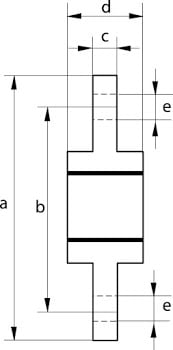
Technical Specifications
| Product Code |
W.L.L. (t) |
A (mm) |
B (mm) |
C (mm) |
D (mm) |
E (mm) |
Weight (kg) |
| GPTBSEE1 |
1 |
174 |
128 |
12.5 |
49 |
21 |
1.4 |
| GPTBSEE2 |
2 |
223 |
173 |
19 |
68 |
22 |
3.5 |
| GPTBSEE3 |
3 |
278 |
210 |
26 |
79 |
29 |
6.4 |
| GPTBSEE5 |
5 |
290 |
222 |
26 |
89 |
31 |
7.9 |
| GPTBSEE8 |
8 |
366 |
276 |
40 |
106 |
43 |
15.2 |
| GPTBSEE10 |
10 |
390 |
300 |
40 |
118 |
49 |
19.1 |
| GPTBSEE15 |
15 |
457 |
355 |
40 |
52 |
49 |
26.6 |
| GPTBSEE20 |
20 |
474 |
372 |
40 |
59 |
51 |
25 |
| GPTBSEE30 |
30 |
612 |
472 |
64 |
68 |
59 |
50 |
| GPTBSEE40 |
40 |
760 |
600 |
68 |
106 |
65 |
- |
Full dimensional data and Working Load Limits for every size are given in the manufacturer information sheet.
LOLER Ready
Carbon steel. Black painted finish. Minimum breaking load is 5 times the W.L.L. Marked with CE, W.L.L, manufacturers ID, size and traceability code. Under LOLER 1998, lifting accessories require thorough examination by a competent person at intervals not exceeding 12 months, and immediate withdrawal after any overload.
Suitable Applications
Wire rope and chain assemblies where twist accumulates: long slings, loads that turn as they lift, winch and hoist lines, and marine and towing applications. A bearing swivel is essential where a load must be free to rotate under load; a plain swivel is adequate and cheaper where twist only needs relieving before the lift.
More About This Product
A swivel is bought to solve a problem that is often invisible until it causes one: accumulated twist. A wire rope assembly stored coiled, a chain sling that has been used choked, a long line spooled onto a drum — all of them build twist, and that twist has to go somewhere when the assembly is loaded.
Without a swivel it goes into the load, which spins slowly and unpredictably as it lifts. With the wrong swivel it goes nowhere at all, because a plain swivel locks solid under load and the rigger discovers this with the load in the air.
Bearing Types and What Rotation Under Load Costs
The distinction that governs selection is simple to state and frequently missed: whether the swivel turns with the load applied.
A plain swivel is a pin in a hole. Unloaded it turns freely, which lets a rigger orient the hook and relieve twist before taking weight. Loaded, the friction between the bearing faces is far greater than anything a hanging load can overcome, and it locks. That is not a fault — it is what a plain swivel is, and for most chain sling work it is entirely adequate and considerably cheaper.
A needle or thrust bearing swivel puts rolling elements between the load-bearing faces. The bearing carries the axial load while the swivel rotates, so the assembly can unwind itself continuously under load. That is what you need where a load rotates as it leaves the ground, where twist accumulates through the lift, or on winch and hoist lines that spool.
The cost difference is real and so is the maintenance difference. A bearing swivel needs lubricating per the manufacturer's schedule, and a bearing left dry in a damp environment will seize — at which point you have paid for a bearing swivel and are using a plain one without knowing it. That is why checking free rotation before every use is not a formality.
How to Use
- Establish whether you need rotation under load: A plain swivel does not provide it. Only a bearing swivel does.
- Position a plain swivel before taking load: It will not turn once loaded.
- Confirm the swivel moves freely before use: A seized swivel offers nothing and may be side loaded without the rigger realising.
- Load in line: Swivels are designed for axial load, not side loading.
- Lubricate bearing types per the manufacturer: A bearing left unlubricated in a damp environment will seize.
- Do not modify: Never weld, heat, machine or repaint.
Warning: A plain swivel does not rotate under load. If your load turns as it lifts, or twist accumulates during the lift, a needle or thrust bearing swivel is required. Keep hands clear of a bearing swivel while the load is suspended.
Safety Information
- Never exceed the marked Working Load Limit.
- Confirm whether the swivel is rated for rotation under load.
- Check the swivel moves freely before every use.
- Load in line; do not side load.
- Keep hands clear of a rotating swivel while the load is suspended.
- Lubricate bearing types in accordance with the manufacturer's instructions.
- Withdraw any swivel that has seized, or shows wear beyond the manufacturer’s stated limit, distortion or cracks.
- Thorough examination by a competent person required at intervals not exceeding 12 months under LOLER 1998.
Inspection and Maintenance
The swivel action is what you are paying for and what needs checking. It must turn freely by hand through its full range; one that has stiffened from grit, corrosion or wear will not turn under load, which means it is being side loaded while everyone assumes it is not. On bearing types check for play in the bearing housing as well as free rotation. Inspect both eyes or jaws for elongation and wear, the body for distortion and cracking, and confirm markings remain legible. Lubricate per the manufacturer's instructions.
Downloads
Frequently Asked Questions
Q: What is the difference between a plain and a bearing swivel?
A plain swivel turns freely when slack and locks solid under load — it relieves twist before the lift. A needle or thrust bearing swivel keeps turning with the load applied. If the load rotates as it lifts, you need the bearing.
Q: Needle bearing or thrust bearing?
Both permit rotation under load. The choice comes down to the load and the manufacturer's rating; compare the published figures for your application.
Q: My swivel has stiffened. Does it matter?
Yes. A seized swivel cannot align or unwind, so the assembly transmits twist into the load and the swivel itself may be side loaded. Lubricate, and if it does not free up, withdraw it.