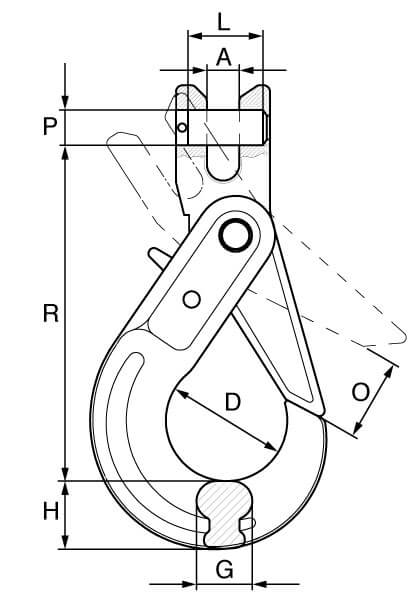
A safety catch keeps a load on the hook when the sling goes slack. A self locking hook goes further: the mechanism locks positively under load and cannot be opened while the load is applied. It has to be deliberately released, with two hands, once the load is down.
That matters wherever a hook could be knocked, dragged or fouled — lifting into confined spaces, working around structure, or any lift where the operator cannot watch the hook throughout. BS EN 1677-3 is the standard for self locking hooks specifically, a different certification from the 1677-2 covering ordinary sling hooks.
On temperature: Kito Grade 8 runs to +400 °C where the Cobra Grade 8 range stops at +200 °C. For foundry, forge and heat treatment work that is the deciding difference, with reductions in Working Load Limit above +200 °C.
Key Features
- Positive self locking mechanism: Locks under load and cannot be opened while loaded. Deliberate two-handed release once the load is down.
- Clevis fitting: Pins straight to the chain end link, no coupling link needed
- BS EN 1677-3: The self locking hook standard, a different certification from ordinary sling hooks
- -40 °C to +400 °C: Twice the upper range of Cobra Grade 8, with derating above +200 °C
- 5 sizes: Chain 6 mm through 16 mm
- Red painted finish: Identifies Grade 8 — never repaint a lifting fitting
Technical Specifications
| Product Code |
Chain Dia (mm) |
Part No. |
A (mm) |
D (mm) |
G (mm) |
H (mm) |
O (min) (mm) |
R (mm) |
PxL (mm) |
| G8CSLH6 |
6 |
SNC6 |
6.7 |
35 |
16 |
20.5 |
28 |
94 |
7.4 x 16.5 |
| G8CSLH8 |
7/8 |
SNC7-8 |
8.5 |
43.5 |
20 |
26 |
34 |
123 |
9.6 x 23 |
| G8CSLH10 |
10 |
SNC10 |
12 |
56 |
24.5 |
30 |
45 |
143.5 |
12.5 x 29.5 |
| G8CSLH13 |
13 |
SNC13 |
15 |
69 |
34.5 |
40 |
51.5 |
179.5 |
16 x 37 |
| G8CSLH16 |
16 |
SNC16 |
19 |
80 |
35.5 |
50 |
60 |
217 |
20 x 52 |
Working Load Limits and full dimensional data are in the user information sheet. The 20 mm hook suits both 19 mm and 20 mm chain.
BS EN 1677-3 | Grade 8 | SELF LOCKING | -40 °C to +400 °C | LOLER Ready
Conforms to BS EN 1677-3. Grade 8 alloy steel with a red painted finish. Marked with material grade, manufacturer’s identification, size, product ID mark and traceability code, and supplied with a certificate. Rated -40 °C to +400 °C, with reductions in Working Load Limit above +200 °C. Under LOLER 1998, thorough examination by a competent person at intervals not exceeding 12 months.
Suitable Applications
Specified wherever a hook could be knocked open or fouled, and wherever the consequence of a load coming off is severe: lifting into confined spaces, work around structure and pipework, overhead lifting where people may pass beneath, and any lift the operator cannot watch throughout. The wide temperature rating adds foundry, forge and heat treatment work. Where the hook is in plain sight and easily controlled, a sling hook with a safety catch is lighter and cheaper.
More About This Product
Shackles are the most-handled component in any lifting operation, and that is precisely why they wear out first. A sling gets rigged and derigged; a shackle gets rigged, derigged, dropped, driven over, thrown into a box and picked up by whoever needs one. Most lifting gear fails from a single overload; shackles fail from accumulated inattention.
The grade markings matter more than most people realise. A Grade 6 high tensile shackle to BS EN 13889 and a Grade 8 alloy shackle look similar and share the same body shape, but the alloy version carries considerably more at the same size. Once a shackle is in a box with fifty others, the only way to tell them apart is the marking — which is why an unmarked shackle has to be scrapped no matter how good it looks.
Understanding the Load Path
A shackle has two distinct load-bearing elements and they do different jobs. The bow takes the sling; the pin takes the load. Reverse that — put the sling on the pin and the load on the bow — and two things happen. The sling bears on a smaller radius than it was designed for, and any movement in the sling starts to rotate the pin.
On a screw collar pin that rotation is the failure mechanism. A sling shifting under a settling load, or vibration transmitted from plant nearby, will slowly unscrew the pin over minutes or hours. It rarely happens quickly enough for anyone to see it happening.
The second consideration is angle. A shackle loaded in line with the pin carries its full rating. Loaded at an angle across the bow it carries substantially less, and published derating tables cover a limited range of angles — beyond that range no figure is published because none applies. On a multi-leg sling every leg is at an angle by definition, which is why the bow shackle exists and why putting a multi-leg sling into a dee shackle is a genuine mistake rather than a preference.
How to Use
- Confirm the mechanism locks: Engage the load and check the hook has locked before taking weight.
- Release only with the load down: The mechanism is designed not to open under load. Never force it.
- Keep the mechanism clean: Grit and corrosion is the usual cause of failure to lock.
- Seat the load in the throat: Load bears in the throat, never on the tip. Tip loading is the classic cause of hook failure.
- Derate above +200 °C: Use the figures in the user information sheet.
- Do not modify: Never weld, heat, machine, drill or repaint.
Warning: A self locking hook that does not lock positively must be withdrawn immediately. Never force the mechanism open under load. Never tip load.
Safety Information
- Never exceed the marked Working Load Limit.
- Confirm the mechanism locks positively before every lift.
- Never force the mechanism open under load.
- Load must bear in the throat, never on the tip.
- Keep the locking mechanism clean and free of grit and corrosion.
- Operating range -40 °C to +400 °C, with derating above +200 °C.
- Withdraw any hook that fails to lock, or shows throat opening, wear beyond the manufacturer’s stated limit, distortion or cracks.
- Never weld, heat treat, machine or repaint.
- Thorough examination by a competent person required at intervals not exceeding 12 months under LOLER 1998.
Inspection and Maintenance
The locking mechanism is the whole point of the hook and the first thing to check. Operate it repeatedly and confirm it locks positively and releases cleanly every time — a mechanism that has become vague from grit, corrosion or wear is on its way to failing, and a self locking hook that does not lock is worse than a plain hook because the operator trusts it. Check the tip and throat bearing surfaces for gouging and wear and withdraw at the manufacturer’s stated wear limit. Inspect the clevis pin for straightness, wear and full engagement, and the pin bores for elongation. On assemblies used at temperature, look for heat discolouration and scaling, and confirm the grade marking remains legible.
Downloads
Frequently Asked Questions
Q: What is the difference between this and a safety catch hook?
A safety catch stops the load falling off when the sling goes slack. A self locking hook locks positively under load and cannot be opened while loaded — it needs a deliberate two-handed release once the load is down. Different standard too: BS EN 1677-3 rather than 1677-2.
Q: When do I need self locking?
Wherever the hook could be knocked, dragged or fouled, and wherever a load coming off would be serious — confined spaces, work around structure, overhead lifting near people.
Q: The mechanism has stiffened. Is that a problem?
Yes. A sluggish mechanism is the main failure mode, usually grit or corrosion in the pivot. Clean and test repeatedly; if it still does not lock positively, withdraw the hook.
Q: Kito or Cobra Grade 8?
Same grade and capacity. Kito runs to +400 °C where Cobra stops at +200 °C, so for hot work Kito is the one. Otherwise choose on price and availability.