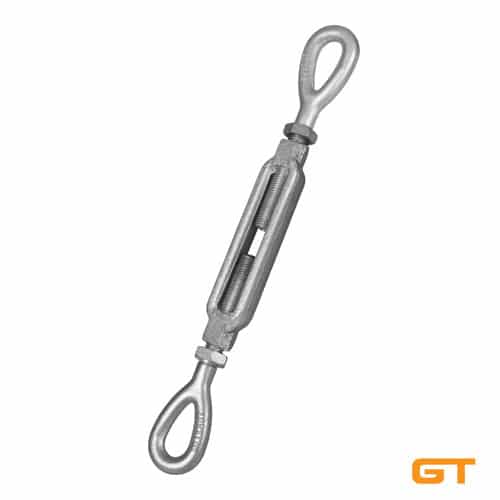
A turnbuckle takes up slack and applies tension. The body has a right hand thread at one end and a left hand thread at the other, so turning it draws both end fittings together — or pushes them apart, depending which way you turn.
The end fittings decide the application. Jaw ends connect directly to shackles, plates and fittings. Eye ends suit a permanent connection through a thimbled rope eye. Hook ends are quickest to engage but rely on the load staying in tension.
The most common failure is winding out too far. Both end fittings must remain adequately threaded into the body, and a turnbuckle wound towards its limit leaves too little engaged.
Manufacturer specification. Drop forged, high tensile steel, SAE 1035 or SAE 1045. Hot dipped galvanised finish. Meets the performance requirements of ASTM F1145-92 (formerly US Fed. Spec. FF-T-791b). Temperature range -20ºC up to +200ºC. Proof load tested to 2 times the W.L.L. Minimum breaking load is 5 times the W.L.L. UNC Threads. All items available with lock nuts. Marked with CE, UKCA, W.L.L, manufacturers ID, size, traceability code and L/R.
Key Features
- Hot Dipped Galvanised finish: Identifies the range on site — never repaint a lifting product
- Minimum breaking load 5 times the W.L.L.: The safety factor built into the rating
- Drop forged, high tensile steel, SAE 1035 or SAE 1045: As specified by the manufacturer
- Hot dipped galvanised finish: As specified by the manufacturer
- Meets the performance requirements of ASTM F1145-92 (formerly US Fed: As specified by the manufacturer
- FF-T-791b): As specified by the manufacturer
- Temperature range -20ºC up to +200ºC. Proof load tested to 2 times the: As specified by the manufacturer
- All items available with lock nuts: As specified by the manufacturer
Technical Specifications
| Product Code |
Size (inches) |
Take Up (inches) |
W.L.L. (t) |
A (mm) |
B (mm) |
R (mm) |
S (mm) |
C (mm) |
O (mm) |
Weight (kgs) |
| TBEE6X4 |
1/4 |
4 |
0.23 |
120 |
102 |
20 |
8.5 |
215 |
307 |
0.14 |
| TBEE8X4.5 |
5/16 |
4 1/2 |
0.36 |
138 |
114 |
24 |
11.2 |
249 |
354 |
0.2 |
| TBEE10X6 |
3/8 |
6 |
0.54 |
180 |
152 |
28.5 |
13.5 |
308 |
460 |
0.34 |
| TBEE12X6 |
1/2 |
6 |
1 |
190 |
152 |
36.5 |
18 |
380 |
532 |
0.71 |
| TBEE12X9 |
1/2 |
9 |
1 |
267 |
229 |
36.5 |
18 |
456 |
685 |
0.85 |
| TBEE12X12 |
1/2 |
12 |
1 |
343 |
305 |
36.5 |
18 |
510 |
815 |
1 |
| TBEE12X18 |
1/2 |
18 |
1 |
495 |
457 |
36.5 |
18 |
684 |
1081 |
1.6 |
| TBEE16X6 |
5/8 |
6 |
1.59 |
203 |
152 |
45 |
22.5 |
398 |
550 |
1.17 |
| TBEE16X9 |
5/8 |
9 |
1.59 |
279 |
229 |
45 |
22.5 |
474 |
703 |
1.42 |
| TBEE16X12 |
5/8 |
12 |
1.59 |
355 |
305 |
45 |
22.5 |
550 |
855 |
1.67 |
| TBEE19X6 |
3/4 |
6 |
2.36 |
213 |
152 |
53 |
25.4 |
448 |
600 |
1.87 |
| TBEE19X9 |
3/4 |
9 |
2.36 |
289 |
229 |
53 |
25.4 |
524 |
753 |
2.22 |
| TBEE19X12 |
3/4 |
12 |
2.36 |
365 |
305 |
53 |
25.4 |
600 |
900 |
2.57 |
| TBEE19X18 |
3/4 |
18 |
2.36 |
517 |
457 |
53 |
25.4 |
752 |
1209 |
3.27 |
| TBEE22X12 |
7/8 |
12 |
3.27 |
374 |
304 |
60 |
32 |
630 |
934 |
3.77 |
| TBEE22X18 |
7/8 |
18 |
3.27 |
527 |
457 |
60 |
32 |
782 |
1239 |
4.7 |
| TBEE25X6 |
1 |
6 |
4.54 |
233 |
152 |
76 |
37 |
552 |
704 |
4.1 |
| TBEE25X12 |
1 |
12 |
4.54 |
385 |
305 |
76 |
37 |
704 |
1009 |
5.33 |
| TBEE25X18 |
1 |
18 |
4.54 |
537 |
457 |
76 |
37 |
856 |
1313 |
6.56 |
| TBEE25X24 |
1 |
24 |
4.54 |
690 |
610 |
76 |
37 |
1010 |
1620 |
7.83 |
| TBEE32X12 |
1 1/4 |
12 |
6.89 |
388 |
305 |
90 |
46 |
776 |
1081 |
9.1 |
| TBEE32X18 |
1 1/4 |
18 |
6.89 |
541 |
457 |
90 |
46 |
928 |
1385 |
10.94 |
| TBEE32X24 |
1 1/4 |
24 |
6.89 |
693 |
610 |
90 |
46 |
1080 |
1690 |
12.75 |
| TBEE38X12 |
1 1/2 |
12 |
9.71 |
403 |
305 |
103 |
53.8 |
838 |
1143 |
12.93 |
| TBEE38X18 |
1 1/2 |
18 |
9.71 |
555 |
457 |
103 |
53.8 |
990 |
1447 |
15.43 |
| TBEE38X24 |
1 1/2 |
24 |
9.71 |
708 |
610 |
103 |
53.8 |
1144 |
1754 |
17.97 |
| TBEE44X18 |
1 3/4 |
18 |
12.7 |
571 |
457 |
117 |
60.5 |
1076 |
1544 |
23.37 |
| TBEE44X24 |
1 3/4 |
24 |
12.7 |
724 |
610 |
117 |
60.5 |
1230 |
1840 |
26.91 |
| TBEE50X24 |
2 |
24 |
16.8 |
740 |
610 |
146 |
68 |
1400 |
2010 |
39.93 |
| TBEE63X24 |
2 1/2 |
24 |
27.2 |
795 |
610 |
165 |
79 |
1490 |
2100 |
70.96 |
| TBEE70X24 |
2 3/4 |
24 |
34 |
795 |
610 |
178 |
82.5 |
1562 |
2172 |
82.22 |
Full dimensional data and Working Load Limits for every size are given in the manufacturer information sheet.
LOLER Ready
Drop forged, high tensile steel, SAE 1035 or SAE 1045. Hot dipped galvanised finish. Meets the performance requirements of ASTM F1145-92 (formerly US Fed. Spec. FF-T-791b). Temperature range -20ºC up to +200ºC. Proof load tested to 2 times the W.L.L. Minimum breaking load is 5 times the W.L.L. UNC Threads. All items available with lock nuts. Marked with CE, UKCA, W.L.L, manufacturers ID, size, traceability code and L/R. Under LOLER 1998, lifting accessories require thorough examination by a competent person at intervals not exceeding 12 months, and immediate withdrawal after any overload.
Suitable Applications
Tensioning and adjusting rigging runs: guy wires on masts and towers, structural bracing and tie rods, fencing and barrier tensioning, marine rigging and mooring, tent and marquee structures, and machinery alignment. Closed body types are stronger and cleaner; open body straining screws let you see the thread engagement, which is a genuine advantage on a run that gets adjusted often.
More About This Product
A turnbuckle is one of the few rigging components whose failure is usually caused by adjustment rather than by load. Overloaded turnbuckles are rare; turnbuckles wound out until almost nothing is threaded into the body are common, and they fail at a fraction of their rating without anyone having exceeded the marked capacity.
The second cause is vibration. A turnbuckle carrying a guy wire on a mast, or bracing on a structure with plant running nearby, will unwind itself over weeks. The tension goes, the brace stops working, and nothing about the installation looks different from the ground.
Thread Engagement, Locking and Reading the Body
Thread engagement is the specification that matters and the one nobody records. Both end fittings must remain substantially threaded into the body — the manufacturer states the minimum, and a turnbuckle wound out towards its limit is carrying its load on a few threads at each end rather than along the full engagement.
The practical rule is that if you need more take-up than the turnbuckle comfortably provides, you need a longer turnbuckle, not a more optimistic reading of this one. Open body straining screws have a genuine advantage here: you can see the engagement, which on a closed body you cannot.
Locking matters on anything left in service. Lock nuts on both ends, tightened against the body, are the standard answer. Wire locking is used where vibration is severe. An unsecured turnbuckle on a vibrating structure is a maintenance item that will need attention long before anyone plans for it.
Reading the body at inspection tells you what has happened to it. A bent body means side loading — the turnbuckle has been used at an angle rather than in straight-line tension, and it is scrap. Distorted jaws or elongated pin holes mean overload. Both are visible if you look, and both are easy to walk past on a structure with fifty turnbuckles on it.
How to Use
- Check thread engagement at both ends: Winding out towards the limit leaves too little thread engaged and is the common cause of failure.
- Fit lock nuts on anything left in service: Vibration unwinds turnbuckles. A slackened brace or guy is doing nothing.
- Tension progressively: Turn the body steadily rather than forcing it, and check the run as tension comes on.
- Do not apply side or angular load to the body: A turnbuckle is designed for straight-line tension.
- Fit the correct securing device: Safety bolts or cotter pins retain the jaw pins, and the type changes with size.
- Do not modify: Never weld, heat, machine or drill.
Warning: Winding a turnbuckle out too far leaves insufficient thread engaged and is a common cause of failure. Both ends must remain adequately threaded into the body. Fit lock nuts on any installation left in service, since vibration will unwind an unsecured turnbuckle.
Safety Information
- Never exceed the marked Working Load Limit.
- Maintain adequate thread engagement at both ends.
- Fit lock nuts on permanent and semi-permanent installations.
- Do not apply side or angular load to the body.
- Withdraw any turnbuckle showing thread damage, jaw distortion, body bending or cracks.
- Never weld, heat treat, machine or repaint.
- Where used as a lifting accessory, thorough examination at intervals not exceeding 12 months under LOLER 1998.
Inspection and Maintenance
Check thread engagement first, since that is the most common problem and the easiest to see: both end fittings should be well into the body, not wound out to their limit. Inspect the threads themselves for damage, stretching and corrosion, and the body for bending, which indicates side loading. Examine both end fittings for opening and wear at the pin holes, and confirm the pins and their securing devices are present. On galvanised turnbuckles left outdoors for years, check for corrosion where the coating has broken down, particularly in the threads where it matters most.
Downloads
Frequently Asked Questions
Q: How far can I wind it out?
Not to the limit. Both end fittings must remain adequately threaded into the body. If you need more take-up, use a longer turnbuckle rather than extending this one.
Q: Do I need lock nuts?
On anything left in service, yes. Vibration unwinds turnbuckles, and a guy wire or brace that has slackened is doing nothing useful.
Q: Closed body or open body?
A closed body is stronger and cleaner. An open body straining screw lets you see how much thread is engaged, which is a real advantage on a run adjusted often.