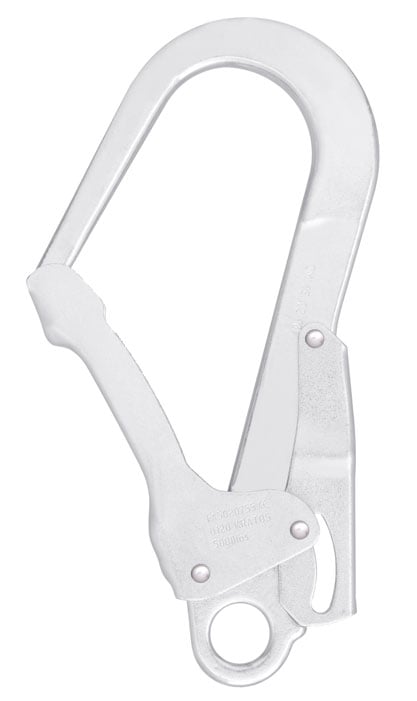
A scaffold hook is a karabiner scaled up to fit a scaffold tube, and that single change makes it the connector of choice for anyone working on or around scaffolding. The 50.8 mm gate drops over standard tube without needing to thread a sling round first, and the double action mechanism means the gate locks itself as soon as it closes, with no collar to remember. Alloy steel, 23 kN breaking strength, certified to BS EN 362 Class T.
Key Features
- 50.8 mm gate opening: Sized to clip directly onto scaffold tube, structural members and larger anchor points that a standard karabiner will not fit.
- Double action locking: The gate locks automatically on closing and needs a deliberate two-stage action to open. Nothing to forget, which matters when clipping and unclipping repeatedly at height.
- Class T termination connector: Designed so the load sits in a predetermined direction, which is what gives a large-gate hook its stability under load.
- 23 kN breaking strength: Above the EN 362 requirement despite the large opening.
- Alloy steel: Robust enough for constant clipping onto steel tube, which is abrasive work.
- Standard lanyard fitting: Commonly supplied as the working end of shock absorbing lanyards.
Technical Specifications
| Property |
Value |
| Product Code |
FA 50 207 55 |
| Material |
Alloy steel |
| Breaking Strength |
23 kN |
| Gate Opening |
50.8 mm |
| Operating Type |
Double action locking |
| Conformity |
BS EN 362 Class T |
| PPE Category |
Category III |
BS EN 362 Class T | Double Action Locking | 23 kN | Category III PPE
Conforms to BS EN 362 Class T, the classification for termination connectors designed so the load is applied in a predetermined direction. Double action locking mechanism requires a deliberate two-stage operation to open. Category III personal protective equipment under Regulation (EU) 2016/425, supplied with a Declaration of Conformity. Requires inspection by a competent person at intervals not exceeding 12 months and immediate withdrawal after arresting a fall.
Suitable Applications
The scaffold hook is standard equipment for scaffolding erection and dismantling, work on and around tube and fitting structures, steel erection where members are too large for a standard karabiner, temporary works, and general construction where anchor points are structural rather than engineered. It is most often found on the working end of a shock absorbing lanyard, since a technician moving along a scaffold clips and unclips constantly and the automatic locking removes a step each time. Where the anchor point is even larger, the 110 mm anchorage hook or a 60 mm rebar hook may be needed.
More About This Product
Connectors are bought on price more often than any other component in a fall protection system, and they are the component where that is least sensible. A karabiner is the single point through which the entire system passes, and the difference between a good one and a poor one is measured in how the gate behaves after two years on site rather than in how it performs new.
The practical differences show up in use. A gate that is stiff with a glove on gets clipped carelessly. A connector too small for the anchor gets forced. One too large rolls out. None of these is a rating problem, and none of them appears on a spec sheet.
Gate Types, Roll-Out and Choosing by Anchor
Gate mechanism determines how a connector is used in practice. A screwgate is secure and slow, needing a deliberate twist to lock — and it is the one most often left unlocked, because locking it is a separate action nobody sees you skip. A twist-lock or triple-action gate locks automatically, which removes that failure mode entirely at the cost of being fiddlier with heavy gloves.
Roll-out is the failure mode that surprises people. A correctly rated connector can twist and come out of an anchor point that is too wide, too flat or awkwardly shaped, under load, without anything breaking. It is a geometry problem, not a strength problem, and no amount of extra rating prevents it. Where the anchor is a wide flat plate or a large eye, a connector with a captive-eye or a purpose-shaped body is the answer.
Gate opening is the dimension to check before buying a fleet. A connector that will not fit the anchor points on your site is useless whatever its rating, and the discovery is normally made on the day by someone who then improvises.
How to Use the Scaffold Hook
- Check the anchor is suitable: Scaffold tube is convenient but the structure must be capable of withstanding fall arrest forces. Not every tube is.
- Clip on and confirm it has locked: The gate should close and lock automatically. Confirm by trying to open it without operating the mechanism.
- Load along the spine: Class T means the connector is designed to sit in a particular orientation under load. Let it find that position rather than forcing it.
- Never load the gate.
- Watch for roll-out on large sections: A large-gate hook on a large member can rotate into a position where it levers open. Check the geometry.
- Keep the mechanism clean: Double action mechanisms have more moving parts than a screw collar and grit affects them more.
Warning: Category III PPE for trained, competent persons only. Confirm the double action mechanism has locked after every connection. Check that the connector cannot rotate into a position where it could lever open against the structure. Withdraw immediately after arresting a fall.
Safety Information
- For use only by trained and competent persons within a safe system of work.
- The anchor structure must be capable of withstanding fall arrest forces.
- Confirm the gate has locked after every connection.
- Load along the spine. Never load the gate.
- Check the connector cannot lever open against the structure.
- Withdraw if the double action mechanism fails to lock automatically.
- Withdraw immediately after arresting a fall.
- Inspection by a competent person required at intervals not exceeding 12 months.
Inspection and Maintenance
The double action mechanism is the part that needs attention and it has more to go wrong than a screw collar. Operate it repeatedly at each inspection: the gate must close and lock under its own action every time, and opening must require the full deliberate two-stage sequence. A mechanism that occasionally fails to lock, or that can be opened with a single movement, is a failure regardless of how the connector otherwise looks. Keep it clean and lightly oiled, since scaffold work generates grit and rust scale that work into the pivot. Inspect the throat and gate nose for wear from repeated contact with steel tube, and check the body for distortion and legible marking.
Downloads
Frequently Asked Questions
Q: What does Class T mean?
Class T is a termination connector, designed so that the load is applied in a predetermined direction. On a large-gate hook that geometry is what keeps the connector stable and correctly oriented under load, which a plain oval karabiner of the same size would not be.
Q: What is double action locking?
The gate locks itself as soon as it closes, and opening requires two deliberate movements in sequence, typically pushing and then twisting. The advantage over a screw collar is that nothing can be forgotten. The disadvantage is more moving parts to keep clean.
Q: Will it fit standard scaffold tube?
Yes. The 50.8 mm gate is sized for standard scaffold tube, which is 48.3 mm outside diameter. It will also fit many structural members and larger anchor points. For anything bigger, look at the 60 mm rebar hooks or the 110 mm anchorage hook.
Q: Is aluminium available?
Yes, FA 50 218 60 is the aluminium double action scaffold hook with a 60 mm gate. Lighter, larger opening, but less resistant to the abrasion of repeated clipping onto steel tube. For heavy daily scaffolding use, steel usually lasts better.