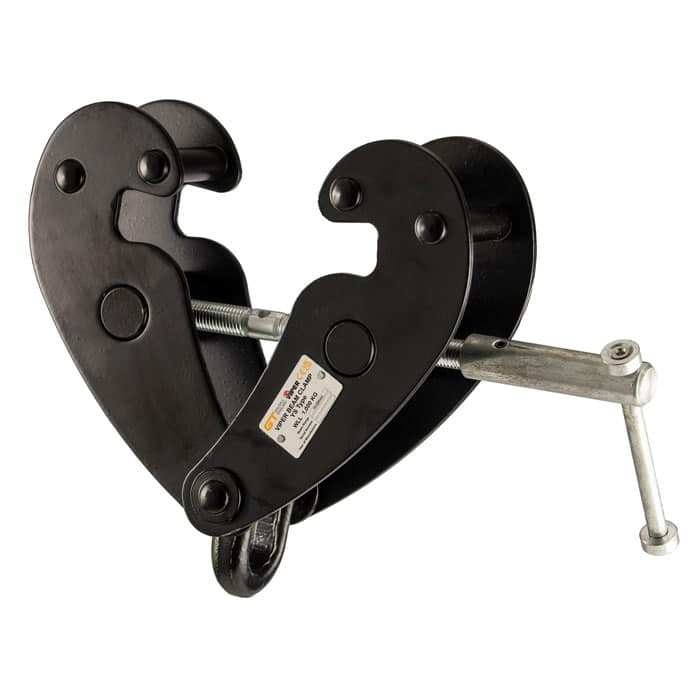
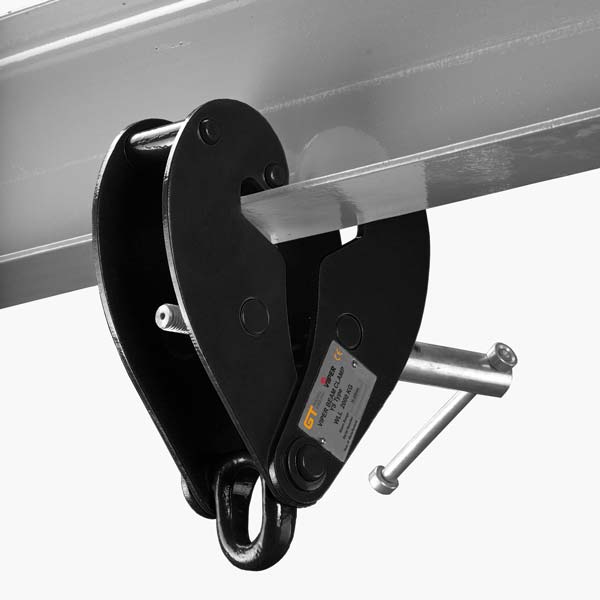
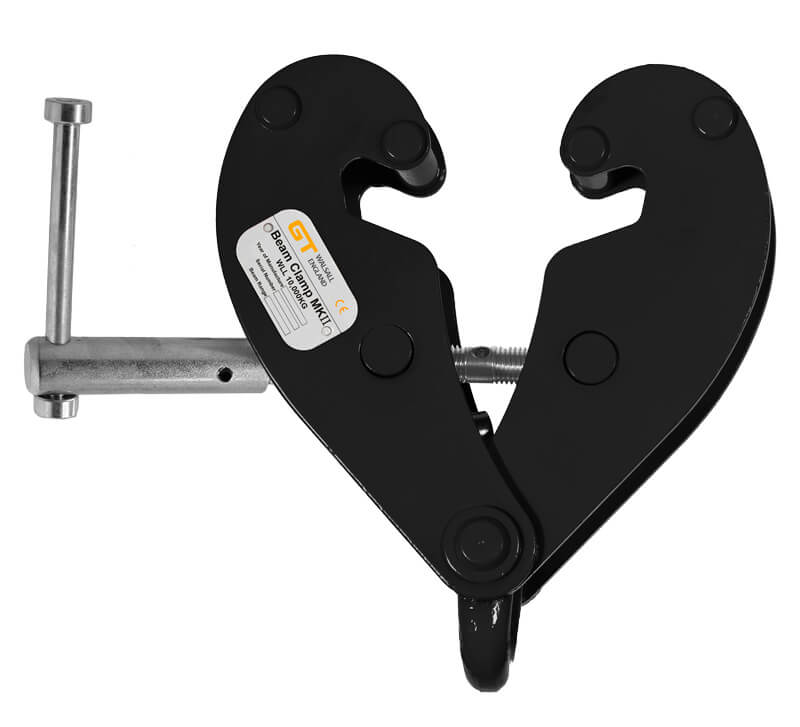
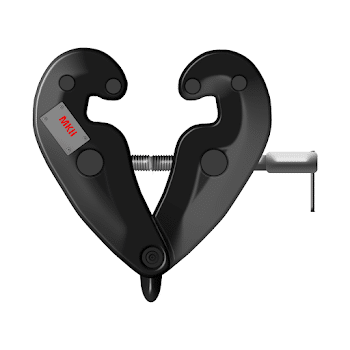
A chain block is no use without something to hang it from. A beam clamp turns any suitable structural beam into a rated lifting point in under a minute, with no drilling, welding or permanent alteration. Wind the screw adjuster to the flange width, tighten, and you have a certified anchor. The jaw geometry on this range is worth understanding: it applies load inboard of the flange edge rather than at the tip, which substantially reduces the bending stress imposed on the flange itself.
Key Features
- Load applied away from the flange edge: The jaw design puts the load inboard rather than at the flange tip, reducing flange stress. On older or lighter beams that difference can be the deciding factor in whether the beam is suitable at all.
- Wide flange range: 75 mm to 220 mm on the standard range, covering most common universal beams and columns.
- Screw adjustment: Simple, quick and positive. Set to the flange, tighten, done.
- Five capacities: 1, 2, 3, 5 and 10 tonnes, matching the common chain block and lever hoist sizes.
- BS EN 13155: The standard for non-fixed load lifting attachments, with a minimum breaking load of four times the W.L.L.
- Light for capacity: The 1 tonne clamp weighs 3.8 kg, so it goes up a ladder without difficulty.
Technical Specifications
| Product Code |
W.L.L. (kg) |
Flange Range (mm) |
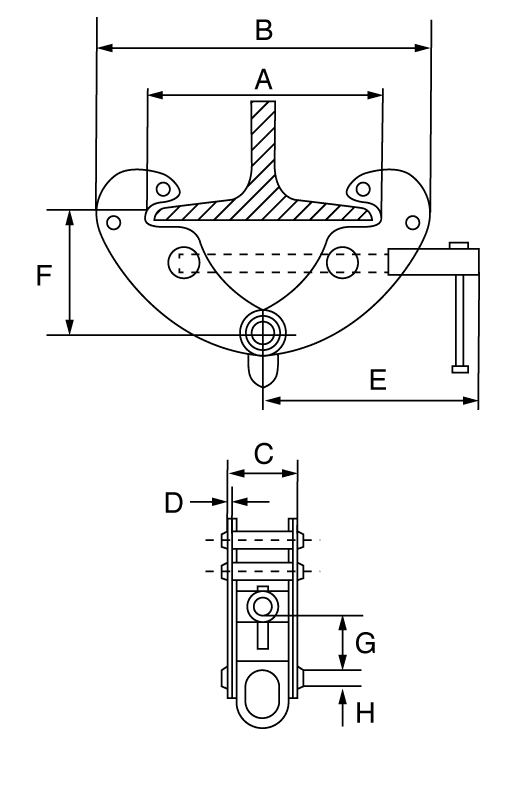
A max (mm) |
B max (mm) |
B min (mm) |
C (mm) |
E (mm) |
F max (mm) |
F min (mm) |
Weight (kg) |
| VBC1 |
1,000 |
75 – 220 |
295 |
400 |
185 |
80 |
225 |
165 |
90 |
3.8 |
| VBC2 |
2,000 |
75 – 220 |
295 |
400 |
185 |
85 |
225 |
165 |
90 |
5 |
| VBC3 |
3,000 |
— |
— |
— |
— |
— |
— |
— |
— |
— |
| VBC5 |
5,000 |
— |
— |
— |
— |
— |
— |
— |
— |
— |
| VBC10 |
10,000 |
— |
— |
— |
— |
— |
— |
— |
— |
— |
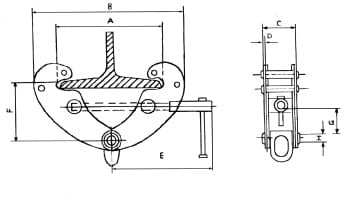
All dimensions in millimetres. Full dimensional data for the 3, 5 and 10 tonne clamps is given in the user instruction manual below.
BS EN 13155 | 4:1 Minimum Breaking Load | LOLER Ready
Manufactured and marked in accordance with BS EN 13155, the standard for non-fixed load lifting attachments. Minimum breaking load is four times the marked Working Load Limit. Supplied with test certification. Under LOLER 1998, lifting equipment requires thorough examination by a competent person at intervals not exceeding 12 months, or 6 months where used to lift persons.
Suitable Applications
Beam clamps suit any lift needing a temporary fixed anchor from overhead steelwork: workshop and maintenance lifting, plant and machinery installation, engine and gearbox removal, temporary hoisting on construction sites, and rigging in existing buildings where no lifting beam is installed. Paired with a chain block it makes a complete lifting arrangement in minutes. Note that a clamp is a fixed point: if the load must also travel along the beam, a trolley is the correct product.
More About This Product
Material handling equipment solves the problem that most manual handling injuries come from: moving something heavy a short distance. Cranes handle the long lifts; the damage is done shifting a machine six metres across a workshop because it seemed too short a distance to be worth rigging.
The equipment is straightforward. The considerations that catch people out are the floor, the route and the momentum of something heavy once it is rolling.
The Route Is the Risk
A load on wheels behaves entirely differently from a load being lifted, and the risks move with it.
Point loading comes first. Wheel loads under a laden truck or skate concentrate onto small hard wheels, and the pressure at each contact patch is far higher than the load's own footprint would suggest. Slabs that carry the static load comfortably can crack, and floor coverings can be marked or cut.
Level changes are where control is lost. A multi-tonne load rolling at walking pace and stopping abruptly against a threshold, an expansion joint or a change in floor covering keeps trying to move. Anyone with a hand on it at that moment finds out how much energy is in it. The answer is to slow down before the change, not at it.
Gradients compound the same problem. Even a slight slope in a workshop floor will accelerate a heavy load on good wheels, and a load that gets away has no brakes.
Nobody walks alongside. The instinct is to have people at the sides steadying the load, and that is exactly where they should not be if it shifts or a wheel collapses. Push or pull from a position of control, keep feet clear of the wheels, and treat the route as part of the plan rather than as the bit between the lifting points.
How to Use the Beam Clamp
- Assess the beam first, always: The clamp is rated; the beam may not be. The structure must be capable of taking the load plus the weight of the hoist and clamp, and a structural engineer's view is needed where there is any doubt.
- Check the flange is in range: Measure the flange width and confirm it falls within the clamp's range.
- Centre the clamp on the beam: The clamp must sit square with both jaws bearing evenly on the flange.
- Tighten fully: Wind the adjuster until the clamp is firm against the flange on both sides. A loose clamp can shift under load.
- Check it after first loading: Take up the load slowly, then re-check the clamp has not moved before committing.
- Do not side load: This clamp is designed for vertical load. Angular pulling imposes forces it is not rated for. Where side loading is unavoidable, use the VUBC universal clamp, which is rated for any angle.
Warning: The beam clamp is only as safe as the beam it clamps to. Always assess the structure before use. Do not side load a standard beam clamp. Never exceed the marked Working Load Limit, and remember it must carry the hoist and clamp weight as well as the load.
Safety Information
- The supporting structure must be assessed as capable of taking the load.
- Never exceed the marked Working Load Limit.
- Flange width must fall within the clamp's stated range.
- Both jaws must bear evenly on the flange with the clamp square to the beam.
- Tighten fully and re-check after initial loading.
- Vertical loading only. Use a universal clamp where side loading is required.
- Do not use with a damaged, distorted or corroded beam flange.
- Thorough examination by a competent person required at intervals not exceeding 12 months under LOLER 1998.
Inspection and Maintenance
The jaws and the screw thread are what matter. Inspect the jaw faces for wear, spreading and any deformation, since a jaw that has opened no longer grips as designed and may load the flange edge rather than inboard. Check the screw thread runs smoothly through its full travel and shows no stripping or corrosion, as a thread that binds gets forced and a forced thread strips at the worst moment. Look for cracking at the frame, particularly around the jaw transitions, and confirm the suspension eye shows no elongation. Keep the thread clean and lightly oiled.
Downloads
Frequently Asked Questions
Q: Beam clamp or beam trolley?
A clamp is a fixed point: the load goes up and down in one place. A trolley runs along the beam, so the load can travel. If you are lifting a machine out and setting it down beside itself, a clamp is fine and cheaper. If it needs moving along the bay, you want a trolley.
Q: How do I know my beam can take it?
You need to assess it, and if you are not competent to do so, get someone who is. The clamp's rating tells you nothing about the beam. Consider the beam section, its span, what it already carries, and where along its length you are loading it, since a load at mid-span is far more onerous than one near a support.
Q: What does "load away from the flange edge" mean?
The jaw is shaped so the load bears inboard on the flange rather than at its tip. Loading at the tip bends the flange, and on lighter sections that bending can be the limiting factor. Applying it inboard reduces that stress considerably, which widens the range of beams the clamp can safely be used on.
Q: Can I pull at an angle with it?
Not with this clamp, which is designed for vertical loading. Angular pull imposes side loads on the jaws that it is not rated for. The VUBC universal beam clamp is rated at full capacity at any angle and is the correct product for angled work.
Q: What size do I need for my hoist?
Match the capacity to the hoist, and remember the clamp carries the hoist's own weight as well as the load. A 2 tonne chain block lifting 1.8 tonnes with the hoist weighing 20 kg needs a clamp rated for the total, not just the load.