WolffKran Group · Est. 1854Fast UK delivery & export optionsPrice match promiseCredit accounts for business01709 437141
Prices
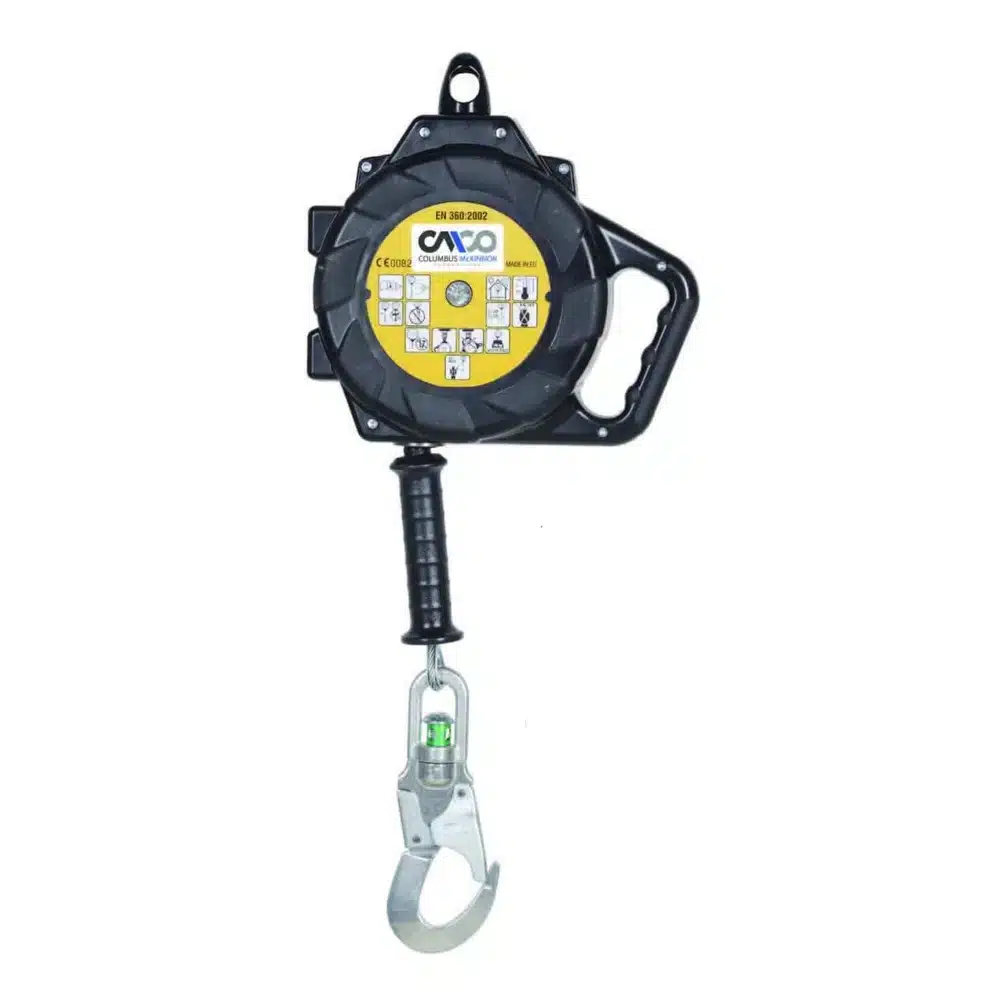
The Yale fall arrest cable block is a self-retracting fall arrest block to BS EN 360.
Its galvanised steel wire rope pays out as the user moves away from the anchor and winds back in as they return. If the user falls, a speed-sensitive brake locks the line, so the fall distance is much shorter than with a fixed lanyard.
It comes in six lengths from 6 m to 25 m. The 6 m to 15 m CMHCR250v blocks use 4 mm cable, are rated 140 kg and have a fall indicator in the connector. Made by Columbus McKinnon and supplied with a test certificate and operating manual.
Choose a size above to see its specifications.
| Model | Article no. | Cable length | Cable diameter | WLL | Weight |
|---|---|---|---|---|---|
| CMHCR250v06-2 | 192066967 | 6 m | 4 mm | 140 kg | 4 kg |
| CMHCR250v10-2 | 192066968 | 10 m | 4 mm | 140 kg | 4.2 kg |
| CMHCR250v12-2 | 192066972 | 12 m | 4 mm | 140 kg | 4.7 kg |
| CMHCR250v15-2 | 192066973 | 15 m | 4 mm | 140 kg | 4.9 kg |
| CMHCR30020 | N37320020 | 20 m | |||
| CMHCR30025 | N37320025 | 25 m |
Cable: galvanised steel wire rope. Standard: BS EN 360. Anchor: overhead and certified; see the operating manual.
Fall arrest equipment only works as a complete system, with every part certified for fall arrest:
| Part | Standard | What it does |
|---|---|---|
| Anchor device | EN 795 | The secure point you connect to. Types A to E cover fixed anchors, temporary anchors such as tripods and beam clamps, flexible and rigid lifelines, and deadweight anchors. |
| Energy-absorbing lanyard | EN 355 | Limits the force on the body in a fall to no more than 6 kN. The absorber can extend by up to 1.75 m as it works. |
| Retractable fall arrester (fall arrest block) | EN 360 | The line pays out and retracts as you move, and locks if you fall, limiting the force to no more than 6 kN. |
| Full body harness | EN 361 | Connect fall arrest equipment only to the attachment points marked A. |
| Connectors | EN 362 | Karabiners and hooks that join the parts together. |
Always read the manufacturer’s instructions before use.
Pick the shortest cable that gives you the working radius you need from the anchor. Longer cables add weight and allow more swing.
For shorter reach, the 6 m Yale webbing block uses webbing instead of cable. The 6 m and 10 m blocks suit single-storey access; 15 m to 25 m suit multi-level structural work.
The anchor must be overhead and certified; ask us to confirm the rating. Check the fall clearance for your block in its operating manual.
A: The block keeps the line taut and locks quickly in a fall, so the fall distance and clearance needed are shorter than with a lanyard and energy absorber.
A: No. It must be anchored overhead, ideally directly above the work position.
A: Take the block out of service for inspection by a competent person. A contaminated cable may not lock properly.
A: A check before every use, a thorough examination by a competent person every 6 months, and any manufacturer service at the interval in the operating manual. Withdraw it after any fall arrest.


Loading your basket…
Delivery calculated at checkout.
CheckoutCard, Apple Pay, Pay by bank, proforma or 30-day account

Yale's story starts in 1868, when Linus Yale Jr. and Henry R. Towne set up a factory in Stamford, Connecticut. Hoist production followed in 1875, and in 1877 Yale built the first hand chain hoist with a load pressure brake, a design still used in almost every manual hoist made today.
See all Yale products →