

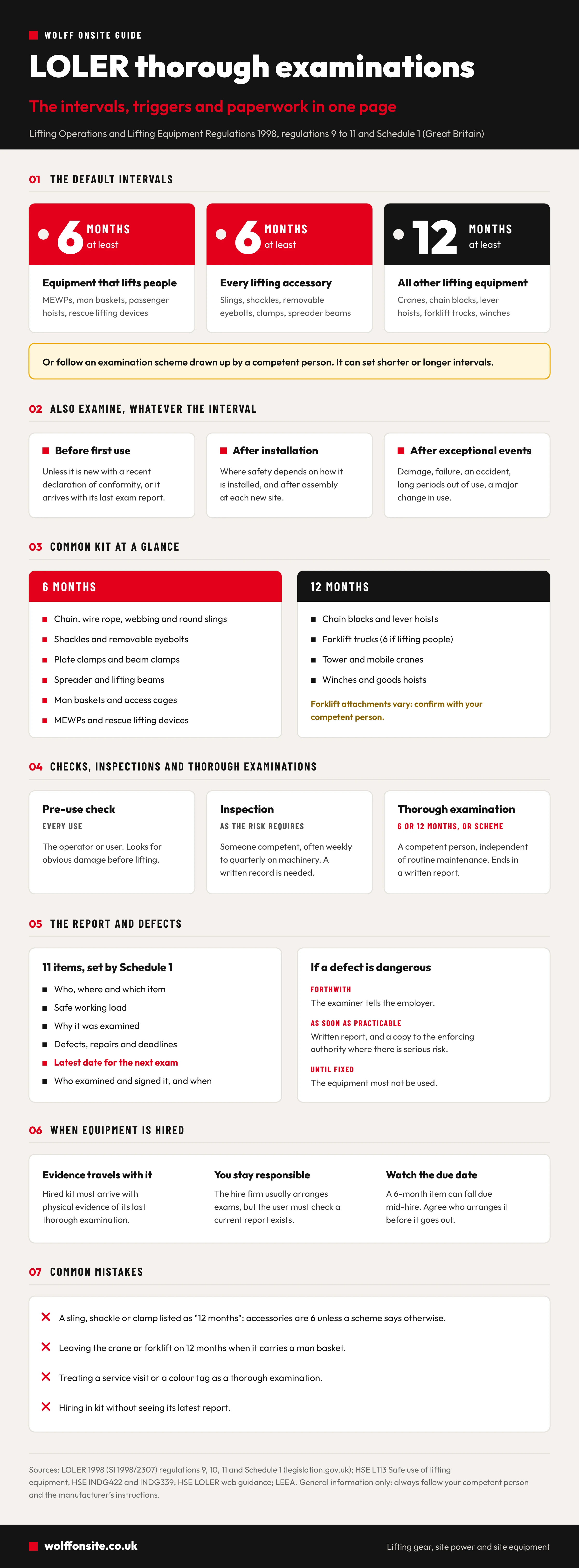
Under LOLER, lifting accessories and anything used to lift people must be thoroughly examined at least every 6 months. Other lifting equipment needs it at least every 12 months, unless a competent person has drawn up an examination scheme that sets different intervals. That one sentence is the core of regulation 9(3), but the detail around it is where most mistakes happen: which items count as accessories, what "before first use" means for new kit, what happens to the interval when a forklift carries a man basket, what a report must say, and who is responsible when equipment is hired. This guide works through each point using the regulations themselves, HSE's Approved Code of Practice (L113) and leaflets, and LEEA guidance, with sources at the end.
This guide is general information for Great Britain. It does not replace the judgement of a competent person or the manufacturer's instructions for your equipment.
The quick answer
- 6 months at least: lifting accessories (slings, shackles, removable eyebolts, plate clamps, spreader beams and similar) and any lifting equipment used to lift people (MEWPs, man baskets and the machine carrying them, passenger hoists, rescue lifting devices). Source: LOLER regulation 9(3)(a)(i).
- 12 months at least: all other lifting equipment, such as cranes, chain blocks, lever hoists, winches and forklift trucks used only for goods. Source: regulation 9(3)(a)(ii).
- Or an examination scheme: a competent person can set different intervals, shorter or longer, based on how the equipment is used and how fast it deteriorates. Source: regulation 9(3)(a)(iii).
- Extra examinations: before first use (with a narrow exemption for new kit), after installation or assembly at a new site where safety depends on installation, and after exceptional circumstances such as damage, an accident or a long period out of use. Source: regulations 9(1), 9(2) and 9(3)(a)(iv).
- The report: must contain the 11 items listed in Schedule 1, including the latest date by which the next thorough examination must be carried out.
- Dangerous defects: the examiner must tell the employer forthwith; where there is an existing or imminent risk of serious injury, a copy of the report also goes to the enforcing authority. The equipment must not be used until the defect is put right. Source: regulation 10.
- Hired equipment: must be accompanied by physical evidence that its last thorough examination was carried out. The intervals do not change because the kit is hired. Source: regulation 9(4).
What counts as lifting equipment, accessories and people-lifting kit
The Lifting Operations and Lifting Equipment Regulations 1998 (SI 1998/2307), usually shortened to LOLER, apply in Great Britain to lifting equipment provided for use or used at work. Northern Ireland has its own equivalent, the Lifting Operations and Lifting Equipment Regulations (Northern Ireland) 1999. The duties fall on employers, on self-employed people for the equipment they use at work, and on anyone who has control of lifting equipment, of the people using it, or of the way it is used, to the extent of that control (regulation 3).
Which interval applies depends on which of three groups an item falls into, so the definitions matter.
Lifting equipment
Regulation 2 defines lifting equipment as "work equipment for lifting or lowering loads", including its attachments used for anchoring, fixing or supporting it. HSE's LOLER FAQ adds that a load can include a person. L113 (paragraph 28) lists examples including cranes, lift trucks and telehandlers, hand pallet trucks with raisable forks, mobile elevating work platforms, and excavators when they are used for lifting rather than normal earth-moving.
Lifting accessories
An "accessory for lifting" is defined in regulation 2 as work equipment for attaching loads to machinery for lifting. HSE describes it as any equipment used to attach a load to lifting equipment that is not a permanent part of either the load or the lifting equipment. L113 (paragraph 29) lists slings, removable eyebolts, chains, shackles, grabs, magnets, vacuum lifters, crane forks, lifting beams and spreaders. An accessory can be a single item or an assembly, such as a multi-leg chain sling with its master link, hooks and shorteners.
The "not a permanent part" test is the one to keep in mind. LEEA's FAQ on skip-loader chains applies the same logic: hoisting mechanisms permanently attached to a vehicle are examined at least every 12 months, but quickly detachable chain assemblies used with different vehicles should be treated as lifting accessories and examined at least every 6 months.
Equipment for lifting people
Regulation 9(3)(a)(i) puts "lifting equipment for lifting persons" on the 6-month interval along with accessories. Regulation 5 adds design and use requirements for it, including preventing people being crushed, trapped, struck or falling from the carrier, and making sure anyone trapped can be freed. HSE's guidance on lifting people says such equipment must be thoroughly examined at six-monthly intervals, or in accordance with an examination scheme. It is the use that counts: a crane or forklift that is normally a 12-month machine becomes people-lifting equipment when it is used with a man basket.
What is not covered
- Fall-arrest equipment: L113 (paragraph 32) excludes fall-arrest equipment, including eyebolts fixed to a structure to secure it. Harnesses, lanyards and fall-arrest blocks used only to arrest a fall are inspected under the Work at Height Regulations 2005 instead.
- Fixed anchor points that form part of a building or structure, according to HSE's FAQ.
- Pallets, skips and similar containers that carry material and are not permanently attached to the lifting machine are usually treated as part of the load. They do not need a thorough examination, though HSE says they should still be maintained and inspected.
- Eyebolts permanently fixed to the load are part of the load (L113 paragraph 32).
- Equipment that only lifts itself or its own parts, such as a cab tilt mechanism, is not lifting equipment, according to HSE's operational guidance for vehicle workshops.
Anything that falls outside LOLER is still work equipment under PUWER, which requires it to be maintained and, where it deteriorates in a way that could be dangerous, inspected.
The three intervals: 6 months, 12 months or a scheme
Regulation 9(3) applies to lifting equipment "exposed to conditions causing deterioration which is liable to result in dangerous situations". In practice almost all lifting equipment in use on sites, in workshops and in warehouses meets that description. For it, the employer must make sure it is thoroughly examined:
- at least every 6 months, for lifting equipment for lifting persons or an accessory for lifting;
- at least every 12 months, for other lifting equipment; or
- in either case, in accordance with an examination scheme;
and also each time exceptional circumstances that are liable to jeopardise its safety have occurred.
Three points are often missed.
"At least" means a maximum gap, not a target. Six months is the longest the equipment may go without a thorough examination unless a scheme says otherwise. Each report must state "the latest date by which the next thorough examination must be carried out" (Schedule 1, paragraph 8). Work to the date on the report, not to a calendar month you remember.
The interval follows the use, not the product. A chain block is a 12-month item when used to lift goods. A forklift truck is a 12-month item until it carries a man basket. HSE's LOLER FAQ states the minimum plainly: thorough examination "must take place every 12 months - or every 6 months if the equipment is used to lift people."
Accessories have no 12-month default. LEEA's chief executive put it bluntly in 2015, warning that some users had been "incorrectly advised that money can be saved by extending all the intervals between thorough examinations to 12 months", and that "any extension to intervals must be based on a rigorous risk assessment". The route to a longer interval for an accessory is an examination scheme, not a product description.
How examination schemes work
An examination scheme is defined in regulation 2 as a suitable scheme drawn up by a competent person for thorough examinations of lifting equipment at set intervals. It replaces the 6- and 12-month defaults for the equipment it covers. HSE's INDG422 explains what a scheme does:
- it sets out a detailed schedule of checks, examination techniques and any testing, suited to the equipment's operating conditions;
- it can cover a group of similar items used in the same conditions;
- it can specify intervals shorter or longer than 6 or 12 months, but longer periods must rest on "a rigorous assessment of the risks";
- it must be reviewed at each thorough examination and after any event that may change the risks.
HSE's thorough examination page adds that a scheme must specify the parts to be examined, the methods and the intervals, and should cover any other inspection regimes. It does not have to be a single document, but you must be able to produce a written copy on request and protect it from loss or unauthorised changes.
Schemes are not only a way to stretch intervals. HSE's FAQ says a competent person may set a stricter regime for extreme temperatures, corrosive environments, heavy use, or where failure could be catastrophic. Equally, a longer interval may be justified where deterioration is slow, and sampling may be used for large numbers of identical items. A scheme is a professional judgement about a specific fleet in specific conditions. It is not something you can copy from another site or take from a product page.
Before first use, after installation and after exceptional circumstances
The periodic interval is only one of four triggers in regulation 9.
Before first use: regulation 9(1)
Every employer must make sure lifting equipment is thoroughly examined for defects before it is put into service for the first time. There are two exemptions. The first needs both conditions: the equipment has not been used before, and (where an EC declaration of conformity could or should have been drawn up) the employer has received a declaration made not more than 12 months before the equipment is put into service. The second covers equipment obtained from another undertaking, such as kit bought second-hand or hired in: it does not need an examination before first use if it comes with physical evidence that its last thorough examination was carried out (regulation 9(4)). In plain terms, new kit with a recent declaration of conformity, or second-hand or hired kit that arrives with its last report of thorough examination, does not need a separate thorough examination before first use. New kit whose declaration is more than 12 months old does. Second-hand kit does too, unless it comes from another undertaking with physical evidence of its last thorough examination (regulation 9(4)).
Note that the 12 months here is the age of the declaration of conformity when the item goes into service. It has nothing to do with the in-service interval. A new sling that goes into service in January with a recent declaration is due its first periodic thorough examination by July.
After installation or assembly: regulation 9(2)
Where the safety of lifting equipment depends on how it is installed, it must be thoroughly examined after installation and before first use, and after assembly and before use at each new site or location. HSE's FAQ gives tower cranes as the obvious example. A chain block hung from a runway beam, a beam trolley, a gantry or a davit all depend on their installation for safety. The report for this examination must say that it is a first examination after installation or assembly and that the equipment has been installed correctly and is safe to operate (Schedule 1, paragraph 6).
After exceptional circumstances: regulation 9(3)(a)(iv)
Lifting equipment must also be examined each time exceptional circumstances liable to jeopardise its safety have occurred. HSE gives examples including damage or failure, long periods out of use, major changes in conditions of use, an accident or dangerous occurrence, and replacement of examinable parts. A sling that has been shock-loaded, a hoist that has been dropped, or a crane that has been struck all fall into this category. The examination is needed before the equipment is used again, whatever date the previous report gave.
How the intervals apply to common kit
The matrix below gives the default interval for each item, assuming no examination scheme is in place. The notes that follow explain the borderline cases.
Chain slings
Chain slings are lifting accessories: 6 months. The examination covers the whole assembly, including the master link, any intermediate links, connectors, hooks and shorteners. HSE's FAQ notes that chain and wire slings can be marked with their safe working load on a durable tag, the ferrule or the master link.
Webbing and round slings
Flat webbing and round slings are also accessories at 6 months. Textile slings are vulnerable to cuts, abrasion, heat and chemical attack, and the label carrying the working load limit is part of what makes them usable: a sling with an illegible label cannot be identified against its report. HSE's FAQ accepts colour coding on textile slings as a supplement to marking, but not as a substitute for it.
Shackles
Shackles are accessories: 6 months. Where a shackle stays permanently part of an assembly, HSE says it needs no separate marking, but the assembly's safe working load must suit every component in it.
Eyebolts
Removable eyebolts are accessories at 6 months. An eyebolt permanently fixed to the load is part of the load, and an eyebolt fixed to a structure to anchor fall-arrest equipment is excluded from LOLER altogether (L113 paragraph 32). The same item can therefore sit in three different regimes depending on how it is used. If you use lifting points that stay fitted to a load, ask your competent person how they should be recorded.
Plate clamps and beam clamps
Plate clamps attach the load to the hook, so they are accessories at 6 months. Beam clamps are a borderline case. LEEA's Code of Practice for the Safe Use of Lifting Equipment treats them as lifting accessories that should be examined at intervals not exceeding 6 months, but says a period not exceeding 12 months is permitted where adequate controls ensure the clamp stays installed as a suspension point.
Spreader and lifting beams
Spreader beams and lifting beams are named as accessories in L113 paragraph 29: 6 months. Modular beams should be examined in the configurations in which they are used, and the report should record the safe working load for the last configuration examined (Schedule 1, paragraph 5).
Chain blocks and lever hoists
Chain blocks and lever hoists are lifting machinery rather than accessories: 12 months. HSE's operational circular for vehicle workshops lists chain blocks and winches at 12 months. Where a hoist is installed on a beam or gantry, it also needs an examination after installation. Hoists that move from job to job, are used in dirty or corrosive conditions or are heavily used are common candidates for a shorter interval under a scheme.
Forklift trucks and forklift attachments
HSE's FAQ says a forklift's chains, forks, mast and cylinders, and fork attachments, need a thorough examination every 12 months or in line with a written scheme. If the truck is used with a man basket, it is lifting people and moves to 6 months. The truck's non-lifting parts, such as brakes and lights, are maintained and inspected under PUWER.
Forklift attachments are the area where views differ most. HSE groups fork attachments with the truck at 12 months. But an attachment that is detached and moved between trucks, or that is used to hang a load from a hook, has a lot in common with a lifting accessory, and many examiners place items such as fork-mounted jibs and fork hooks on a 6-month cycle. LEEA's reasoning on detachable skip-loader chains points the same way. The safe course is to ask your competent person which interval they apply and to record it in the scheme. The slings and shackles used with a fork-mounted jib are accessories at 6 months whatever the jib's interval.
Man baskets and access cages
Man baskets and access cages lift people, so they are on 6 months, and so is the crane or truck carrying them while it is used that way. HSE's guidance on lifting people says equipment not designed for lifting people should only be used to do so in exceptional circumstances, and points to its guidance PM28 on non-integrated work platforms on forklifts. L113 advises that lifting equipment not designed for lifting people should be derated by 50% when used for that purpose (paragraph 128). Where the risk of the carrier falling cannot be prevented by suitable devices, regulation 5(2) requires an enhanced safety coefficient suspension rope or chain, which a competent person must inspect every working day.
MEWPs
Mobile elevating work platforms are lifting equipment for lifting people (L113 paragraph 28): 6 months, plus the operator's pre-use checks and any inspections the risk assessment requires.
Fall-arrest kit used for rescue
Fall-arrest equipment used only to arrest a fall is outside LOLER and is inspected under the Work at Height Regulations 2005. Rescue is different. A rescue winch on a tripod, a fall-arrest block with an integral rescue winch, or a rescue lifting device used to raise or lower a person is doing exactly what the regulation 2 definition describes: lifting or lowering a load, where the load is a person. The widely held position, which follows from the definitions, is that such kit is lifting equipment for lifting people when used that way and should be on a 6-month thorough examination cycle under LOLER as well as its work-at-height inspections. Check how your competent person and the manufacturer classify the specific device. WOLFF Onsite's rescue and rope access range includes equipment in both categories.
Tower cranes
A tower crane needs a thorough examination after erection and before use at each site (regulation 9(2)), then periodic examinations at least every 12 months, unless it lifts people or an examination scheme applies. If the crane is climbed, extended or reconfigured, ask the competent person whether that counts as a reassembly or as exceptional circumstances needing examination; the scheme should say. The hook block is part of the crane, but the slings, shackles and other gear hung from it are accessories on 6 months. Our guide to tower crane lifting accessories covers that equipment in detail.
Worked example: one year, four items
The timeline below is an illustration, not a real record. It assumes no examination scheme is in place and shows how the triggers in regulation 9 combine over twelve months.
- Chain sling, new in January. It is unused and comes with a declaration of conformity well under 12 months old, so no examination is needed before first use. Its first periodic thorough examination is due by July and the next by January. Pre-use checks happen every time it is used.
- Chain block installed on a runway beam in January. Its safety depends on the installation, so it is examined after installation and before first use. In August it is dropped while being moved. That is an exceptional circumstance: it is examined before it is used again. Its 12-month examination is due by the date on its last report.
- Man basket used with a crane. Both the basket and the crane are lifting people, so both are on 6 months: January, July and January. If the crane also does general lifting, its 6-month cycle still applies, because it is used to lift people.
- Hired webbing sling. Its last report is dated February, so its next examination is due by August. It is hired from April to November, so the examination falls due during the hire. The hirer and hire company need to agree before it goes out who will arrange the examination, or swap the sling for one with a current report.
Inspections, checks and thorough examinations
LOLER uses "thorough examination" and "inspection" as separate things, and both are separate from the user's pre-use check and from routine servicing.
| Activity | Who does it | How often | Legal basis | Record |
|---|---|---|---|---|
| Pre-use check | The operator or user | Before each use | Good practice under PUWER and LOLER; HSE expects pre-use checks on slings and chains | Not required by LOLER, often logged |
| Inspection | A competent person, often trained operators or maintenance staff | As the risk assessment and competent person decide, often weekly, monthly or quarterly on machinery | LOLER regulation 9(3)(b) | Written record, kept until the next one is made (regulations 10(2) and 11) |
| Thorough examination | A competent person independent of routine maintenance | 6 or 12 months, a scheme, and the other triggers in regulation 9 | LOLER regulation 9 | Report containing the Schedule 1 items |
| Servicing and maintenance | Maintenance staff or contractors | As the manufacturer specifies | PUWER regulation 5 | Maintenance log, where kept |
INDG422 says inspections may be needed between thorough examinations, usually where the risk assessment identifies a significant risk, and normally include visual and functional checks. It also says accessories such as chains or slings normally do not need inspections if they have thorough examinations and pre-use checks. HSE's FAQ is clear that servicing does not replace a thorough examination, and that the organisation that services the equipment may carry out the examination, but the person who services it should not examine it, because they would be assessing their own work.
Testing is a different question again. The regulation 2 definition says a thorough examination includes such testing as is appropriate. HSE notes that most equipment does not need routine testing at every examination and that some overload tests can cause damage. Whether to test is the competent person's call, based on risk.
How LOLER works with PUWER
LOLER does not stand alone. L113 says LOLER builds on the Provision and Use of Work Equipment Regulations 1998 (PUWER), and that PUWER applies to all work equipment, including lifting equipment. In practice:
- PUWER regulation 5 requires all work equipment, lifting equipment included, to be maintained in an efficient state, in efficient working order and in good repair. LOLER examinations do not replace that.
- PUWER regulation 6 requires inspection of work equipment that is exposed to dangerous deterioration, but regulation 6(5)(c) disapplies it for "work equipment for lifting loads including persons", because LOLER regulation 9 covers that ground. Regulation 6(5)(f) also disapplies it for equipment covered by regulation 12 of the Work at Height Regulations 2005, which is where fall-arrest kit is inspected.
- Selection, training and information come from PUWER for lifting equipment as for any other work equipment.
- Non-lifting parts of a lifting machine, such as a forklift's brakes and lights, are dealt with under PUWER. INDG422 makes this point directly.
HSE's operational circular for vehicle workshops sums it up: PUWER covers the non-lifting side of work equipment, LOLER covers lifting, and the two act together.
Who counts as a competent person
LOLER does not define "competent person". HSE's thorough examination page quotes L113, which says the person should have "appropriate practical and theoretical knowledge and experience" of the equipment, enough to detect defects and weaknesses and judge how important they are to safe use. HSE also says:
- the competent person must be sufficiently independent and impartial to make objective decisions;
- they can come from an outside organisation, but do not have to; in-house staff can do it if they have the competence, authority and independence;
- they should not be the person who carries out routine maintenance on the equipment, because they would be assessing their own work.
Note that the competent person who plans a lift under regulation 8, often called the appointed person, is a different role with different skills. L113 says so explicitly. Being competent to plan lifts does not make someone competent to examine equipment, or the other way round.
LEEA trains and accredits lifting equipment examiners, and many duty holders use LEEA member companies, insurers' engineering inspection services or independent inspection bodies. None of these is a legal requirement in itself; competence and independence are.
What a report of thorough examination must contain
There is no prescribed form. HSE says there is "no longer a defined format or form", as long as the report contains all 11 items in LOLER Schedule 1. It must be in writing and signed or authenticated in an equivalent secure way (regulation 10(1)(b)).
Schedule 1 requires:
- The name and address of the employer for whom the examination was made.
- The address of the premises where it was made.
- Particulars sufficient to identify the equipment, including its date of manufacture where known.
- The date of the last thorough examination.
- The safe working load or, where it depends on configuration, the safe working load for the last configuration examined.
- For a first examination after installation or assembly: a statement that it is such an examination and, if so, that the equipment has been installed correctly and would be safe to operate.
- For any other examination: whether it was within a 6-month interval, a 12-month interval, under an examination scheme, or after exceptional circumstances, and, if so, that the equipment would be safe to operate.
- In every case: identification of any part found to have a defect that is or could become a danger to people, with a description of the defect; particulars of any repair, renewal or alteration needed; for defects that are not yet dangerous, the time by which they could become so and the remedy; the latest date by which the next thorough examination must be carried out; particulars of any test; and the date of the examination.
- The name, address and qualifications of the person making the report, and whether they are self-employed or, if employed, the name and address of their employer.
- The name and address of a person signing or authenticating the report on behalf of its author.
- The date of the report.
Item 7 is where the interval is stated, and item 8 is where the next due date is fixed. If a report for a sling says "12-month interval" with no examination scheme behind it, that is worth querying with whoever issued it.
Defects and the timescales for reporting
Regulation 10 sets out what the examiner and the employer must do. The language is "forthwith" and "as soon as is practicable"; the regulation itself sets no number of days.
- Any defect that is or could become a danger to people: the examiner must notify the employer forthwith (regulation 10(1)(a)).
- Every thorough examination: the examiner must, as soon as is practicable, make a written report to the employer and to any person from whom the equipment has been hired or leased (regulation 10(1)(b)).
- Existing or imminent risk of serious personal injury: the examiner must also send a copy of the report as soon as is practicable to the relevant enforcing authority (regulation 10(1)(c)). For hired or leased equipment that is HSE; otherwise it is the authority responsible for the premises where the examination took place (regulation 10(4)). INDG422 says this applies even where the defect is dealt with on the spot.
- The employer's duty: once notified, the employer must make sure the equipment is not used before the defect is rectified or, for a defect with a time given in the report, after that time unless it has been rectified (regulation 10(3)).
On timing, HSE's leaflet on thorough examination of lifts (INDG339) says the report should be sent as soon as practicable and "should normally be within 28 days", and that you should expect it much sooner where a serious defect needs attention. That 28-day figure is HSE guidance, not a number written into LOLER, but it is a reasonable benchmark to put into an examination contract.
Inspections have a parallel duty: the person inspecting must notify the employer forthwith of any dangerous defect and make a written record of the inspection (regulation 10(2)).
Record-keeping
Regulation 11 sets how long each document must be kept available for inspection. INDG422 reproduces the same periods in its Table 3.
| Record | Keep it | Regulation |
|---|---|---|
| EC (or equivalent) declaration of conformity | For as long as you operate the equipment | 11(1) |
| Report of examination before first use, lifting equipment | Until you stop using the equipment | 11(2)(a)(i) |
| Report of examination before first use, lifting accessory | Two years after the report is made | 11(2)(a)(ii) |
| Report of examination after installation or assembly | Until you stop using the equipment at the place it was installed or assembled | 11(2)(a)(iii) |
| Periodic and exceptional-circumstances reports (6-month, 12-month, scheme) | Until the next report is made, or two years, whichever is later | 11(2)(a)(iv) |
| Inspection records | Until the next record is made | 11(2)(b) |
Records do not have to be on paper. HSE says electronic records are acceptable if they are protected against unauthorised alteration and you can produce a written copy on request, including to an inspector. In practice, many duty holders keep reports for the life of the equipment, because the history helps the examiner spot trends.
Two practical habits make the records useful rather than just compliant. First, give every item a unique identifier that appears on the item and on its report; a report that cannot be matched to a sling is not much use. Second, keep a register of every item with its next due date, so the 6-month items do not drift onto the annual cycle.
What changes when equipment is hired
Less than many people assume. The intervals are the same, and the legal duty to have equipment thoroughly examined sits with the employer using it.
- Evidence must travel with it. Regulation 9(4) says lifting equipment must not leave an undertaking, and equipment obtained from another undertaking must not be used, unless it is accompanied by physical evidence that the last required thorough examination has been carried out. L113 (paragraph 44) gives the example of a crane hire company's duty to make sure such evidence, for example a copy of the latest report, goes with the crane.
- The user remains responsible. HSE's FAQ says hire firms usually carry out or arrange the examinations, but the legal responsibility rests with the user, who should confirm a current report exists before use.
- The hire company gets a copy. The examiner's report goes to the employer and to the person from whom the equipment was hired or leased (regulation 10(1)(b)).
- HSE is the enforcing authority for serious-defect reports on hired or leased equipment (regulation 10(4)).
- Watch the due date. A 6-month item hired for several months can fall due mid-hire. Put in the hire agreement who will arrange the examination, or plan to swap the item.
- Installation is on site. If hired kit is installed or assembled on your site in a way that affects its safety, it needs the regulation 9(2) examination there, whoever owns it.
HSE also says written copies of records must be available when equipment leaves your undertaking for any reason: on hire, for use elsewhere, or for second-hand sale.
Colour-tag schemes
Many sites use coloured tags, cable ties or paint to show at a glance that an item has been examined in the current period. The colour changes each examination period, so anything still carrying the previous colour stands out.
It is a common and useful industry practice, but it is not a legal requirement. LEEA's FAQ says there is "no statutory requirement within legislation, or applicable standards mandating the use of colour-coded tags". Duty holders can choose tags, labels or digital tracking, provided the system is clear to staff. Two cautions apply:
- A tag is not a report. The thorough examination report is the legal record; the tag only signals it.
- Colour coding is not safe working load marking. HSE's FAQ says colour coding alone is generally not acceptable for marking safe working loads, though it can supplement other marking, for example on textile slings.
If you use a colour scheme, write down which colour applies to which period, make sure examiners and site staff use the same key, and check that tags do not damage the item or hide its markings.
Common mistakes
Treating accessories as 12-month items
This is the most common error, and it is widespread in product copy. Manufacturer and retailer descriptions for slings, shackles, eyebolts and clamps regularly state that the item "requires inspection every 12 months under LOLER". Without an examination scheme drawn up by a competent person, a lifting accessory must be examined at least every 6 months. If a product page or a certificate says otherwise, the regulation wins.
Forgetting the base machine when lifting people
A man basket on a 6-month cycle carried by a forklift or crane still on its 12-month cycle is a gap. The machine is lifting people, so it needs the 6-month interval too.
Assuming new kit needs no paperwork
The before-first-use exemption only applies to unused equipment with a declaration of conformity made not more than 12 months before it goes into service. Keep that declaration for as long as you operate the equipment. Second-hand kit needs an examination before first use unless it arrives from the previous owner or hirer with physical evidence of its last thorough examination (regulation 9(1) and 9(4)); if in doubt, have it examined.
Treating a service as an examination
Servicing is a PUWER maintenance task. It does not replace a thorough examination, and the person who services an item should not examine it.
Skipping the post-installation examination
Hoists on beams, trolleys, gantries and davits all depend on their installation. Moving one to a new beam or a new site triggers a fresh examination.
Not acting on a time-limited defect
A defect that "could become dangerous" comes with a date. After that date the equipment must not be used unless the defect has been put right (regulation 10(3)).
Relying on tags instead of reports
A current colour tag on an item with no traceable report does not show compliance.
Not checking hired kit
Hired equipment without evidence of its last thorough examination must not be used (regulation 9(4)).
Checklist for duty holders
- Every lifting item has a unique ID that matches its report.
- Your register shows, for each item, whether it is an accessory, people-lifting equipment or other lifting equipment, and its next due date.
- Accessories and people-lifting equipment are on 6 months unless a competent person's scheme says otherwise, and the scheme is written down.
- Any machine that lifts people, even occasionally, is on the 6-month interval.
- New items have a declaration of conformity no more than 12 months old at first use, or have been examined before first use.
- Installed equipment has been examined after installation at its current location.
- Staff know that damage, overloads, accidents and long periods out of use trigger an examination before reuse.
- Each report contains all 11 Schedule 1 items, including the latest date for the next examination.
- Defects with a deadline are tracked to completion, and dangerous kit is quarantined.
- The examiner is competent and independent of the people who maintain the kit.
- Pre-use checks are done and inspections are scheduled where the risk requires them.
- Hired items arrive with evidence of their last examination, and due dates during the hire are agreed in advance.
- Records are kept for at least the regulation 11 periods and can be produced in writing on request.
If you are buying lifting gear, WOLFF Onsite supplies chain slings, shackles, hoists and the rest of the kit in this guide from established manufacturers. Ask for the declaration of conformity with each item, and put its first in-service examination date in your register on the day it arrives.
Frequently asked questions
Q: How often do lifting accessories need a thorough examination?
At least every 6 months, under LOLER regulation 9(3)(a)(i), unless a competent person has drawn up an examination scheme that sets a different interval. There is no 12-month default for accessories such as slings, shackles, removable eyebolts, plate clamps and spreader beams.
Q: Is LOLER every 6 months or every 12 months?
Both. Equipment used to lift people and lifting accessories are at least every 6 months; other lifting equipment is at least every 12 months. An examination scheme can replace either default.
Q: Does new lifting equipment need a thorough examination before first use?
Not if it has never been used and the employer has received a declaration of conformity made not more than 12 months before it is put into service (regulation 9(1)). New equipment with an older declaration must be examined before first use, and so must second-hand equipment unless it comes from another undertaking with physical evidence of its last thorough examination (regulation 9(4)). Equipment whose safety depends on installation must also be examined after installation.
Q: Is a LOLER inspection the same as a thorough examination?
No. A thorough examination is the periodic examination under regulation 9 by a competent person, ending in a report with the Schedule 1 contents. An inspection is a lighter check between examinations where the risk calls for it, with a written record. People often say 'LOLER inspection' when they mean a thorough examination.
Q: Who can carry out a LOLER thorough examination?
A competent person with appropriate practical and theoretical knowledge and experience of the equipment, who is independent and impartial enough to make objective decisions. They can be in-house or external, but should not be the person who routinely maintains the equipment.
Q: How quickly must the report be issued?
LOLER says the employer must be told forthwith of dangerous defects and the written report must follow as soon as is practicable. HSE's lifts leaflet INDG339 says this should normally be within 28 days, and sooner where a serious defect needs attention.
Q: Does a forklift need a 6-month or 12-month LOLER examination?
12 months for goods-only use, covering the forks, chains, mast and cylinders and fork attachments, or as set by a scheme. If it is used with a man basket or any other way to lift people, it needs 6-monthly examination.
Q: Are harnesses and fall-arrest lanyards covered by LOLER?
Not when used only for fall arrest: L113 excludes fall-arrest equipment, and it is inspected under the Work at Height Regulations 2005. Equipment used to raise or lower a person in a rescue is lifting people and is generally treated as LOLER equipment on a 6-month cycle; check with your competent person and the manufacturer.
Q: Who is responsible for LOLER examinations on hired equipment?
The employer using it holds the legal duty, even though hire companies usually arrange examinations. Hired equipment must arrive with physical evidence of its last thorough examination (regulation 9(4)), and you should check its next due date falls after the hire ends.
Q: Are colour-coded tags a legal requirement?
No. LEEA confirms there is no statutory requirement for colour-coded tags. They are a useful way to show at a glance which items are in date, but the thorough examination report is the legal record, and colour alone is not acceptable as safe working load marking.
Q: How long must LOLER reports be kept?
Periodic reports until the next report or two years, whichever is later. Reports of examination before first use until you stop using the equipment, or two years for accessories. Post-installation reports until you stop using the equipment at that place. Inspection records until the next record. Declarations of conformity for as long as you operate the equipment.
Q: Can an examination scheme extend accessory intervals beyond 6 months?
Yes, if a competent person draws up a scheme based on a rigorous assessment of the risks, sets out what is examined and how, and reviews it at each examination. It cannot simply be copied from a product description or another site.
Sources
- The Lifting Operations and Lifting Equipment Regulations 1998 (SI 1998/2307), legislation.gov.uk
- LOLER regulation 9: Thorough examination and inspection
- LOLER regulation 10: Reports and defects
- LOLER Schedule 1: Information to be contained in a report of a thorough examination
- LOLER regulations 2, 3, 5, 7 and 11 (body of the regulations)
- The Provision and Use of Work Equipment Regulations 1998, Part II (regulations 5 and 6)
- HSE L113: Safe use of lifting equipment, Approved Code of Practice and guidance (second edition, 2014)
- HSE INDG422: Thorough examination of lifting equipment, a simple guide for employers
- HSE INDG290: Lifting equipment at work, a brief guide
- HSE INDG339: Thorough examination and testing of lifts
- HSE: Thorough examinations and inspections of lifting equipment
- HSE: LOLER frequently asked questions
- HSE: Lifting equipment used for lifting people at work
- HSE Operational Circular OC 803/69: PUWER and LOLER in motor vehicle repair
- LEEA COPSULE: Statutory thorough examination of beam clamps
- LEEA FAQ G12: Is the use of coloured tagging mandatory?
- LEEA FAQ G33: Thorough examination of skip wagon chains
- KHL/Vertikal: LEEA warns about thorough examination intervals (16 March 2015)


