
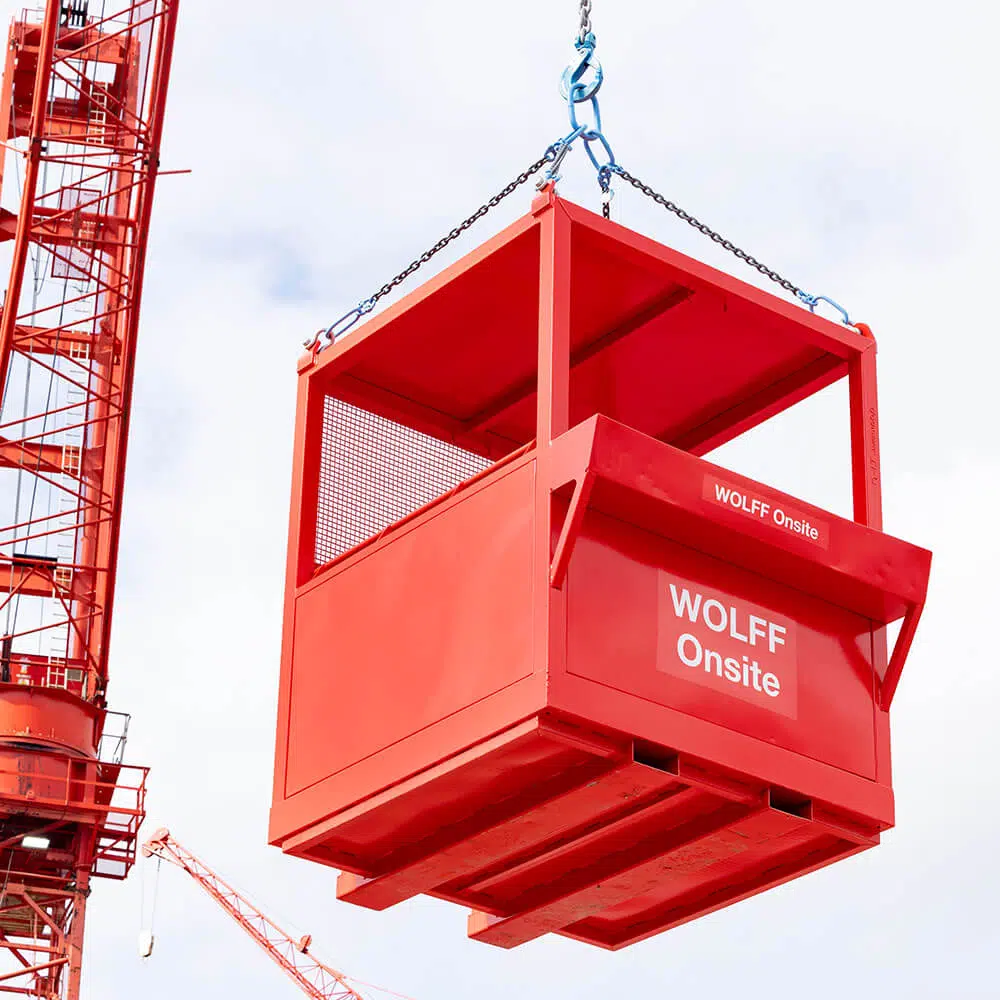
A man basket (also called a man rider, man cage or personnel access cage) is a cage designed and certified for lifting people on a crane hook. In the UK it should only be used where it is not reasonably practicable to use a safer means of access such as a MEWP, scaffold or stair, and every lift must be planned by a competent person under LOLER, following BS 7121, with a rescue plan, communication, harness attachment as the cage manufacturer specifies, a trial lift and pre-use checks. Choose the cage by the number of people, the rated load including tools, the size and gate arrangement, and the cage's certification for lifting persons, and never put people in a goods cage.
WOLFF Onsite stocks crane-suspended personnel cages, mainly from Conquip and Eichinger: the Conquip Access Cage range (1, 2, 4, 6 and 12 persons), the Eichinger Access Cage Man Riding Basket (1, 2 and 4 persons), a cantilevered Offset Access Cage for work beneath slabs and slipform structures, and the Conquip Shaft Access Platform for membrane work in shafts. Alongside them sit rescue and stretcher cages, and goods carrying cages that are for materials only.

WOLFF man baskets and personnel cages at a glance
The table below is built from WOLFF's product listings. WLL and SWL are given as each listing states them; both mean the most the cage may carry, people, tools and materials together.
| Cage | Persons | Rated load | Size and self weight | Door or access | Features stated | Standard cited by the listing |
|---|---|---|---|---|---|---|
| Conquip Access Cage | 1, 2, 4, 6 or 12 | 120 kg to 1,440 kg, depending on size | Not stated per size | Self-closing door with safety locking catch | Half-height solid steel sides; harness point per occupant; SHS Emergency Descent Point; four-leg chain supplied; 2-person size has fork pockets and toolbox | BS EN 14502-1:2010, BS 8681-2024 |
| Conquip Access Cage - 6 Person | Check before ordering: the product page gives 6 persons in the title but 4 persons in the capacity field. | Description states 720 kg; confirm | Not stated | Description: single gated entry with secondary latch | Harness point per occupant; four-leg chain | BS EN 14502-1 |
| Eichinger Access Cage 1074.1 | 1 | 150 kg SWL | 780 mm wide, 810 mm long, 2,185 mm high; self weight not stated | Inward-swinging door with catch | Four crane lifting points, fork pockets, overhead harness anchor points | BS EN 14502-1 |
| Eichinger Access Cage 1073.2 | 2 | 250 kg SWL | 1,060 mm wide, 1,200 mm long, 2,250 mm high; self weight not stated | Inward-swinging door with catch | As 1074.1; heel retaining bracket for forklift use | BS EN 14502-1 |
| Eichinger Access Cage 1074.4 | 4 | 660 kg SWL | 1,625 mm wide, 2,150 mm long, 2,185 mm high; self weight not stated | Inward-swinging door with catch | As 1073.2 | BS EN 14502-1 |
| Offset Access Cage | 3 | 500 kg SWL | 4,200 mm long, 900 mm wide, 2,200 mm high; 1,720 kg | Entry door not described; the opening hatch is for bolting brackets to cores | Cantilevered; handrail; harness points; tool tethering rails; bump stops | Listing states tested to BS EN 14502-2:2010; ask for the certificate |
| Conquip Shaft Access Platform | 5 operatives plus 1 membrane roll and tools | 4,500 kg WLL | 9,005 mm long, 2,430 mm wide, 2,550 mm high; 2,650 kg | Entry not described; retractable roof for lowering in membrane rolls | Half-moon shape; membrane A-frames; harness anchor points; purchase only | Listing cites LOLER, PUWER and the Work at Height Regulations 2005 |
Rescue and stretcher cages are covered below and in the rescue cages and stretcher cages guide.
When can you lift people with a crane?
Lifting people on a crane hook is not a normal way of getting to a work position. Cranes are designed first and foremost to lift loads, and the HSE position is that crane-suspended personnel carriers should only be used where it is not reasonably practicable to use a safer means of access. In practice that means you should have looked at, and ruled out, the alternatives first:
- A permanent or temporary stair, ladder tower or scaffold access to the work position.
- A mobile elevating work platform (MEWP), such as a scissor lift or boom lift, where the ground, reach and access route allow one.
- A mast climbing work platform or a passenger or passenger/goods hoist on taller structures.
- Doing the work at ground level, for example by fitting items before they are lifted.
This follows the Work at Height Regulations 2005 approach: avoid work at height where you can, prevent falls where you cannot, and minimise the consequences of a fall where risk remains. Write down why the safer options were not reasonably practicable. If a MEWP could do the job, use the MEWP.
The situations where a crane-suspended cage tends to be the only practical option are ones where nothing else can reach or nothing else can be set up: the top of a structure with no access yet, a position over water or open ground that cannot take a MEWP, a deep shaft or excavation, the underside of a slab or slipform structure, or an emergency rescue.
A man basket is a last-resort access method, not a quicker alternative to a MEWP or scaffold. Record why safer access is not reasonably practicable before you plan the lift.
The UK rules: LOLER, PUWER, BS 7121 and BS EN 14502-1
LOLER 1998
LOLER applies to the crane, the cage, the chain sling and every accessory in the lift. HSE's LOLER overview sets out the regulations in full. For lifting people the key points are:
- Planning. Every lifting operation must be properly planned by a competent person, appropriately supervised and carried out in a safe manner. In practice, and following BS 7121, a lift involving people needs a written lift plan specific to that lift.
- Equipment for lifting persons. LOLER requires that equipment for lifting people prevents a person being crushed, trapped, struck or falling from the carrier, and that people trapped in a carrier can be freed if the equipment fails. That second duty is the reason a rescue plan is not optional.
- Marking. Lifting equipment must be marked with its safe working load. Equipment designed for lifting people must be clearly marked as such, and equipment that is not designed for lifting people but could be mistaken for it should be marked to show that it is not. That is why goods cages should carry a "not for lifting persons" warning.
- Thorough examination. Equipment for lifting people, and lifting accessories, must have a thorough examination by a competent person at least every 6 months, or in line with a written scheme of examination. It is also examined after exceptional circumstances such as damage.
The 6-month interval covers the cage, its chain sling and fittings, and the crane when it is used for lifting people, so check all three reports before the lift.
PUWER 1998
PUWER requires the cage to be suitable for the purpose, maintained, inspected where needed and used only by people with adequate information, instruction and training: follow the manufacturer's instructions and keep inspection records.
BS 7121
BS 7121 is the British Standard code of practice for the safe use of cranes. It sets out how lifting operations are organised, including the role of the Appointed Person who plans the lift and is responsible for the lift plan, the crane supervisor, the crane operator and the slinger/signaller. If you are using a tower crane, the tower crane lifting equipment guide gives more background on the accessories in the lift.
BS EN 14502-1
BS EN 14502-1 is the design standard for baskets suspended from cranes and used for lifting people. Most of the personnel cages WOLFF lists cite it: the Conquip Access Cage range cites BS EN 14502-1:2010 and BS 8681-2024, the Eichinger Access Cage Man Riding Basket cites BS EN 14502-1, and the Conquip Rescue Cage and Conquip Stretcher Cage cite BS EN 14502-1:2010 and BS 8681-2024. Check for it on the listing, the certificate and the data plate. If a cage is not stated as designed for lifting people, do not use it for people.
Goods cages are designed to a different standard. The Conquip Crane Forks Cage, for example, states BS EN 13155, which covers non-fixed load lifting attachments for materials. That is the clearest sign on paper that a goods cage is not a man basket, however similar it looks.
What the lift plan must cover
The Appointed Person writes the lift plan and makes sure everyone involved is briefed on it before the lift. It must be specific to the job, crane, cage and people, and cover these controls.
Justification and method
Record why safer access is not reasonably practicable, the work, the route, and the landing points where occupants get in and out with the cage grounded or secured.
The crane and its limits
The crane must be one its manufacturer permits for lifting people, and the lift plan must record any conditions the crane manufacturer sets for personnel lifting. Some manufacturers and contractors reduce the permitted duty when people are lifted; how much depends on the crane, so take the figure from the crane manufacturer and the Appointed Person, not from a rule of thumb. The same goes for wind: the lift plan sets the wind speed limit for the lift, which may be lower than the limit for ordinary loads, and the crane should have a reliable way of measuring wind at the right height. The wind speed limits guide covers wind limits for tower crane operations.
Communication
The crane operator, the slinger/signaller or lift supervisor, and the people in the cage must be able to talk to each other at all times. That normally means dedicated, tested radio channels, an agreed stop signal and one person giving the operator instructions. The two-way radios guide covers site radio choice, and WOLFF's radios range includes site radios. A crane camera system can help the operator see the cage but does not replace voice communication.
Harness and attachment points
Occupants should wear a harness and attach to the cage's designated anchor points where the cage manufacturer specifies it, using the lanyard type and length the manufacturer and the lift plan specify. Every personnel cage in the WOLFF range lists harness attachment points. Never attach to the hook, sling or structure unless the lift plan says so.
Rescue plan
The plan must say how people will be got out if the crane breaks down, loses power or cannot move the cage, or if someone in the cage is taken ill. Options include the crane's emergency lowering, a second crane, a MEWP, rope access or a rescue cage. The Conquip Access Cage, Rescue Cage and Stretcher Cage carry an SHS Emergency Descent Point, which Conquip describes as a secured anchor for evacuation if the crane or lifting chain fails, and rescue products such as the Evacuation Triangle sit in the rescue and rope access range. The people and equipment for the rescue must be on site and briefed before the lift starts.
Trial lift and pre-use checks
A trial lift with the cage loaded to the planned weight but without people on board proves the route, the clearances, the crane set-up and the communication before anyone rides in it. Pre-use checks on the cage, sling and harnesses come before every lift; both are covered below.
People and supervision
Name the Appointed Person, lift supervisor, crane operator, slinger/signaller and occupants, and confirm the occupants are trained in the cage and harness and briefed on the rescue plan.
The personnel cages in the WOLFF range
Conquip Access Cage (1 to 12 persons)
The Conquip Access Cage is a crane-lifted personnel cage made in the UK in 1, 2, 4, 6 and 12-person sizes, with a working load limit from 120 kg to 1,440 kg depending on size. Every size comes with a certified four-leg lifting chain and has half-height solid steel sides, a self-closing door with safety locking catch, recessed handrails, a harness point per occupant and an SHS Emergency Descent Point. The 2-person size also has integrated fork pockets and a toolbox for forklift or telehandler lifting with tools on board. The range cites BS EN 14502-1:2010 and BS 8681-2024, with LOLER 1998 and PUWER 1998 compliance.
There is also a separate Conquip Access Cage - 6 Person listing. Its product page is currently inconsistent (the title says six persons, the capacity field four), so confirm the details with us before ordering from it.
Eichinger Access Cage Man Riding Basket (1, 2 and 4 persons)
The Eichinger Access Cage Man Riding Basket comes in three sizes: the 1074.1 single-person cage (150 kg SWL, 780 mm wide by 810 mm long, 2,185 mm high) for confined and restricted access; the 1073.2 two-person cage (250 kg SWL, 1,060 mm by 1,200 mm, 2,250 mm high) for general work at height; and the 1074.4 four-person cage (660 kg SWL, 1,625 mm by 2,150 mm, 2,185 mm high) for crews. All three have four crane lifting points, fork pockets, internal overhead harness anchor points, solid sides to half height with close mesh above and an inward-swinging door with catch.
The listing says they can be used with a tower crane, mobile crane, telehandler or forklift; on forks, the heel retaining bracket on the 1073.2 and 1074.4 must be fitted before anyone enters. Separately, check that the forklift or telehandler manufacturer permits personnel cage use on that machine.
Offset Access Cage (3 persons)
The Offset Access Cage is a specialist cantilevered cage for reaching areas a conventional basket cannot, such as beneath concrete slabs, under buildings, below slipform structures and within restricted spaces between scaffolding. It carries up to three operatives with a 500 kg SWL, weighs 1,720 kg and measures 4,200 mm long, 900 mm wide and 2,200 mm high. It has a full-length handrail, harness attachment points, two tool tethering rails, forklift pockets, side lifting points, an opening hatch so brackets can be bolted to cores without leaving the cage, and four bump stops. The listing states it is tested to BS EN 14502-2:2010. Ask us for the certificate and confirm the standard with the Appointed Person before relying on it in a lift plan.
Follow the manufacturer's instructions on loading positions and lifting points; at 1,720 kg the cage weighs far more than it carries.

Conquip Shaft Access Platform
The Conquip Shaft Access Platform is a large steel half-moon platform for applying waterproofing membrane to shaft walls and for shaft maintenance. Adjustable A-frames hold membrane rolls, a retractable roof lets fresh rolls be lowered in, and it has handrails and multiple internal harness anchor points. Its 4,500 kg WLL covers one membrane roll plus five operatives and their tools; the platform weighs 2,650 kg and measures 9,005 mm by 2,430 mm by 2,550 mm. It is listed as purchase only.
How to choose a man basket: eight questions
- Is a man basket justified at all? Confirm and record that a MEWP, scaffold, stair or other safer access is not reasonably practicable. If one is, you do not need a cage.
- How many people need to be in it? Choose the smallest person rating that does the job. The WOLFF range covers 1 to 12 persons.
- What is the total load? Add up the actual weight of the people in their PPE, plus every tool and material going up. That total must be within the cage's rated load (WLL or SWL).
- Will it fit at both ends? Check the cage's footprint and height against the landing positions, the working position and the route.
- How will people get in and out? Look at the door or gate type and which way it opens. Plan landings so the door opens onto a safe, level surface.
- Do you need overhead protection? If there is a risk of falling objects from above, ask whether the cage has a roof. None of our personnel cage listings describes a protective roof (the Shaft Access Platform's retractable roof is for loading membrane rolls), so raise it with us before ordering and control the risk in the lift plan.
- Where will tools go? The Conquip 2-person cage has a toolbox and the Offset Access Cage has two tool tethering rails. Otherwise plan tethering in the lift plan.
- Is it certified for lifting people, and is it in date? Check the standard on the listing and certificate (most of the range cites BS EN 14502-1), the data plate, the chain sling certificate and an in-date thorough examination report.
The full range is in the access cages and man baskets category.
Rated load, self weight and what the crane lifts
Three weights matter, and mixing them up is an easy way to get the crane calculation wrong:
- Rated load (WLL or SWL): the maximum the cage may carry, including people, tools and materials.
- Self weight: the weight of the empty cage.
- Gross suspended weight: what the crane actually lifts, which is the cage's self weight plus the load inside it, plus the chain sling and any other accessories between the cage and the hook.
The figures below come from WOLFF's listings and cover the cage and contents only; add the rigging.
| Cage | Self weight | Rated load | Cage plus full rated load |
|---|---|---|---|
| Offset Access Cage | 1,720 kg | 500 kg | 2,220 kg |
| Conquip Shaft Access Platform | 2,650 kg | 4,500 kg | 7,150 kg |
| Conquip Rescue Cage | 680 kg | 1,000 kg | 1,680 kg |
| Conquip Stretcher Cage | 470 kg | 240 kg | 710 kg |
| Eichinger 1075 Stretcher Rescue Cage | 450 kg | 250 kg | 700 kg (the listing's stated maximum total weight) |
Two things stand out. First, the cage can weigh far more than the people in it: the Offset Access Cage weighs more than three times its rated load. Second, the crane capacity you need is not simply the gross weight. The Eichinger 1075 listing, for example, gives a maximum total weight of 700 kg but a minimum crane capacity of 960 kg. The crane manufacturer and the Appointed Person decide whether a crane is suitable, not this table.
The Eichinger and Conquip Access Cage listings do not give self weights per size; ask us for them.
Checking the load against the rating
Here is a simple check using illustrative weights. Two operatives weighing 90 kg and 100 kg in their PPE take 20 kg of hand tools up in an Eichinger 1073.2 two-person cage. The net load is 90 + 100 + 20 = 210 kg, which is within the 250 kg SWL. If they also took a 50 kg bag of fixings, the load would be 260 kg and the cage would be overloaded, even though it still has only two people in it.
Goods cages vs personnel cages
Goods cages and personnel cages can look alike, but a goods cage is certified for materials only. The Conquip Compact Goods Cage listing says it plainly: a goods cage must never be used to carry people.
| Feature | Personnel cage (man basket) | Goods carrying cage |
|---|---|---|
| Purpose | Lifting people to a work position or rescuing them | Lifting materials, pallets and loose items |
| Standard cited on WOLFF's listings | BS EN 14502-1 (most of the range) | BS EN 13155 is cited by the Conquip Crane Forks Cage |
| Rating | Persons and rated load, both on the data plate | Load only (for example 1,500 kg, 3,000 kg or 5,000 kg) |
| Occupant protection | Handrails, harness attachment points, door with locking catch; Conquip range adds an Emergency Descent Point | Mesh or solid sides to contain the load; no harness points for people |
| Gates and ramps | Doors designed for people to enter when the cage is grounded | Gates and ramps for forklifts, pallet trucks and sack barrows |
| Thorough examination | At least every 6 months or per a written scheme | Commonly examined as a lifting accessory, at least every 6 months or per a written scheme |
WOLFF's goods carrying cages include the Conquip Goods Cage (3,000 kg WLL, Small and Large, gate or ramp access), the Conquip Compact Goods Cage (1,500 kg WLL, sized for a single 1,200 x 1,000 mm pallet), the Conquip XXL Lifting Cage (5,000 kg WLL, up to six 1,200 x 1,000 mm pallets), the Eichinger Goods Carrying Cage (1,500 kg and 3,000 kg SWL), and brick and block cages for crane forks: the Conquip Crane Forks Cage, the Eichinger Crane Fork Cage (Eichinger's crane forks and safety cages page covers the range) and the Brick Forks and Cage package. None of them is for people.

Never ride in a goods cage, a skip, a pallet, crane forks or on the hook. If the cage is not certified for lifting persons and marked with a person rating, it is not a man basket.
Rescue cages and stretcher cages
Rescue and stretcher cages are personnel carriers too, so the same planning, examination and harness rules apply. WOLFF's rescue cages include three models:
- Conquip Rescue Cage: an inverted T-shape cage designed for retrieving people suspended from a leading edge by their harness, and for reaching between floors and through restricted vertical openings. It carries four occupants, or three plus a casualty on a stretcher, with a 1,000 kg WLL and a designated harness point per occupant. It weighs 680 kg and is supplied with chain slings.
- Conquip Stretcher Cage: a rescue frame for an injured worker on a Conquip foldable stretcher plus one attendant, from a structure, tunnel or excavation. It has a 240 kg WLL, weighs 470 kg, and has an up-and-over door and a raised frame base to prevent crushing risk on landing.
- Eichinger Stretcher Rescue Cage 1075: a fully enclosed crane-suspended evacuation cage for a casualty on a stretcher plus one attendant, with a 250 kg SWL and 450 kg self weight. At 880 mm wide it is designed for tight areas between buildings, within structures and inside excavations. It has two sliding doors and spring-loaded lifting eyes to cushion landing.

A rescue cage only helps if the crane, operator and team are available and the rescue has been practised. See the rescue cages and stretcher cages guide for more.
Key terms
| Term | What it means |
|---|---|
| Man basket, man rider, man cage | Everyday names for a crane-suspended personnel carrier: a cage or basket designed and certified for lifting people. |
| WLL / SWL | Working load limit or safe working load: the maximum the cage may carry, including people, tools and materials. |
| Person rating | The maximum number of people the cage is certified to carry. Both the person rating and the rated load must be respected. |
| Appointed Person | Under BS 7121, the competent person who plans the lift and is responsible for the lift plan. |
| Thorough examination | A detailed examination by a competent person under LOLER, at least every 6 months for equipment for lifting people, or per a written scheme of examination. |
| Pre-use check | A visual and functional check by a trained user before each use. It does not replace thorough examination. |
| Trial lift | A lift of the loaded cage without people, through the planned route, to prove the plan. |
| Emergency Descent Point (EDP) | On Conquip cages, a secured anchor point for evacuation if the crane or lifting chain becomes inoperable. |
| BS EN 14502-1 | The design standard for baskets suspended from cranes for lifting people. |
| BS EN 13155 | The standard for non-fixed load lifting attachments for materials, cited by the Conquip Crane Forks Cage. |
Four example scenarios, worked through
The examples below are typical scenarios, not records of particular jobs. Weights are illustrative. Every real lift needs its own lift plan from a competent Appointed Person.
1. Fixing a bracket at the top of a steel frame with no access yet
Two steel erectors need to fit a bracket at the top of a new frame before the floor below is decked. Soft backfill and an open excavation rule out a MEWP, and the Appointed Person records why. Weighed in PPE, the erectors are 85 kg and 105 kg, and their tools and the bracket total 45 kg, a net load of 235 kg. That is within the 250 kg SWL of the Eichinger 1073.2, but with little margin, so the plan bans any extra items. The plan takes the duty and wind limit from the crane manufacturer, and a trial lift with 235 kg of test weights goes first.
2. Work beneath a slipform core
A contractor needs operatives to bolt tie brackets to a core below a slipform structure, where a basket hanging straight under the hook cannot get close. The cantilevered Offset Access Cage is designed for this. Three operatives plus tools must stay within the 500 kg SWL. The crane calculation starts from at least 1,720 + 500 = 2,220 kg before the chain sling and fittings are added, and the Appointed Person confirms the duty at the working radius. The contractor asks for the certificate before sign-off.
3. Membrane lining inside a deep shaft
A waterproofing team needs to line the wall of a circular shaft. Scaffold inside the shaft would obstruct the work, so the team uses the Conquip Shaft Access Platform. Five operatives, their tools and one membrane roll must stay within 4,500 kg WLL, and the platform itself weighs 2,650 kg, so the crane must handle a gross suspended weight of up to 7,150 kg plus rigging. The communication plan allows for the operator having no sight of the platform.
4. Someone suggests using a goods cage "just this once"
A supervisor needs one person on a roof edge for a ten-minute check and the only cage on site is a 3,000 kg Conquip Goods Cage. The answer is no. The goods cage has no person rating, no harness points and no certification for lifting people, and Conquip's Compact Goods Cage listing states that a goods cage must never be used to carry people. Use a safer means of access, or plan a proper personnel lift with a certified man basket.
Pre-use checks and the trial lift
A trained person checks before every lift, following the manufacturer's instructions. A typical checklist:
- Paperwork: the cage's certificate and current report of thorough examination; the chain sling's certificate and examination; the crane's examination; the lift plan, signed and briefed.
- Data plate: person rating and rated load clearly marked and readable, and matching the lift plan.
- Structure: no cracks, distortion or missing parts.
- Door or gate: opens and closes freely, and the catch or latch engages fully and cannot be knocked open.
- Harness points and EDP: present, undamaged and the type the occupants' lanyards are meant to connect to.
- Lifting points and sling: lifting eyes undamaged; chain sling legs, master link and fittings free of damage, stretch or wear; sling tagged and connected as the manufacturer specifies.
- Harnesses and lanyards: each occupant's harness and lanyard checked and fitted.
- Contents: tools tethered or stowed; total load within the rated load.
- Conditions: wind and weather within the limits in the lift plan; communication tested; rescue team and equipment in place.
If anything fails the check, the cage is not used until it has been put right and, where needed, re-examined. For more on inspecting chain slings, see the chain sling grades guide and WOLFF's chain slings.
The trial lift
Before the first personnel lift, and whenever the set-up changes, the cage is lifted without people but loaded to the weight planned, through the full route from the loading point to the work position and back. It proves that the cage hangs level, that the clearances work, that the crane has capacity at each radius and that communication works. Whether aids such as load navigation systems suit a personnel lift is for the Appointed Person to decide.
Common mistakes
- Using a man basket because it is convenient. If a MEWP or scaffold is reasonably practicable, the crane cage is the wrong choice.
- Riding in a goods cage, skip or on crane forks. These are not designed or certified for people.
- Counting heads instead of weighing. The person rating and the rated load both apply. Heavy tools can overload a cage with the correct number of people in it.
- Forgetting the cage's self weight. The crane lifts the cage, the contents and the rigging. The Offset Access Cage alone weighs 1,720 kg.
- Using a load-lifting wind limit or duty for a personnel lift. Take the limits for lifting people from the crane manufacturer and the lift plan.
- No rescue plan, or a rescue plan nobody has practised. LOLER requires that trapped people can be freed.
- Attaching to the wrong point. Use the cage's designated harness points as the manufacturer specifies, not the sling, the hook or the structure.
- Missing or out-of-date examinations. Equipment for lifting people needs thorough examination at least every 6 months or per a written scheme. Check the cage, the sling and the crane.
From the WOLFF team
These examples come from real enquiries, quotes and orders we have handled. Customer details are left out.
Hundreds of man baskets supplied
We have supplied man baskets hundreds of times to construction sites. Recently we also supplied our Offset Access Cage to the marine and shipbuilding industry, where its cantilevered reach gets operatives into spaces a standard basket can't. Whatever the sector, the same questions come up: how many people the basket must carry, the rated load including tools, the size of the opening it has to fit through, and how it will be rigged to the crane.
When the specification doesn't add up
An export customer's tender asked for a two-person man basket to BS EN 14502-1 with a 250kg rated load, but with a maximum width of 500mm. Two people can't work in a basket that narrow. The closest standard two-person cage we could offer is more than twice that width. Rather than quote something that wouldn't meet the dimension, we asked whether 500mm was a genuine opening restriction or an error. We also flagged that the tender's 7:1 man-riding factor on the sling set meant a sling set certified for lifting people, not a standard four-leg sling.
Frequently asked questions
What is a man basket?
A man basket is a cage or basket designed and certified for lifting people on a crane. It is also called a man rider, man cage, personnel carrier or access cage. Most in the WOLFF range cite BS EN 14502-1, the design standard for crane-suspended baskets for lifting people.
Is it legal to lift people with a crane in the UK?
Yes. The law does not ban it, but HSE guidance and BS 7121 treat it as a method for use only where a safer means of access, such as a MEWP or scaffold, is not reasonably practicable. You need a cage designed and certified for lifting people, a crane its manufacturer permits for the purpose, and a lift planned by a competent person as LOLER requires, normally following BS 7121.
How often does a man basket need a thorough examination?
Under LOLER, equipment for lifting people must be thoroughly examined by a competent person at least every 6 months, or in line with a written scheme of examination. Pre-use checks do not replace it.
Can I use a goods cage to lift people?
No. A goods cage is designed and certified for materials, not people, and has no person rating or harness points.
How do I work out what size man basket I need?
Start with the number of people the task needs, then weigh those people in their PPE and add all tools and materials. Choose a cage whose person rating and rated load both cover that total, which fits the landing and working positions, and whose door suits how people will get in and out.
Do people in a man basket need to wear a harness?
Occupants should wear a harness and attach to the cage's designated anchor points where the cage manufacturer and the lift plan specify it.
What wind speed is safe for a man basket?
There is no single figure. The wind speed limit for a personnel lift is set by the crane manufacturer and the lift plan, and it may be lower than the limit for ordinary loads. See our wind speed limits guide for how crane wind limits work.
Does the crane need to be derated for lifting people?
Some crane manufacturers and contractors require a reduced duty for personnel lifting, but the amount depends on the crane and the manufacturer's instructions. Take the figure from the crane manufacturer and the Appointed Person, and include the cage's self weight and rigging in the calculation.
What is the difference between a rescue cage and an access cage?
An access cage takes people to a work position. A rescue cage or stretcher cage is designed to retrieve people, often a casualty on a stretcher with an attendant, during an emergency. Both follow the same planning and examination rules.
Where next
Browse the ranges:
- Access cages and man baskets
- Rescue cages
- Goods carrying cages (materials only)
- Rescue and rope access equipment
- All lifting equipment
Products in this guide:
- Conquip Access Cage and Eichinger Access Cage Man Riding Basket
- Offset Access Cage and Conquip Shaft Access Platform
- Conquip Rescue Cage, Conquip Stretcher Cage and Eichinger Stretcher Rescue Cage
- Conquip Goods Cage, Conquip XXL Lifting Cage and Goods Carrying Cage for materials
Related guides:
- Rescue cages and stretcher cages for crane work
- Wind speed limits for tower crane operations
- Two-way radios for construction sites
- Tower crane lifting equipment and accessories: the complete guide
- Webbing slings vs round slings vs chain slings
- Spider crane vs mini crawler vs tower crane
Send us the number of people, the tools going up, the access openings at each end and the crane you plan to use, and we will help you choose the right cage. Email hello@wolffonsite.co.uk, call 01709 437141, or contact our team.


