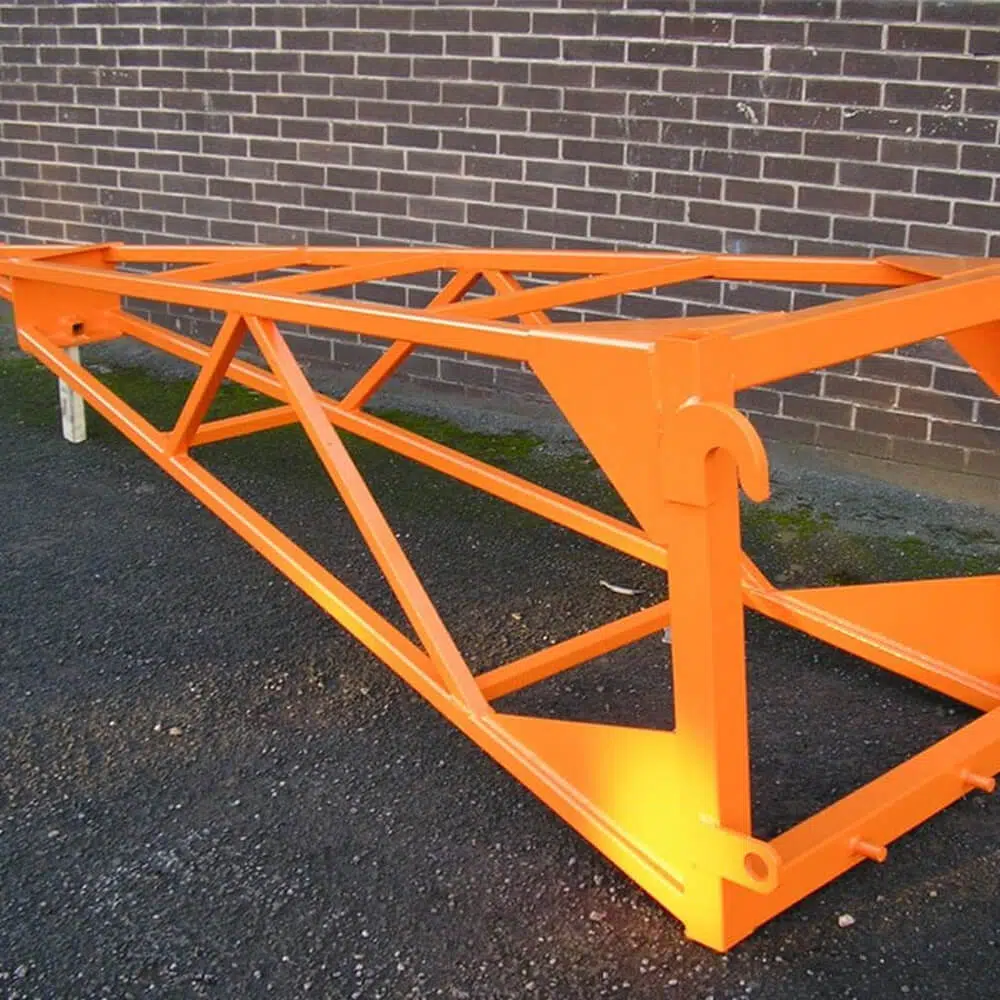
The Eichinger Forklift Adjustable Extending Jib (Model 2082) is a heavy-duty telescopic crane arm that converts a standard forklift truck or telehandler into a universal mobile crane unit. A 7-step telescopic extension runs from 740mm to 3,735mm, and a 3-step height adjustment angles the jib up to 45° for lifting tall or awkward items such as roof trusses over obstacles. Built in Germany by Florian Eichinger GmbH and available in 2,500kg (2082.1) and 5,000kg (2082.2) capacities.
Key Features
- 3-step height adjustment to 45° — allows the jib to be angled upward in 3 increments, enabling loads to be lifted over obstacles or positioned at height, ideal for roof trusses and tall loads
- 7-step telescopic extension — extends from 740mm to 3,735mm, providing flexible reach for a wide range of lifting applications
- Massive section tube construction — welded and bolted profile tubes provide maximum structural strength and durability under load
- Pin retention system — locking pin secures the jib directly to the forklift carriage, preventing unintentional slip-off during operation
- Swivel load hooks supplied — two rotatable swivel hooks included as standard, facilitating use with chains, slings and other lifting gear
- Multiple hook positions — hooks can be positioned at various points along the jib, with load centres ranging from 950mm to 3,850mm
Technical Specifications
| Model |
Max Capacity (kg) |
Extension Range |
Angle Adjustment |
Width |
Height |
| 2082.1 |
2,500 |
740–3,735mm (7 steps) |
0–45° (3 steps) |
540mm |
645mm |
| 2082.2 |
5,000 |
740–3,735mm (7 steps) |
0–45° (3 steps) |
540mm |
645mm |
The load capacity varies depending on the telescopic extension position and the angle setting — maximum capacity is achieved at the shortest extension in the horizontal position. The lifting capacity decreases as the jib is extended and as the angle is increased. Always use in conjunction with the forklift manufacturer's data and load plates. Contact WOLFF Onsite for the full load chart at each extension and angle position.
CE Marked & UKCA Compliant
This product carries CE marking in accordance with EU Machinery Directive 2006/42/EC, and a UKCA certificate is also provided where required for the UK market. Manufactured under DIN ISO 9001:2015 quality management and independently tested by TÜV Nord. An EC Declaration of Conformity is supplied with every unit as standard.
More About This Product
The Eichinger Forklift Adjustable Extending Jib (Model 2082) is a heavy-duty telescopic crane arm attachment with height adjustment that converts a standard forklift truck or telehandler into a universal mobile crane unit. In addition to the 7-step telescopic extension from 740mm to 3,735mm, the 2082 features a 3-step height adjustment function allowing the jib to be angled up to 45°, making it particularly suited to lifting tall or awkward items such as roof trusses over obstacles or into elevated positions. Constructed from welded and bolted section tubes with pin retention to prevent unintentional slip-off. Supplied with swivel load hooks as standard. Available in two capacities: 2,500kg (2082.1) and 5,000kg (2082.2). Also see our standard Extending Jib (Model 2081) for applications where height adjustment is not required. Built in Germany by Florian Eichinger GmbH.
Suitable Applications
The 2082 Adjustable Extending Jib is designed for construction sites and industrial environments where a forklift or telehandler needs to lift loads at an angle or over obstacles. The height adjustment makes this model particularly suited to positioning roof trusses, lifting materials over site hoarding, loading equipment into elevated positions, and handling tall or awkward items that require angular lifting. The 7-step telescopic extension allows the jib to be set to the minimum length required for each lift, maximising the available lifting capacity.
A jib suspends the load, which makes the work a lifting operation with the examination and planning that follows. Where the load can be carried on the tines instead, fork extensions or brick forks avoid that entirely.
How to Use the Adjustable Extending Jib
- Check the forklift manufacturer's load plate to confirm the residual capacity at the intended load centre. The load centre varies with the telescopic extension position and the angle setting.
- Set the jib to the required telescopic extension position using the locking pin. Ensure the pin is fully engaged.
- Set the height adjustment angle as required (horizontal, or one of the three angled positions up to 45°). Ensure the angle locking mechanism is fully engaged.
- Position the swivel load hook at the appropriate point along the jib for the load being lifted.
- Drive the forklift forks into the jib's fork pockets and secure the jib to the forklift carriage using the retention pin.
- Attach chains, slings or lifting gear to the swivel hook. Ensure the load does not exceed the rated capacity at the selected extension and angle position.
- Lift the load slowly and check for stability before transporting. Keep the load as close to the ground as practical during travel.
- Position the load at the delivery point and lower carefully.
- After use, return the jib to the horizontal position, remove the retention pin and reverse the forklift out of the jib.
Warning:
Do not drag loads with the extending jib — lift loads clear of the ground only. Always ensure all locking pins are fully engaged before lifting. The lifting capacity varies with both the telescopic extension position and the angle setting — refer to the load chart. Do not change the angle while a load is suspended.
Certification and Compliance
This product is CE marked and supplied with a full EC Declaration of Conformity in accordance with the EU Machinery Directive 2006/42/EC. A UKCA certificate is also provided where required for the Great Britain market. Manufactured under a DIN ISO 9001:2015 certified quality management system and independently tested by TÜV Nord. All lifting equipment used on UK construction sites must comply with the Lifting Operations and Lifting Equipment Regulations 1998 (LOLER) and the Provision and Use of Work Equipment Regulations 1998 (PUWER).
Safety Information
- Never exceed the rated capacity at the selected extension and angle position — refer to the load chart.
- Always use in conjunction with the forklift manufacturer's data and load plates.
- Always ensure the retention pin, telescopic locking pin and angle locking mechanism are fully engaged before lifting.
- Do not adjust the angle while a load is suspended from the hook.
- Do not drag loads — lift clear of the ground only.
- At full extension with an elevated angle, the effective load centre is significantly forward and above the forklift — check stability carefully.
- Do not use the jib if any locking mechanisms are missing, damaged or cannot be fully engaged.
- A risk assessment must be carried out prior to using this equipment.
- Required PPE: hard hat, safety boots, gloves, and hi-vis vest.
- The type plate must remain present and legible at all times.
Inspection and Maintenance
The adjustable extending jib must be inspected before each use and undergo a thorough examination at least every 12 months by a competent person in accordance with LOLER 1998. All inspections must be documented. Pay particular attention to all weld points, the telescopic sections for wear or deformation, the height adjustment mechanism and pivot points, all locking pin holes, swivel hooks for free rotation, and the fork pocket condition. Check for cracking, distortion, corrosion or thinning of material, particularly at stress points, telescopic overlap areas and the angle adjustment pivot. General surface rusting should be treated with proprietary rust inhibitors, primers and paint on a regular basis.
Frequently Asked Questions
Q: What is the difference between the 2082 and the 2081?
The 2082 has all the features of the 2081 (7-step telescopic extension, swivel hooks, pin retention) plus a 3-step height adjustment function that allows the jib to be angled up to 45°. This makes it suited to angular lifts such as positioning roof trusses or lifting over obstacles. The 2081 operates in the horizontal plane only. The 2082 is slightly larger (540mm wide, 645mm high vs 520mm wide, 430/510mm high on the 2081).
Q: Can I use the height adjustment while a load is suspended?
No. The angle must never be adjusted while a load is suspended from the hook. Set the angle before attaching and lifting the load. Changing the angle under load could alter the load centre and destabilise the forklift.
Q: How do I choose between the 2082.1 and 2082.2?
The 2082.1 has a maximum capacity of 2,500kg and the 2082.2 has a maximum capacity of 5,000kg. Choose the model that matches the heaviest loads you need to lift, bearing in mind that the forklift's residual capacity must also be sufficient. Both models share the same physical dimensions (540mm wide, 645mm high). Contact WOLFF Onsite for guidance.
Q: How often does the jib need to be inspected?
The jib should be visually inspected before each use and undergo a thorough examination at least every 12 months by a competent person, in accordance with LOLER 1998. Pay particular attention to the telescopic sections, angle adjustment mechanism, locking pins and swivel hooks.