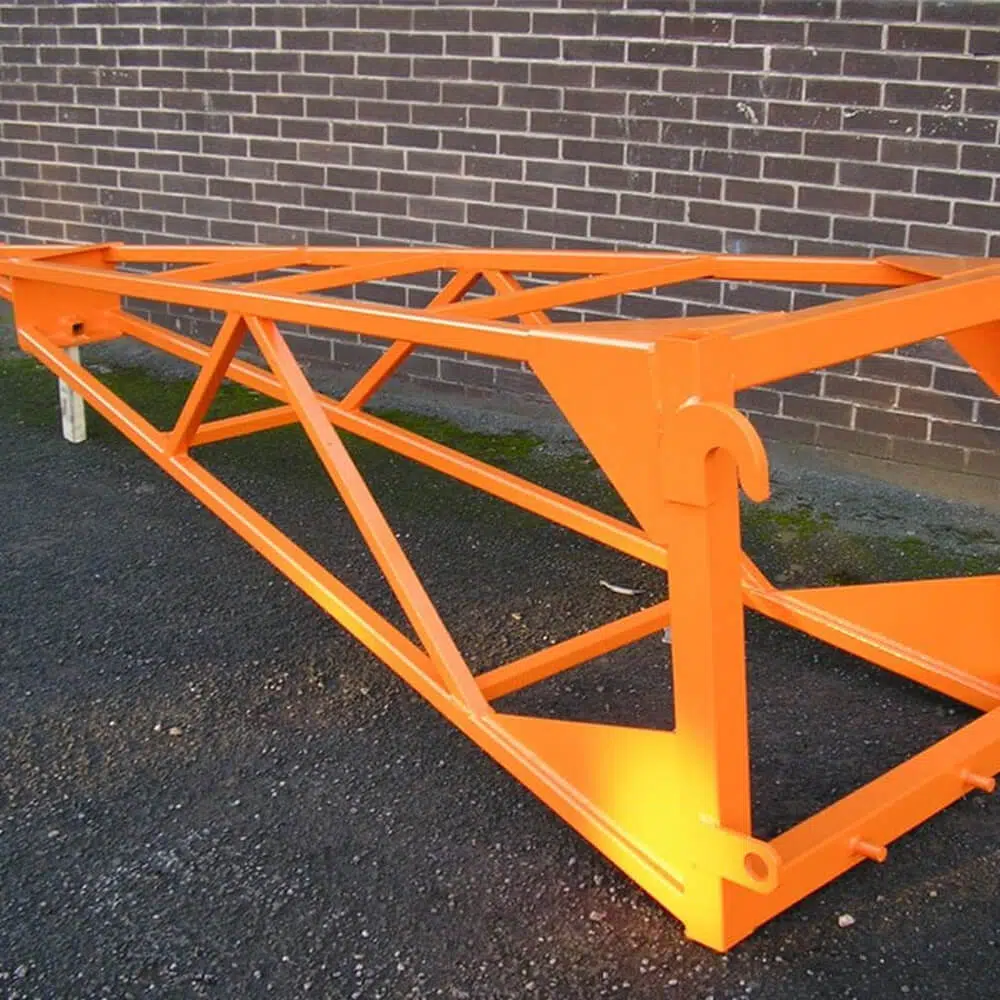
Choose the IFJ when the load is heavy rather than high. It converts a forklift or telehandler into a short-reach crane for lifting unpalletised loads straight off the ground, and because the boom is fixed rather than extending it carries more weight in a lighter, more compact unit. Rated capacity falls as the hook moves outward, so match the model to the load centre you will actually work at, not to the headline figure.
Key Features
- 4 lifting positions — multi hook positioning from 1000mm to 1750mm load centres
- Single swivel hook and shackle — supplied complete as standard
- Compact fixed design — lighter and more compact than extending jib alternatives
- Secure fork attachment — zinc plated heel pins for safe attachment to truck
- High-visibility finish — painted bright orange for safety
Technical Specifications
| Model |
Cap at 1000mm (kg) |
Cap at 1250mm (kg) |
Cap at 1500mm (kg) |
Cap at 1750mm (kg) |
Weight (kg) |
| IFJ-1.0-OP |
1000 |
800 |
600 |
300 |
141 |
| IFJ-1.5-OP |
1500 |
1000 |
800 |
400 |
146 |
| IFJ-2.0-OP |
2000 |
1500 |
1000 |
600 |
152 |
| IFJ-3.0-OP |
3000 |
2000 |
1500 |
1000 |
159 |
| IFJ-4.0-OP |
4000 |
3000 |
2500 |
2000 |
171 |
| IFJ-5.0-OP |
5000 |
4000 |
3300 |
2800 |
183 |
Maximum fork section 150 x 50mm at 435mm centres. C of G 670mm for all models.
UK Manufactured | LOLER Compliant
This product is designed and manufactured in the UK by Invicta Forks & Attachments, the UK's largest mechanical forklift attachment manufacturer, based in Leeds. Where applicable, this product is supplied with a test certificate and EC Declaration of Conformity. LOLER 1998 thorough examinations are required every 6 months by a competent person after initial certification.
Suitable Applications
The IFJ is suited to construction sites, engineering workshops, steel fabrication yards and industrial premises where heavy loads need to be lifted from ground level. Ideal when maximum capacity is needed and the extending feature of the IEJ is not required.
A jib suspends the load, which makes the work a lifting operation with the examination and planning that follows. Where the load can be carried on the tines instead, fork extensions or brick forks avoid that entirely.
How to Use the Fork Mounted Jib
- Position forks to the correct distance apart.
- Remove heel pins and drive forks into fork pockets.
- Insert heel pins and attach safety lynch pin.
- Position the swivel hook to the desired lifting centre.
- Attach the load and lift vertically.
Warning:
Only make vertical lifts. The mast must remain vertical at all times. Do not shock load. Do not exceed the safe working load at each lifting point.
Safety Information
- Ensure heel pins are correctly fitted before every use.
- Ensure shackle pin is adequately tightened.
- Only make vertical lifts.
- Do not shock load.
- The mast must be vertical at all times.
Inspection and Maintenance
Inspect weekly. Certified for six months from manufacture.
Frequently Asked Questions
Q: When should I choose the IFJ over the IEJ?
Choose the IFJ when you need maximum lifting capacity and do not require extended reach. The IFJ is lighter and more compact than the IEJ and provides higher capacities at closer load centres.
Q: How much can the IFJ lift?
Capacity depends on the model and on which of the four lifting centres you use. The IFJ-1.0-OP is rated 1000kg at 1000mm falling to 300kg at 1750mm, while the IFJ-5.0-OP is rated 5000kg at 1000mm falling to 2800kg at 1750mm. Always work from the rated capacity at your chosen load centre.
Q: Why does capacity drop at the outer lifting positions?
Moving the hook further from the fork carriage increases the leverage acting on the truck and on the attachment. The rated capacity chart accounts for this, which is why each model shows four separate figures rather than one.
Q: Will the IFJ fit my forklift?
The IFJ accepts a maximum fork section of 150 x 50mm at 435mm centres. Check your fork dimensions against that before ordering, and confirm the truck's own rated capacity at the resulting load centre.
Q: What is supplied with the jib?
Each IFJ comes complete with a single swivel hook and shackle, and zinc plated heel pins for secure attachment to the truck. A test certificate and EC Declaration of Conformity are supplied where applicable.
Q: What inspection does the IFJ need?
Inspect weekly for damage, wear and secure pin fitment. Under LOLER 1998 a thorough examination by a competent person is required every six months after initial certification, as the attachment is used for lifting.
Q: Can the jib be used at an angle?
No. The IFJ is designed for vertical lifts only and the forklift mast must remain vertical throughout. Angled or dragged lifts place side loading on the attachment and the forks, and are outside its rated use.